Are Biodegradable Foil Balloons Real? The PLA-PBAT Film
A material science comparison of latex, Mylar, and compostable PLA-PBAT films. Backed by SGS ISO 14855-1:2012 test report SHMR220700361301.

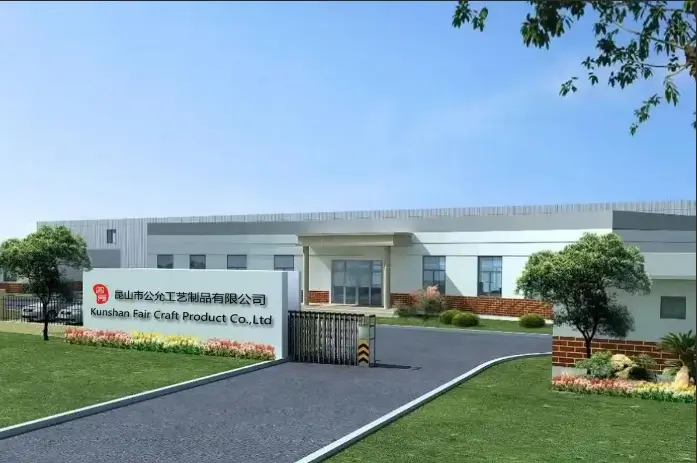
Established in 2007 with 5 million RMB registered capital, FAIR (Kunshan Fair Craft Product Co., Ltd.) is a source factory integrating design, wholesale, and manufacturing of high-barrier Nylon (PA), Polyester (PET), and Laser Metallized foil balloons for global enterprise procurement.
Our factory delivers competitive factory-direct pricing across high-demand product categories, specializing in high-gloss custom advertising balloons, smart automatic self-inflating novelties, shaped cartoon characters, compliant biodegradable foil balloons engineered with PLA+PBAT eco-films, festive decorations, Mylar alphabets and numbers, and leak-free commercial helium balloon wholesale pipelines.
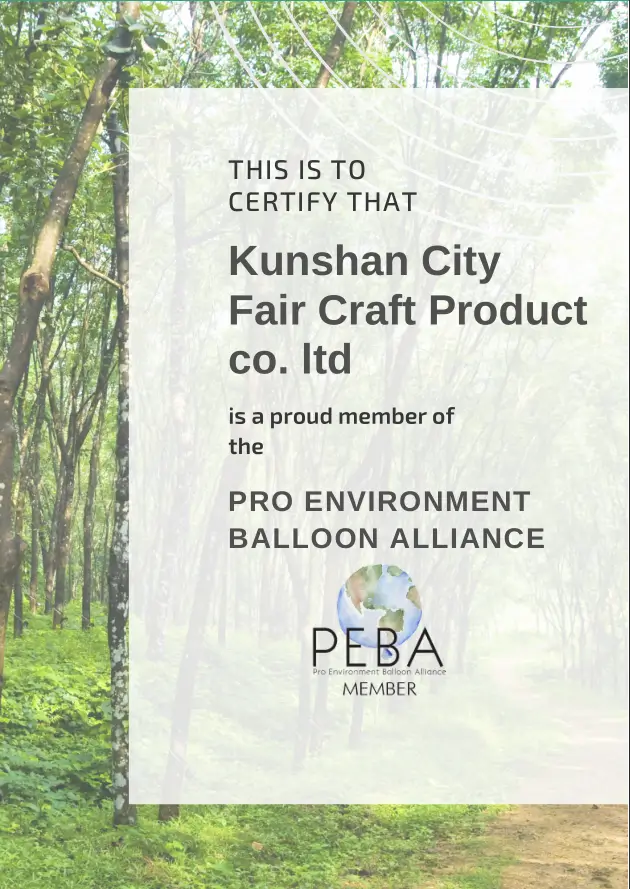
Powered by automated leakage inspection on batch samples, and supported by EN71 and RoHS test reports, FAIR supplies OEM and ODM programs to global buyers. As a member of the PEBA (Pro-Environment Balloon Alliance), we supply large-volume OEM and ODM programs into markets that apply plastic-ban regulations, with the test documentation to support the buyer's compliance file.
At FAIR, biodegradability is a material and manufacturing question rather than a label. A conventional Mylar film does not break down in a landfill or a waterway, and it persists for decades or longer. Regulatory pressure on that material has increased, and EPR reporting and plastic tax rules in several markets now apply to the category. Our approach was to change the film build itself rather than add a claim to an old material.
* As PEBA members, we supply compostable balloon programs to retail chains and distributors in markets that apply plastic-ban and EPR rules, with the test documentation to support the buyer's compliance file.




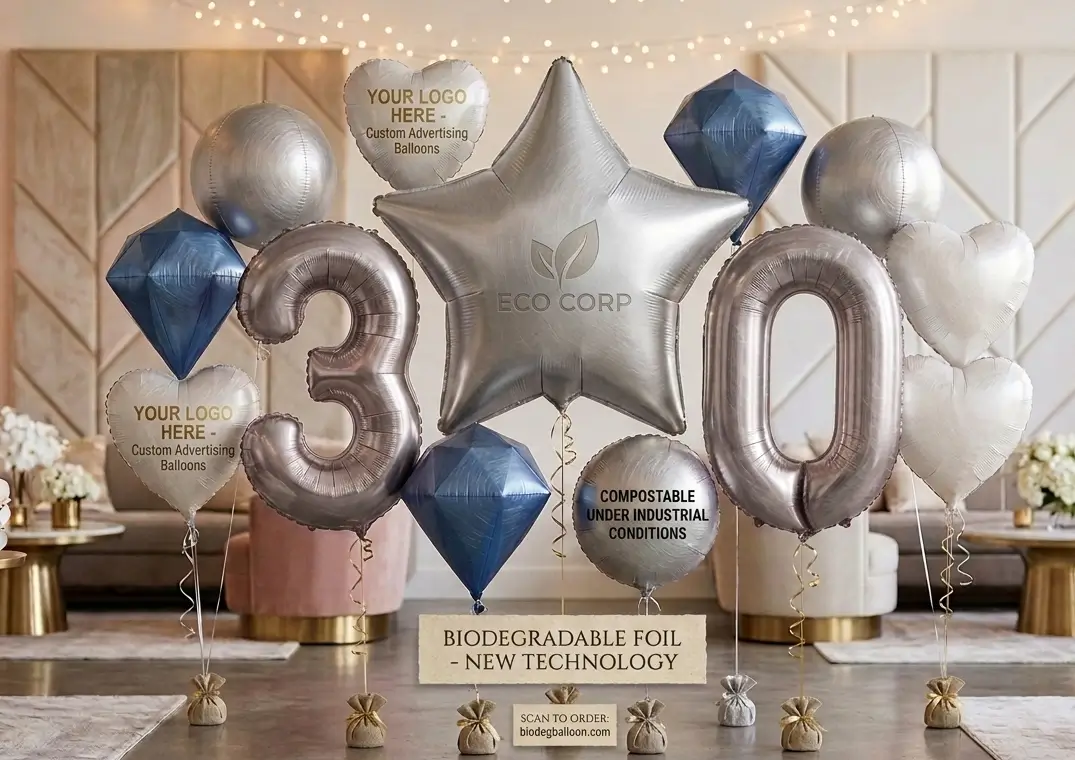




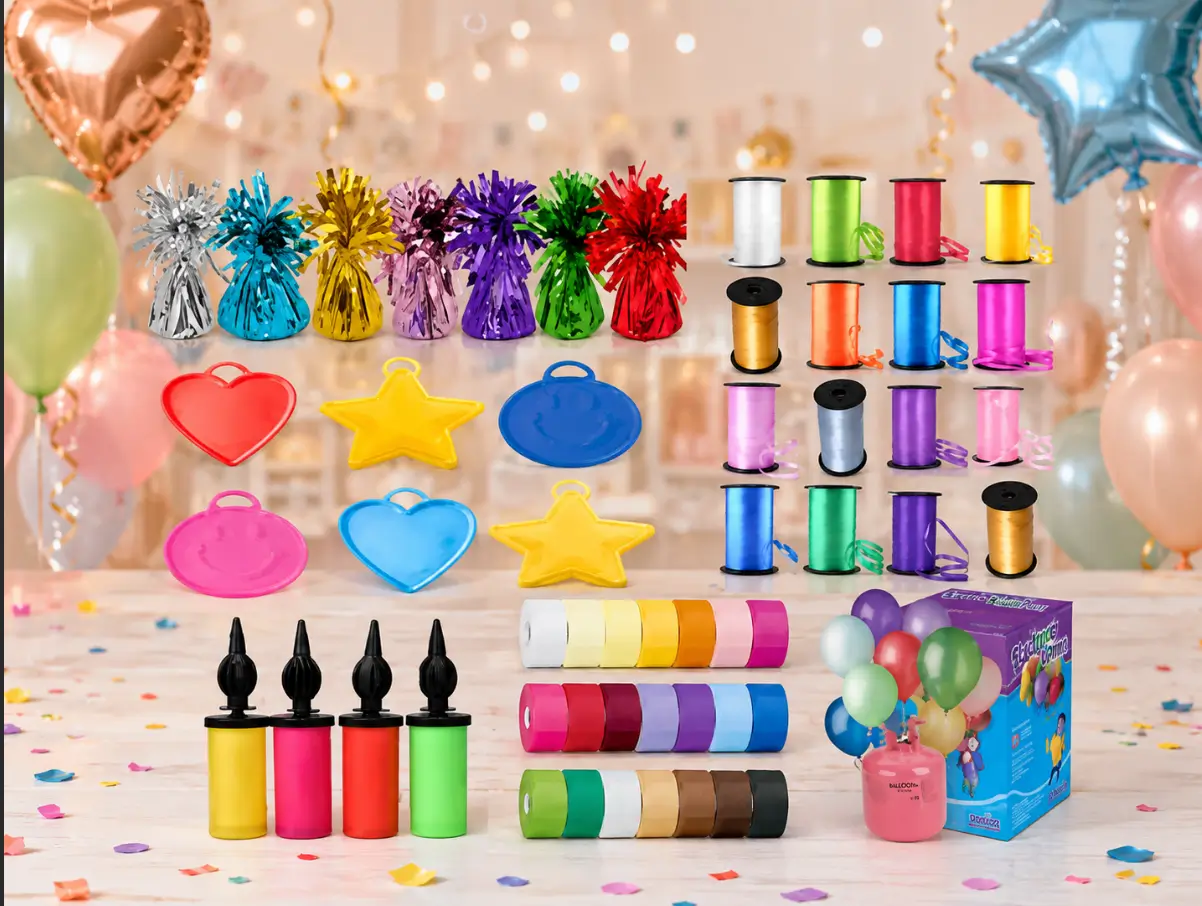
A material science comparison of latex, Mylar, and compostable PLA-PBAT films. Backed by SGS ISO 14855-1:2012 test report SHMR220700361301.
Full ISO 14855-1:2012 test report available for download. Report number SHMR220700361301 with 77.8% biodegradation in 45 days.
A B2B guide to the three composting standards importers encounter. EN 13432 and ASTM D6400 are certification schemes. ISO 14855 is a measurement method. They are not interchangeable.
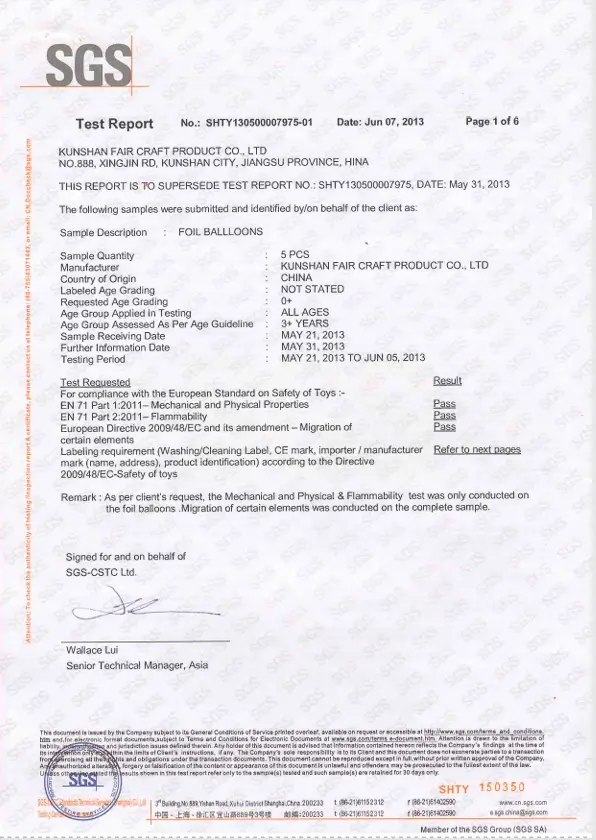
SGS EN71 test report for the foil balloon sample, report number SHTY130500007975-01. Covers EN71 Parts 1, 2, and 3 for the EU toy safety directive.
A material comparison between a PLA-PBAT foil balloon and a natural rubber latex balloon, covering helium retention, latex protein content, and end-of-life documentation.
The custom shape tooling workflow for a compostable foil balloon program, from the design file through the CAD/CNC die and the first article sample.
A B2B guide to the foil and Mylar balloon production flow, from order intake and custom OEM prototyping through gravure printing, batch inspection, and global delivery.
International shipping, HS codes, and storage parameters for a balloon import file. Includes how the factory handles transit and documentation for a global order.
Tools for global importers, event planners, and retail chains: 3D design layout, ocean freight CBM optimization, helium float economics, and plastic tax exemption modeling. No registration or fees required.
Prototype a party backdrop with foil numbers, letters, cursive phrases, and novelty shapes. Drag and drop on the canvas and export a high-resolution PNG design.
Calculate total CBM volume, gross deadweight, and 20FT / 40FT / 40HQ container space utilization rates in real time. Identify unused void space for a given load.
Estimate helium consumption (m3 / cu.ft) and tank yields (40L / 50L cylinders) across foil shapes. Compare the retention profile for Nylon, PET, and PLA-PBAT films.
Model the tax and EPR exposure for a balloon order under California SB 54, EU SUP Directive 2019/904, and UK EPR plastic levies, and compare a conventional film with a PLA-PBAT film.
Guidance on helium flotation, inflation, and specifications from FAIR (established 2007).
A foil balloon (or Mylar balloon) is an inflatable manufactured from thin metallized polymer films, typically a high-barrier Nylon (PA) film laminated with an LLDPE polyethylene layer and vacuum-coated with aluminum. Unlike a porous latex wall, the foil film is a sealed barrier that holds helium over a multi-day window and supports rotogravure printing.
Helium is required for free-floating applications, such as standard 18-inch rounds, jumbo numbers, and 3D spheres. Air is used for stationary decor, such as arches, backdrops, and stick mounts. An air-filled foil balloon holds its shape for a long period because oxygen and nitrogen diffuse through the film much more slowly than helium.
Insert a smooth pump nozzle 2 to 3 inches into the tail inflation channel, marked by the slip sheet. Inflate steadily to a fraction below full extension to leave room for thermal expansion, then pull the nozzle out and pinch the tail flat. The internal LLDPE flap seals shut.
The retention window depends on the film build, the size, and the ambient conditions. A larger balloon carries a larger helium volume and holds buoyancy over a longer window than a smaller one. An air-filled balloon stays taut for a longer period because the gas molecules are larger. The retention window for a given SKU is confirmed at quotation stage.
A balloon will not float when the upward lift from the helium is smaller than the weight of the film and the valve. Three common causes: a balloon below the practical flotation threshold, a narrow shape that adds seam weight, and a helium supply that is below the purity level a dense foil membrane needs.
Two causes. Cold air contracts helium, which temporarily reduces the fill and reverses at room temperature. A physical leak, from a torn valve or a seam failure, does not reverse. Batch samples from each production run pass an inflation inspection held for a controlled window before packaging.


© 2026 Kunshan City Fair Craft Product Co., Ltd.
WhatsApp us