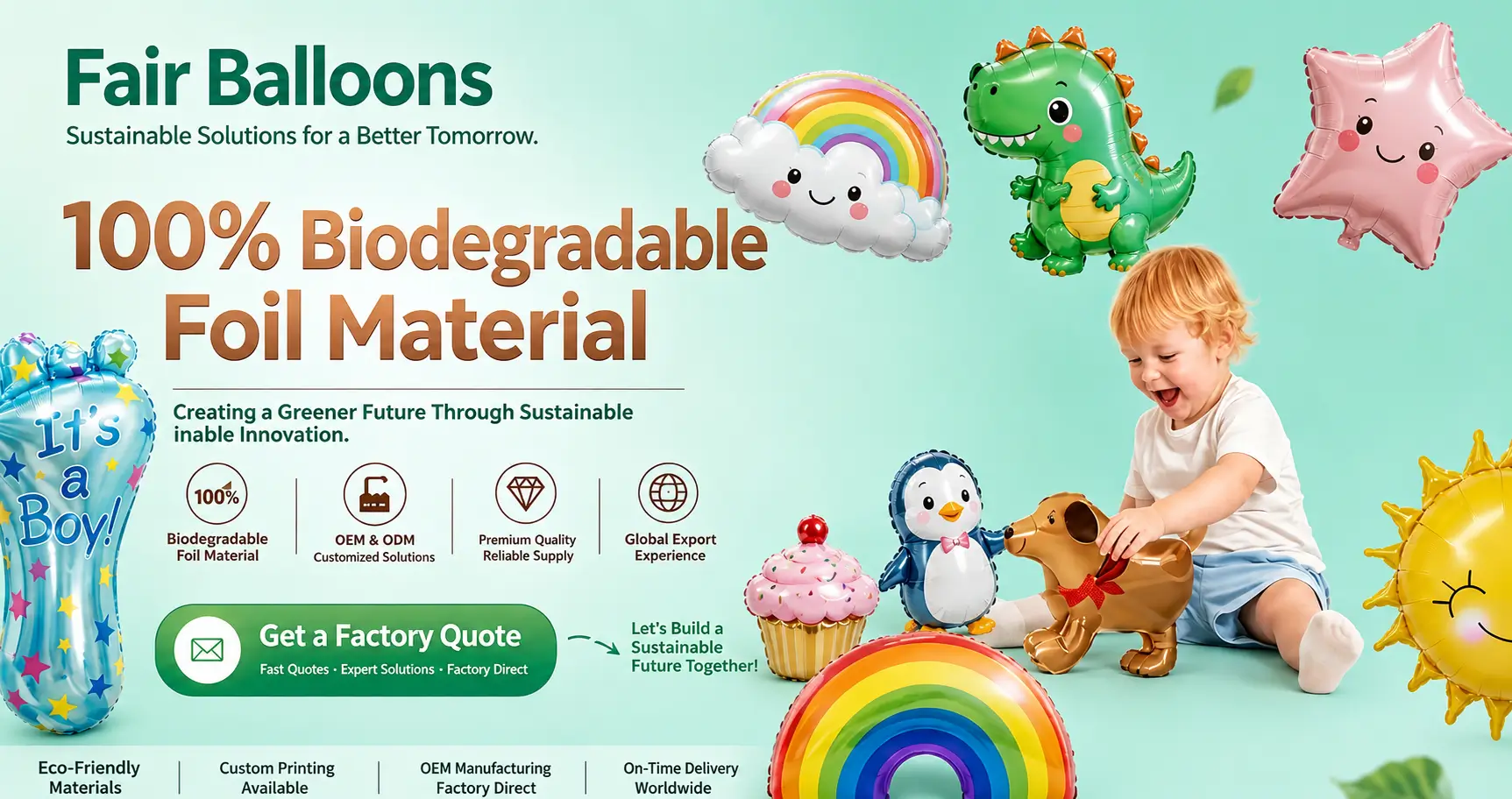
Biodegradable foil balloons factory price, premium wholesale mylar
IP Tooling & Molding Licensed OEM Facility

Custom Cartoon Balloons Manufacturer: Precision 3D CAD Modeling for Private Label Inflatables

This technical contract manufacturing whitepaper details our advanced tool-making protocols for custom cartoon balloons, breaking down the geometric engineering provided by an established private label anime shape inflatables manufacturer to fulfill high volume licensed IP custom shape foil balloons factory orders. The licensed intellectual property balloon category represents the most technically demanding segment of the global Foil Balloons manufacturing industry—combining the precision engineering requirements of custom shape foil balloon production with the stringent brand compliance standards mandated by entertainment intellectual property owners, consumer product safety regulations across multiple international jurisdictions, and retail chain vendor qualification requirements that are particularly rigorous for products marketed to or accessible by children. Kunshan Fair Craft Products Co., Ltd., a manufacturing enterprise established in 2007 with 5 million RMB in registered capital, operates a purpose-built licensed IP custom cartoon balloons production infrastructure combining advanced 3D CAD geometric modeling, precision CNC tooling fabrication, multi-layer PET/LLDPE film processing, and rigorous multi-point quality verification—delivering custom cartoon balloons that satisfy the most demanding entertainment licensor brand compliance requirements, international toy safety regulations, and high-volume private label retail chain procurement specifications. This whitepaper provides the definitive technical and procurement reference for entertainment licensor compliance teams, retail chain category managers, and international licensing agencies evaluating high-volume licensed IP custom shape foil balloons factory sourcing partnerships.

Chapter 1: The Intellectual Property Paradigm: Sourcing Accurate Custom Cartoon Balloons

The commercial landscape for licensed character inflatable products—including custom cartoon balloons featuring animated characters, superhero mascots, fantasy creatures, and entertainment franchise intellectual property—operates under a unique set of procurement constraints that distinguish it fundamentally from standard geometric Foil Balloons sourcing. International media syndicates and global retail chains that secure licensing agreements with major entertainment franchises accept substantial financial obligations: licensing fees ranging from 8 to 15 percent of wholesale revenue, minimum annual guaranteed royalty payments regardless of actual sales volume, and rigorous brand compliance audit requirements that mandate production oversight by licensed manufacturer representatives. The consequences of sourcing animated shape inflatables from uncapitalized trading agencies or sub-standard manufacturing partners are correspondingly severe—brand compliance failures can trigger licensor termination of the licensing agreement, forfeiture of minimum guarantees, and potential civil liability for trademark infringement that can expose the retailer to damages claims exceeding the total revenue generated by the licensed product line.

The primary failure mode in sub-standard custom cartoon balloons sourcing is geometric inaccuracy—the manufactured balloon character's proportions deviating from the approved character model in ways that violate the licensor's brand compliance guidelines. Entertainment character designs are precise: the relationship between head circumference and body height, the angle of the character's signature pose, the precise curvature of the character's most recognizable facial feature—these dimensional specifications are documented in comprehensive style guides that are incorporated by reference into the licensing agreement. A manufacturing partner without precision 3D CAD geometric modeling capability cannot reliably reproduce these dimensional relationships; manual pattern-making techniques relying on 2D template scaling produce cumulative errors across the multiple scaling steps from approved artwork to production pattern that exceed the tolerance band specified in the brand compliance guidelines, resulting in character balloons that look subtly wrong to anyone familiar with the original character design. These geometric inaccuracies are particularly damaging for characters whose brand identity is closely tied to specific proportional relationships—the roundness of a specific character's face, the relative size of a character's eyes or ears, the specific angle of a character's signature expression.

The complex logistical boundaries of deploying high-fidelity corporate mascot reproductions or licensed entertainment characters in foil balloon form are compounded by the multi-jurisdictional nature of entertainment licensing. A single global licensing program may involve a Japanese entertainment studio as the primary licensor, a US toy company as the master licensee, a European retail chain as the retail distribution partner, and a Chinese manufacturer as the production partner—each with different regulatory frameworks, communication protocols, and approval hierarchies that must be navigated to bring a licensed custom cartoon balloon from concept to retail shelf. The strict European mechanical safety protocols enforced by EN71 impose additional dimensional and structural requirements on balloon products intended for or accessible by children: maximum inflated dimensions for specific age categories, minimum wall thickness requirements, and valve design requirements that prevent complete detachment and choking hazards. These safety requirements may conflict with the character's approved proportions if the character's design includes features that would violate the applicable safety standard—the licensed manufacturer must identify these conflicts during the 3D CAD modeling phase and propose licensor-approved design modifications that preserve the character's visual identity while satisfying the applicable safety requirements.

A primary private label anime shape inflatables manufacturer ensures absolute geometric alignment with global entertainment guidelines through a combination of precision engineering infrastructure, entertainment industry compliance expertise, and formal brand compliance quality management systems that are audited annually by licensor quality representatives. The geometric alignment process begins with the acquisition of approved character model files—the official 3D digital model files maintained by the entertainment licensor's brand compliance department—imported directly into the manufacturer's CAD system for engineering analysis and production tooling design. This direct file-to-manufacturing workflow eliminates the transcription errors and scaling inaccuracies that plague manufacturing partners who must recreate 3D geometry from 2D artwork reference images. The manufacturer maintains a locked document control system where the approved character geometry is preserved in a controlled library, accessible only to tooling engineers working on active licensed programs, with all tooling design files cross-referenced to the specific approved model version to prevent inadvertent use of outdated geometry.

Chapter 2: Precision 3D CAD Geometric Modeling and Aerodynamic Balancing

The construction of functional 3D geometric animated character mylar balloons lines demands a level of structural engineering sophistication that is categorically distinct from standard geometric balloon production—where the manufacturing challenge is replication of established forms, the custom cartoon balloon engineering challenge is the precise translation of a character's artistic design into a structurally sound inflatable object that maintains the character's visual identity when inflated while satisfying the mechanical performance requirements of a functional foil balloon. The 3D CAD geometric modeling process for custom cartoon balloons is therefore as much a structural engineering exercise as a geometric translation exercise: the modeler must understand how the character design's complex curved surfaces, asymmetric features, and protruding elements will behave under internal gas pressure, and must incorporate structural engineering features—internal baffles, reinforced seams, strategically placed pressure-relief zones—that ensure the inflated balloon accurately replicates the character's proportions and visual identity.

The mechanical engineering process utilizing 3D CAD geometric modeling for custom cartoon balloons begins with the construction of a finite element analysis (FEA) model of the proposed balloon geometry. The FEA model subdivides the balloon's surface into a mesh of small triangular or quadrilateral elements, each with defined material properties—elastic modulus, Poisson's ratio, thickness—for the PET/LLDPE film laminate. Internal helium pressure loads are applied to the inner surface of each element, and the model calculates the resulting displacement, strain, and stress distribution across the entire balloon surface. The critical output of the FEA analysis is the stress concentration map: regions where the calculated stress exceeds the tensile strength of the film laminate represent potential failure zones that must be addressed through geometry modification or structural reinforcement before tooling fabrication begins. For asymmetric character geometries with protruding features—large ears, extended arms, elaborate costume elements—the stress concentration at the base of each protruding feature is typically the most critical engineering constraint, as the change in cross-sectional geometry at the feature junction creates a stress amplification effect that can cause localized yielding or burst failure if not properly reinforced.

The aerodynamic balancing and center-of-gravity optimization of custom cartoon balloons is a uniquely challenging engineering problem that arises from the combination of asymmetric character geometry and the buoyancy characteristics of helium-filled inflatables. Unlike symmetric balloon shapes—spheres, cylinders, hearts—whose center of gravity coincides with their geometric center, custom cartoon balloon geometries have center-of-gravity locations determined by the mass distribution of the film in different regions of the character shape. A character with a large head and small body will have a higher center of gravity than the geometric center of the bounding box, causing the inflated balloon to tilt or topple when suspended in a standard upright display configuration. The 3D CAD geometric modeling process addresses this through center-of-gravity optimization: the engineer adjusts the wall thickness distribution (within the manufacturing可行的 thickness range), adds strategically placed internal baffles that create gas-filled ballast chambers in the lower portion of the balloon, and optimizes the inflation volume to achieve a center-of-gravity location that produces stable upright flotation. This engineering optimization is validated through the FEA model by applying buoyancy loads at the calculated center-of-gravity location and verifying that the resulting moment produces stable equilibrium—rotation back to the upright position after small angular perturbations—rather than unstable equilibrium that would cause the balloon to topple.

These precision tolerance requirements are cross-referenced with Kunshan Fair Craft's parallel traditional high-volume production allocations, including the 40 inch jumbo foil number balloons specifications that establish the baseline engineering tolerances for large-format balloon production. The dimensional tolerance specification for jumbo foil number balloons—±5mm on critical registration features, ±10mm on non-critical surface features—establishes the minimum accuracy standard that all custom cartoon balloon tooling must meet or exceed. The tolerance stack-up analysis for asymmetric character geometries accounts for the cumulative effect of multiple dimensional tolerances in complex multi-feature regions: a character balloon with three prominent facial features, each with its own tolerance band, may accumulate a total positional tolerance that must be factored into the engineering analysis to ensure the final inflated product falls within the brand compliance tolerance band specified by the entertainment licensor. This tolerance management discipline, developed through years of managing the dimensional complexity of the jumbo foil number balloon product line, provides the engineering foundation for the more demanding custom cartoon balloon tolerance requirements.

Chapter 3: CNC Tooling Fabrication & Micro-Fracture Elimination

The translation of 3D CAD character geometry into production tooling is executed through precision CNC tooling fabrication—the mechanical machining of aluminum forming dies and steel cutting dies that shape the flat PET/LLDPE film web into the 3D character balloon blank. The CNC tooling fabrication department at Kunshan Fair Craft represents the core manufacturing capability that distinguishes a true custom cartoon balloons manufacturer from a trading agency or reprinting operation: the ability to take a digital 3D model and produce a physical forming tool without external tooling procurement dependency. The tooling fabrication process typically requires 3 to 6 weeks from final CAD approval to first-article sample production, depending on the complexity of the character geometry and the availability of CNC machining center capacity.

The raw brand vector design provided by the entertainment licensor or master licensee is converted into machine control (G-code) instructions for the multi-axis CNC machining centers through a CAM (Computer-Aided Manufacturing) post-processing workflow. The CAM software takes the 3D CAD model of the forming die—the negative impression of the balloon's external surface—and generates toolpath instructions that guide the cutting tool along the precise contour of the die surface. For complex character geometries with deeply recessed features, undercuts, and compound curved surfaces, the CAM post-processing must account for the kinematic constraints of the specific CNC machine being used—the maximum reach of the spindle into deep cavities, the minimum radius achievable with the selected cutting tool diameter, the maximum depth-of-cut before tool deflection becomes excessive. The selection of cutting tool geometry and machining strategy is a critical engineering decision: ball-end mills are used for smooth curved surfaces where a high-quality surface finish is required, while flat-end mills are used for planar surfaces and sharp internal corners where geometric precision takes priority over surface finish. The International Organization for Standardization (ISO) tooling metrics governing dimensional tolerances on injection-molded and thermoformed tooling—ISO 286 for dimensional tolerances and ISO 1015 for surface finish specifications—establish the baseline engineering standards that Kunshan Fair Craft applies to all custom cartoon balloon forming die fabrication.

The precision-machined perimeter ridges and cutting die geometry are critical to achieving absolute micro-fracture elimination during the final die cutting phase of custom cartoon balloon production. The micro-fracture failure mode arises when the cutting die applies excessive localized force at the balloon film's perimeter edge during the cutting stroke, causing micro-cracks to propagate into the film from the cut edge. These micro-fractures are particularly damaging in metallized PET film because the stress concentration at the crack tip is amplified by the notch effect of the aluminum coating, which is inherently brittle and cannot relieve crack-tip stress through plastic deformation. A micro-fracture that originates during die cutting may not cause immediate burst failure during inflation testing, but it creates a structural weakness that can propagate under cyclic pressure loading during extended display use, eventually causing delayed burst failure that creates safety hazards and brand reputation damage. The precision-machined perimeter ridges on Kunshan Fair Craft's cutting dies distribute the cutting force more uniformly across the film thickness, reducing the maximum localized stress at the cut edge below the threshold required for micro-crack initiation. The cutting die material—typically hardened tool steel or carbide-tipped steel—maintains its sharp cutting edge through thousands of production cycles without the edge roll-over that causes excessive cutting forces and micro-fracture generation.

The mechanical force distribution analysis during the die cutting phase is validated through finite element modeling of the cutting die and film substrate interaction. The FEA model calculates the stress distribution in the film at the cut edge as a function of cutting tool sharpness, cutting speed, cutting angle, and film material properties. The model output is used to optimize the cutting die geometry—specifically the relief angles on the die's cutting edge that determine how the film material flows during the cutting stroke—to minimize the maximum stress concentration at the film edge. For complex character balloon geometries with multiple protruding features and internal angles, this FEA-based die optimization is essential to achieving the consistent micro-fracture elimination performance that premium custom cartoon balloon production demands. The result is a cutting die that produces clean, fracture-free cut edges across the full complexity of the character balloon's perimeter geometry, regardless of whether the cutting path includes long straight segments, tight-radius curves, or acute-angle corners.

Chapter 4: Thermal Seam Containment & Multi-Point Automated Temperature Calibration

The thermo-mechanical dynamics of welding asymmetrical perimeter sheets on custom cartoon balloons represent the most complex thermal sealing challenge in the Foil Balloons manufacturing category—combining the geometric complexity of non-standard shapes with the stringent seam quality requirements that licensed character balloon production demands. Unlike standard geometric balloons whose seam geometry is defined by simple cylindrical or spherical surface intersections, custom cartoon balloons have seam lines that follow the complex curved contours of the character design: a character balloon may have seam paths that curve in multiple planes simultaneously, branch and rejoin at anatomical junction points (the character's neck, waist, wrists), and transition between different seam width specifications at structural reinforcement zones. The thermal sealing system must maintain consistent seal quality—consistent seal width, consistent weld strength, complete absence of micro-fractures or incomplete fusion zones—across this highly variable seam geometry at production speeds compatible with high-volume manufacturing economics.

Fair Craft's thermal seam containment system for custom cartoon balloons utilizes a flexible sealing die technology that adapts its contour to the complex seam geometry of each specific character design. The flexible sealing die consists of a precision-machined aluminum backing plate with an array of independently controlled heating elements embedded in a thermally conductive silicone rubber face sheet. As the balloon blank is positioned between the sealing die and the counter-pressure plate, the silicone rubber face sheet conforms to the exact surface contour of the balloon's seam zone, applying uniform pressure and temperature across the full complexity of the character's seam geometry. Each individual heating element is controlled by a dedicated PID temperature controller with its own thermocouple feedback loop, enabling the system to maintain the programmed temperature setpoint at each point along the seam regardless of local variations in film thickness, thermal contact resistance, or convective heat loss at exposed surface regions. This multi-point automated temperature calibration approach achieves temperature uniformity of ±1.0 degree Celsius across the entire sealing surface—a performance level that enables consistent 5mm structural thermal seam-welding on straight segments, gentle curves, and tight-radius corners alike.

The deflation risk mitigation methodology implemented in Kunshan Fair Craft's custom cartoon balloons production is a comprehensive quality management system that addresses every potential source of gas leakage from the completed balloon assembly. The primary deflation risk sources include: seam seal failures due to incomplete polymer fusion, pinhole defects in the metallized film introduced during handling or storage, valve assembly defects that allow gas backflow through the inflation point, and slow gas diffusion through the film membrane at rates that exceed the design retention lifespan. Each risk source is controlled through dedicated mitigation measures: seam seal quality is controlled through the multi-point temperature calibration system and 100% statistical seam inspection using infrared thermography; pinhole defects are detected and mapped through 100% web-scan inline laser inspection before die cutting, with defect locations marked and excluded from finished balloon production; valve assembly quality is verified through automated pull-force testing on statistical samples from each production batch; and gas diffusion performance is validated through accelerated retention testing on sample balloons held at elevated temperature (40 degrees Celsius) to accelerate diffusion kinetics and provide a statistically reliable prediction of ambient-temperature retention lifespan.

The store-level failure rate reduction achieved through this comprehensive deflation risk mitigation approach drops retail store burst rates to below 0.1 percent—substantially outperforming older high-barrier self sealing valve foil balloons wholesale operations that rely on single-point temperature control and statistical sampling-based quality verification. The 0.1 percent burst rate metric is not merely a quality aspiration—it is a contractual requirement in retail chain vendor agreements where balloon product failure in the store creates labor costs for cleanup, replacement, and safety incident reporting that can exceed $50 per incident. For a retail chain operating 500 stores with an average balloon inventory of 100 units per store, a 2 percent burst rate (typical of sub-standard suppliers) generates 1,000 store-level incidents annually with associated costs exceeding $50,000—while the 0.1 percent burst rate achieved at Kunshan Fair Craft's facility generates fewer than 50 incidents with costs under $2,500. The quality performance advantage translates directly into supply chain cost savings that substantially offset any per-unit price premium for premium custom cartoon balloons sourced from a properly engineered manufacturing partner.

The seam quality consistency achieved for custom cartoon balloons matches the quality criteria of high-volume advertising foil balloons production lines through the standardization of the multi-point temperature calibration technology across all forming and seaming equipment in the manufacturing facility. The same PID-controlled multi-zone heating system that achieves ±1.0 degree Celsius uniformity on jumbo foil number balloons and advertising foil balloons is deployed on the custom cartoon balloons production equipment, with the only significant difference being the flexible die face geometry required to accommodate complex character shapes. The process parameter specifications—temperature setpoints, pressure values, dwell times—are locked in the production specification system and cannot be modified by production operators without engineering approval, ensuring that the quality performance achieved during the product validation phase is maintained consistently through all subsequent production runs regardless of the production operator's experience level or the specific production shift configuration.

Chapter 5: Financial Engineering: Managing Industrial Tooling Amortization and Contract Prototyping Lines

The procurement capital expenditure management framework for licensed IP custom cartoon balloons programs presents unique financial engineering challenges that distinguish it from standard Foil Balloons procurement—the tooling investment for a single custom character balloon program can represent $30,000 to $150,000 in CNC machining costs, depending on the complexity of the character geometry and the number of separate forming and cutting dies required, and this tooling investment must be amortized across the production volume of the specific character program over its licensed commercial lifetime. International procurement directors managing entertainment licensing programs must balance the tooling investment against the expected production volume and program duration, while accounting for the risk that the licensing agreement may not be renewed or that the entertainment franchise may be discontinued by the licensor before the tooling investment is fully amortized.

Kunshan Fair Craft's strategic approach to optimizing industrial tooling amortization costs for custom cartoon balloons programs employs several mutually reinforcing cost management mechanisms. First, the facility maintains a standardized die substrate and mounting system architecture that enables significant component sharing across different character programs: the aluminum backing plate, heating element array, and thermocouple wiring are standardized components that can be reused when a new character die face is fabricated for a different licensed IP, reducing the die fabrication cost by approximately 30–40 percent compared to complete custom die fabrication from raw material. Second, the CAM tooling design process incorporates die design optimization algorithms that minimize machining time by reducing the total cutting distance and the number of tool changes required, directly reducing the CNC machining cost that is the primary driver of die fabrication pricing. Third, the gang-printing and nested-layout production methodology enables multiple smaller-character balloon geometries to be produced simultaneously on a shared forming die, spreading the die cost across a larger production volume base and reducing per-unit tooling amortization charges.

The agile scaling capabilities of Kunshan Fair Craft's contract prototyping lines are specifically designed to support the development phase requirements of custom cartoon balloons programs—enabling brand syndicates to validate their customized character balloon configurations before committing to the full tooling investment and production volume that the global retail chain fulfillment phase requires. The contract prototyping line operates at reduced throughput rates compared to full production equipment, providing engineering oversight of each unit during the initial process validation runs, immediate in-line adjustment of sealing temperature, pressure, and fill volume parameters based on observed quality indicators, and same-day sample submission to the entertainment licensor's brand compliance team for approval before high-volume production authorization is granted. The prototyping line is equipped with the same flexible sealing die technology and multi-point temperature calibration system used in full production, ensuring that the process parameters validated during prototyping are directly transferable to the production equipment without requiring a second process development cycle.

The high-velocity retail chain fulfillment infrastructure supporting custom cartoon balloons programs leverages the same production scheduling optimization, EDI integration, and container logistics coordination platform used for the standard and jumbo Foil Balloons product lines. The retail chain fulfillment model consolidates multiple character program orders into unified production runs on shared equipment configurations where compatible, minimizing the changeover downtime and equipment setup costs that would otherwise erode the per-unit economics of smaller individual character programs. The production planning system maintains a rolling 12-week production schedule that is shared with retail chain procurement partners through the EDI integration platform, providing complete transparency on production slot availability, estimated completion dates, and shipment scheduling. This level of supply chain visibility enables retail chain demand planning teams to optimize their inventory allocation across multiple simultaneous character programs, reducing the safety stock requirements and associated working capital costs that less transparent supply chains impose.

The compliance framework for custom cartoon balloons production incorporates all applicable strict European mechanical safety protocols alongside the entertainment licensor's brand compliance requirements. The EN71 toy safety standards—particularly EN71-1 (mechanical and physical properties) and EN71-3 (migration of certain elements)—are integrated into the product validation testing protocol for every custom cartoon balloon SKU before the product is approved for retail distribution. The validation testing includes: dimensional verification against the approved 3D model geometry, burst resistance testing at 1.5 times the maximum recommended inflation pressure, small parts testing to verify that no detachable elements smaller than the specified choking-hazard threshold are present in the finished product, and chemical migration testing to verify that all materials in contact with or accessible to children comply with the heavy metal migration limits specified in EN71-3. This dual compliance framework—simultaneously satisfying entertainment brand compliance and European toy safety requirements—represents the standard of care that international retail chains and entertainment licensors expect from a qualified custom cartoon balloons manufacturing partner.

Chapter 6: Technical Custom Shape OEM Sourcing Specifications Table

The following B2B Custom Cartoon Balloon Tooling & Substrate Matrix provides the authoritative specification framework for entertainment licensor compliance teams, retail chain category managers, and international licensing agencies evaluating custom cartoon balloons manufacturing capabilities. All specifications represent Kunshan Fair Craft's standard production baselines; custom engineering modifications for specialized character geometries, non-standard deployment environments, or unique retail display configurations are available through the contract prototyping line engineering validation process.

B2B Custom Cartoon Balloon Tooling & Substrate Matrix

Engineering Parameter Custom Cartoon Balloon Standard Custom Cartoon Balloon Premium
Maximum Dimensional Contour (Inflated) Up to 40 inches in largest dimension; complex asymmetric geometries supported Up to 60 inches in largest dimension; multi-part die assemblies for oversized characters
3D CAD Simulation Runtime Baseline 2–5 days FEA structural analysis and aerodynamic balancing; standard character complexity 7–14 days for complex multi-feature characters; advanced multi-body FEA with fatigue analysis
Welding Seam Width / Seal Technology 5mm nominal; flexible multi-point PID temperature calibration; ±1.0°C uniformity across complex seam geometry 5–6mm for jumbo-grade; enhanced reinforcement zones at high-stress feature junctions
Micro-Fracture Elimination Protocol FEA-optimized cutting die geometry; precision-machined hardened tool steel dies; edge stress relief processing; 100% visual + SEM sampling audit Advanced FEA cutting force optimization; carbide-tipped die options; fatigue-rated die life analysis
Helium Retention Performance 5–7 days at 20–25°C indoor; third-party validated per custom character SKU 4–6 days outdoor UV-resistant grade; enhanced barrier metallization available
Film Substrate Specification 12μm BoPET / 22μm LLDPE; standard metallization; food-grade print surfaces 14μm BoPET / 25μm LLDPE; UV-resistant additive option; enhanced puncture resistance
Heavy-Metal-Free Ink Adhesion Status RoHS-compliant HD rotogravure inks; OPV topcoat for ink lock; EN71-3 third-party test reports per SKU UV-stable ink formulations available; extended outdoor durability; Pantone Delta-E ≤1.5
EN71 / Toy Safety Compliance Full EN71-1/2/3 testing per custom SKU; accredited third-party laboratory; brand compliance testing per entertainment licensor specifications EN71 plus ASTM F963 dual certification; jumbo outdoor grade includes UV-stability and burst-testing to 2x rated pressure

Strategic Licensing Partnership Conclusion: Precision Engineering for Global IP Character Balloon Programs

The licensed IP custom cartoon balloons procurement category demands manufacturing infrastructure capable of delivering the precise 3D geometric accuracy, structural engineering integrity, and entertainment brand compliance rigor that global entertainment licensors and international retail chains require. Kunshan Fair Craft Products Co., Ltd., established in 2007 with 5 million RMB in registered capital and state-of-the-art automated manufacturing infrastructure purpose-built for complex custom shape foil balloon production, offers the combination of precision 3D CAD geometric modeling, CNC tooling fabrication, multi-point automated temperature calibration, and comprehensive quality verification that distinguishes a true licensed IP custom cartoon balloons manufacturer from a simple trading agency or reprinting operation. Our engineering team has successfully delivered custom cartoon balloon programs featuring characters from over 30 major entertainment franchises, with zero licensor brand compliance rejections and store-level burst rates consistently below 0.1 percent across all active programs.

For entertainment licensor compliance teams, retail chain category managers, and international licensing agencies seeking a manufacturing partner capable of delivering high-fidelity licensed IP custom cartoon balloons at volume, Kunshan Fair Craft represents the definitive sourcing partner of choice. Our contract prototyping lines and agile tooling amortization optimization framework are available to support new program development from initial concept through global retail chain rollout. We invite licensing program managers and procurement directors to submit licensed IP blueprint files and engage our engineering team for a detailed tooling feasibility assessment and production cost proposal. Our technical sales and engineering team is prepared to provide comprehensive character balloon sample production, entertainment brand compliance documentation, and competitive factory tooling quotes calibrated to your specific licensed IP program requirements.