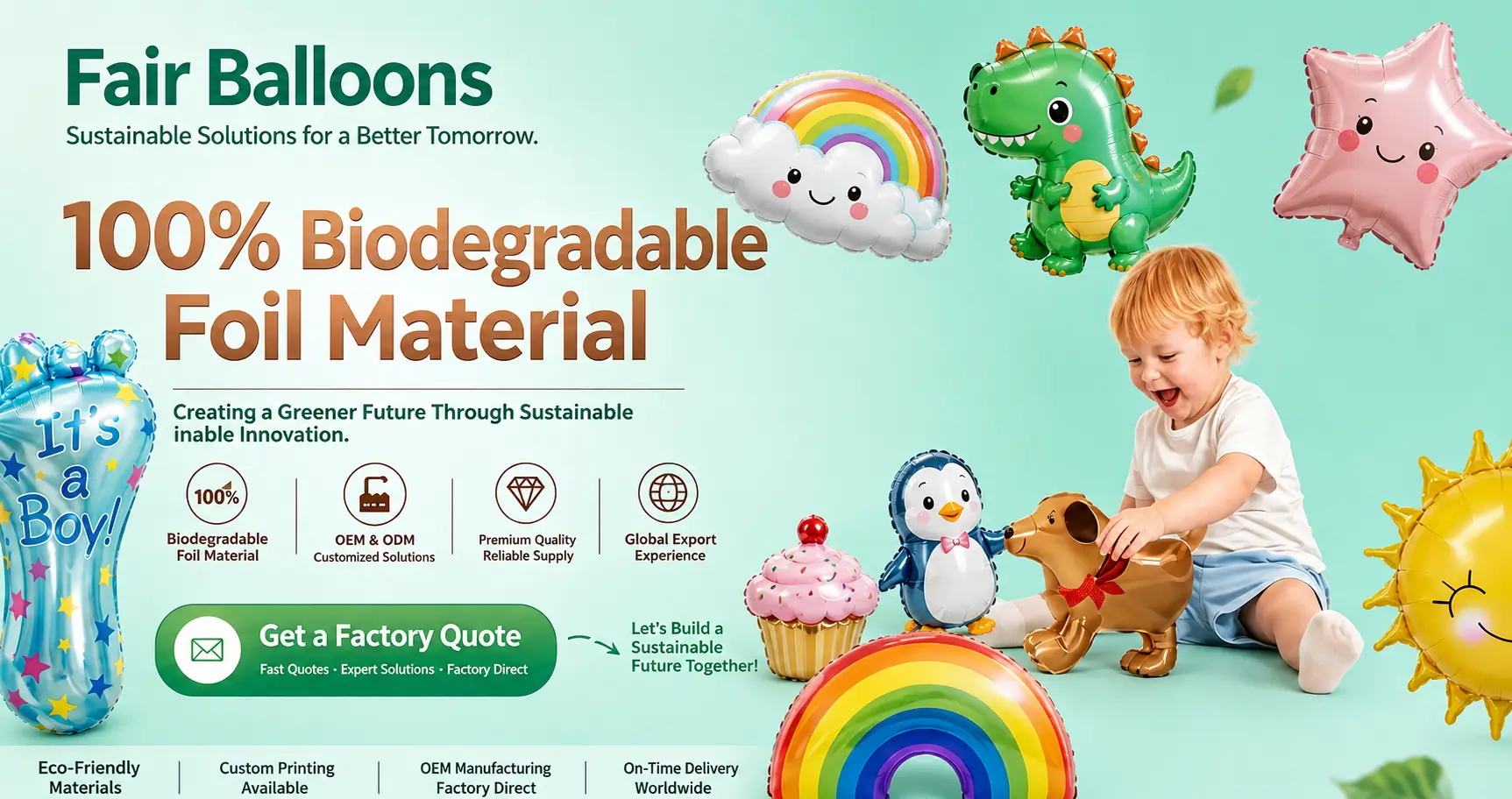
A factory-verified technical reference for global procurement professionals, brand managers, and supply chain directors. Written by Kunshan Fair Craft Products Co., Ltd. (FAIR), a direct-source OEM/ODM manufacturing facility. The handbook covers six chapters: the B2B sourcing landscape, the material science behind the film, the prototyping workflow, high-speed manufacturing, quality assurance and compliance, and packaging and logistics. Each chapter is written for a procurement team that has to make a sourcing decision, not for a general audience.
The standards we hold for the compostable line are EN71 (SGS report SHTY130500007975-01), RoHS (EU) 2015/863 (SGS report SHAHG2207652301), and ISO 14855-1:2012 (SGS report SHMR220700361301). We do not hold ASTM D6400, BPI, EN 13432, ISO 9001, ISO 14001, ASTM F963, REACH, US CPSIA, or California Prop 65 documentation. The production parameters, MOQ, lead time, and tooling cost referenced in this handbook are confirmed at quotation stage against a specific program.
Chapter 1 — The Global B2B Landscape and Direct Factory Sourcing Advantages
1.1 The Global Foil Balloon and Mylar Balloon Market
The global decorative balloon industry is a multi-billion-dollar market. Within that category, foil and Mylar balloons form a premium sub-segment that has grown faster than the overall market in recent years. The distinction between the two terms is both material and perceptual: "foil balloons" is the colloquial umbrella term used by consumers and many B2B buyers to describe a metallic-shiny inflatable decoration, while "Mylar balloons" refers specifically to balloons manufactured from BoPET (biaxially-oriented polyethylene terephthalate) film, the same family of polymer films used in aerospace and food packaging. In global trade and manufacturing contexts, the two terms are often used interchangeably, though the technical distinction matters for a procurement team that is comparing specifications.
North America and Europe are the two largest consumption regions, driven by established party-retail ecosystems and year-round demand from Halloween, Christmas, and Valentine's Day programs. The Asia-Pacific region is the fastest-growing market as urbanization and disposable income growth expand the celebration category. For a procurement professional, the important point is that the market is changing. Three factors are reshaping the sourcing landscape: the sustainability regulatory wave led by the EU Single-Use Plastics Directive and extended producer responsibility frameworks; the rise of e-commerce and direct-to-consumer fulfillment, which demands a different supply chain configuration from traditional retail wholesale; and the consolidation of manufacturing capacity in China, where environmental compliance enforcement has eliminated many smaller, non-compliant operators.
1.2 The B2B Sourcing Landscape: Buyer Archetypes
The B2B procurement landscape for foil balloons and Mylar balloons is not a single market. It is a set of buyer archetypes, each with different volume requirements, quality expectations, and supply chain priorities. Understanding these archetypes is essential for a procurement professional designing a sourcing strategy, because the factory that is optimal for one segment is frequently suboptimal for another.
International retail chain buyers
Category managers and global sourcing directors who supply large retail chains. These buyers typically order high volumes per order, demand AQL inspection levels with mandatory third-party inspection, require full regulatory compliance documentation (EN71, ASTM F963, REACH, Proposition 65 as applicable to the destination market), and negotiate on extended payment terms backed by a Letter of Credit. For this group, price is important but not the primary discriminator. Reliability of supply, consistency of quality, and the factory's ability to absorb volume spikes during peak seasons matter more. See our B2B sourcing terms glossary for the terminology.
Party supplies distributors and wholesale importers
Mid-sized companies that supply independent party stores and regional retail chains. These buyers require a balance of competitive pricing, consistent quality, and responsive service. This is the most price-sensitive segment and the most vulnerable to the trading company trap, where an intermediary markup obscures the true origin of goods and creates quality accountability gaps.
Cross-border e-commerce sellers
Amazon FBA entrepreneurs, Shopify-powered D2C brands, and Etsy sellers. These buyers order in smaller volumes per SKU, require FBA-compliant packaging with FNSKU barcodes applied, and depend on consistent product quality because a defective batch that generates negative reviews can damage a product's listing rank for months. This segment is the most willing to pay a premium for documented quality assurance.
Corporate branding and event marketing buyers
Advertising agencies, event production companies, and corporate marketing departments that order custom-printed foil balloons for brand activations, product launches, and large events. These buyers prioritize design accuracy, color matching, and reliable fulfillment against event deadlines. They are the most design-literate segment and the most natural fit for OEM service and custom shape prototyping engagements.
1.3 The Trading Company Trap: Why an Intermediary Adds Cost
A trading company in the Chinese export context is an entity that does not own manufacturing assets. It does not have a factory floor, production equipment, or direct production labor. Instead, it sources finished or semi-finished goods from one or more factories and resells them to international buyers. In the foil balloon and Mylar balloon trade, a trading company typically adds a markup above the factory's ex-works price, offers sample sourcing services that obscure the actual production origin, and frequently misrepresents its manufacturing capabilities.
Three failure modes are common. The first is a quality accountability gap. When a buyer receives a shipment with a defect rate above the agreed level and the trading company responds that the factory produced it that way, the buyer is left with a damaged shipment and no effective recourse. A direct factory relationship creates a contractual and operational accountability chain where the factory's quality management system is visible and auditable. The second is an intellectual property and compliance risk. A trading company acting as a reseller has no direct relationship with the brand owners of any third-party character designs that appear on a custom order. A buyer that orders a licensed character design through a trading company without proper licensing documentation is exposed to trademark infringement liability in every market where those goods are sold. The third is a cost compounding effect. The trading company markup raises the effective unit cost, and an additional defect rate attributable to the weaker quality control adds replacement, shipping, and handling losses. The total cost of a trading company relationship, properly calculated, can exceed the factory base price by a significant margin.
1.4 OEM vs. ODM vs. Trading Company: A Comparative View
For a procurement professional, the choice between OEM (Original Equipment Manufacturing), ODM (Original Design Manufacturing), and trading company sourcing determines the structure of product development risk, intellectual property ownership, cost competitiveness, and supply chain resilience.
OEM service in the foil balloon context is a manufacturing arrangement where the buyer provides the factory with production-ready artwork and specifications, and the factory is responsible for converting those inputs into finished goods. The buyer owns the product design, the intellectual property, and the brand identity embedded in the print. The factory provides manufacturing capability, quality assurance infrastructure, and regulatory compliance documentation. OEM is the appropriate model for brand owners, licensed character intellectual property holders, corporate branding buyers, and retail chains with established design teams.
ODM customization is a more factory-centric model where the manufacturer develops and maintains a library of pre-designed product architectures, base tooling, and partially developed designs that a buyer can customize through selective modification. The factory owns the core product engineering; the buyer owns the surface customization. ODM is relevant for buyers who lack in-house design capability but want access to a developed foil balloon product architecture without investing in their own research and development. Custom shape prototyping fits naturally within the ODM framework, where a factory's existing die-cut library can be modified to create a custom silhouette at a lower cost than full OEM tooling development.
| Cost Element | Direct Factory | Trading Company |
|---|---|---|
| Unit price | Factory ex-works price; confirmed at quotation stage | Factory price plus intermediary markup |
| Quality inspection | Included in the factory QC protocol | Often outsourced at additional cost |
| Defect accountability | Contractual chain of responsibility | Unclear; often referred back to the factory |
| Total landed cost | Confirmed at quotation stage | Higher by the markup plus defect handling |
1.5 The Total Cost of Ownership Framework
A per-unit price comparison is not enough for a foil balloon category. The Total Cost of Ownership framework captures all cost elements across the procurement and supply chain lifecycle. For a procurement team, the TCO model for a foil balloon program includes four cost dimensions.
Acquisition costs include the ex-works or FOB unit price, the cost of pre-production sample approval, tooling amortization for a custom die-cut shape, and pre-press and artwork preparation costs if the buyer does not have in-house design capability. The unit price, sample cost, and tooling cost for a given program are confirmed at quotation stage.
Logistics and freight costs include the ocean freight for the container configuration the program uses, drayage at the destination port, customs brokerage fees, and inland freight to the buyer's warehouse. The freight and container configuration for a given program are confirmed at quotation stage.
Quality failure costs include the direct cost of defective units, the indirect cost of retail customer returns and chargebacks, the cost of regulatory compliance failures if a non-compliant product is discovered at customs or in market, and the impact of a negative review on a product listing.
Supply continuity costs capture the financial impact of a supply disruption. A retail chain with a committed promotional calendar that experiences a stockout due to a production failure or a logistics delay faces lost sales and, in some cases, contractual penalties from corporate marketing partners.
1.6 The Certified Factory Sourcing Checklist
For a procurement team developing a direct factory relationship, a rigorous factory verification process is essential. The checklist below reflects the minimum due diligence standard for a foil balloon sourcing engagement.
- Business entity validation. Confirm the factory's legal business registration number and its export license. A factory should be willing to provide copies of its business license and export registration certificate.
- Physical asset verification. Request a video walkthrough of the production facility showing the printing lines, lamination equipment, cutting and sealing stations, inflation testing areas, and packaging operations. Key equipment to verify: rotogravure or flexographic printing presses, multi-layer lamination lines, heat-seal cutting presses with consistent temperature and pressure control, and automated inflation testing. A factory that cannot produce verifiable evidence of owning this equipment is not a true manufacturer.
- Quality system audit. Request evidence of the factory's incoming material inspection program, in-process quality control checkpoints at each production stage, and final inspection protocols. Ask specifically about the factory's defect tracking data and its corrective action process.
1.7 Kunshan Fair Craft Products Co., Ltd.: Sourcing Integrity in Action
Kunshan Fair Craft Products Co., Ltd. (FAIR, operating since 2007) is a direct-source factory in the foil balloons and Mylar balloons category. Established in Kunshan, Jiangsu Province, a manufacturing hub adjacent to Shanghai with developed polymer film processing supply chains, FAIR operates with RMB 5,000,000 in registered capital and a vertically integrated manufacturing operation that spans from raw material procurement through final packaging and export documentation. For company background and production capability, see our About FAIR page.
FAIR's OEM service framework is structured around a four-stage engagement model: initial technical consultation to assess design feasibility and identify any regulatory or manufacturing constraints; pre-production sample development with full material and print approval before mass production; mass production with batch inspection; and post-delivery quality follow-up. The company maintains dedicated account managers for international B2B clients, which eliminates the handoff fragmentation that affects a trading company relationship where an inquiry may pass through several contact points before it reaches someone who understands the production process.
For factory-direct sourcing clients, FAIR offers a tooling amortization program for custom shapes that reduces the initial per-unit cost barrier for a low-to-medium volume buyer while preserving the factory's investment recovery. The company's bulk wholesale pricing is set for each program, with custom-designed geometries optimized around the production run MOQ. The MOQ, tooling cost, and unit price for a given program are confirmed at quotation stage.
Chapter 2 — Molecular Chemistry and Multilayer Lamination Engineering
A foil balloon is not a single-material product. It is a multilayer composite engineered at the molecular level. Each functional layer contributes a specific physical property, and the way the layers interact determines the balloon's helium retention time, burst strength, shelf life, and print quality. For a B2B buyer evaluating a specification, an understanding of this structure matters.
2.1 The PET Film Substrate
The outermost structural layer of a Mylar balloon is a biaxially-oriented PET film. PET is synthesized by the condensation polymerization of ethylene glycol and terephthalic acid, forming a repeating ester unit. The benzene ring in the terephthalic acid component provides rigidity and tensile strength, and the ester bond is polar, which creates strong interchain forces that contribute to the film's dimensional stability and creep resistance at elevated temperature. For a foil balloon, only BOPET (biaxially-oriented PET) grades with optical clarity and uniform gauge tolerance are acceptable.
2.2 The Nylon Barrier Layer
The nylon barrier interlayer is the mechanical backbone of the composite. PA6 (polyamide 6) is synthesized by the ring-opening polymerization of caprolactam. The amide groups form strong intermolecular hydrogen bonds between polymer chains, which creates a dense, tightly packed crystalline-amorphous microstructure. This hydrogen-bond network is responsible for nylon's tensile strength, tear propagation resistance, and improved oxygen barrier performance compared to PET alone. The tear resistance matters for the heat-sealing process: it allows the film to withstand the sealing stress without micro-cracking.
2.3 The Vacuum Metallized Aluminum Coating
The aluminum reflective layer is applied by physical vapor deposition. In a vacuum chamber, high-purity aluminum is vaporized and condensed onto the passing substrate to form a dense, reflective layer. It reduces the oxygen transmission rate of the film significantly compared to an uncoated polymer film, and it is the performance enabler for helium retention over a multi-day window in a premium Mylar balloon. The exact thickness and the transmission rate for a given film grade are confirmed at quotation stage.
2.4 Multilayer Co-Extrusion and Lamination
The complete foil balloon composite structure, from outer to inner, follows a sequence of functional layers: a PET print surface, an adhesive layer, an aluminum metallized layer, a tie layer, a nylon barrier layer, a second tie layer, and a heat-seal layer. Dry lamination with a two-component polyurethane adhesive forms a crosslinked urethane network at the bond line. Extrusion lamination with a molten LLDPE tie layer is an alternative that offers lower cost and no solvent residue. The specific lamination method and the bond strength for a given order are confirmed at quotation stage.
A single-layer PET print film has a relatively high oxygen transmission rate, which is not sufficient for long-term helium retention. By co-extruding a BOPET outer layer with a nylon core and an LLDPE sealant layer, the transmission rate is reduced by a large factor. The difference between a two-layer film and a co-extruded multi-layer film is what separates a balloon that holds helium for a couple of days from one that holds it for a longer window. The exact retention window for a given SKU is confirmed at quotation stage.
Chapter 3 — Order Intake, Digital Pre-Press, and Custom Prototyping
The front-end engineering phase transforms a buyer's concept into mass-production tooling. This phase is where downstream errors — wrong dimensions, distorted prints after inflation, or mold seam misalignments — are either prevented or locked in. A procurement team that invests in proper design-for-manufacturing engineering with its factory partner avoids a significant share of unit rework costs and shortens time to market.
3.1 Inflation Compensation and Surface Area Expansion
This is the most technically demanding aspect of a custom shape balloon design, and the one most frequently skipped by a trading company. A balloon is an inflated elastic membrane. When flat panels are welded and inflated, the film stretches biaxially, which means the flat panel layout area has to be larger than the target inflated surface area to prevent cosmetic distortion. Our engineering team uses a non-uniform offset algorithm, where compensation is greater in high-curvature regions such as corners, tips, and tight cleavages, and smaller in flat face centers. The compensation factor for a given design is confirmed at quotation stage. For the mathematical background, see the PLA-PBAT whitepaper.
3.2 Custom Shape Prototyping and Tooling Amortization
Once the compensation simulation is approved, we execute CNC tool-milling. To make a custom shape viable for a buyer with a program at the B2B standard, the tooling amortization schedule is aligned around the production run volume.
| Order Volume Tier | Tooling Fee Refund | Tooling Ownership |
|---|---|---|
| Below the production run MOQ | Tooling at buyer cost; no refund | Factory retains the physical asset |
| At or above the production run MOQ | Partial refund credited to the invoice | Joint ownership, pending full transfer |
| At a volume agreed for the program | Full refund credited to the invoice | Full transfer to the buyer |
Standard catalog shapes such as rounds, stars, hearts, and ovals use existing base tools and do not incur a tooling fee. A custom-milled aluminum prototype tool takes a defined number of business days and requires a committed production run MOQ to satisfy setup amortization. The tooling fee, refund schedule, and lead time for a given design are confirmed at quotation stage. See our compostable vs latex comparison for material background.
Chapter 4 — High-Speed Industrial Manufacturing and Press Operations
This is the engine room of foil balloon manufacturing. Raw multi-layer composite film is printed, laminated, and formed at production line speed. The output capability, the first-pass yield, and the defect control at this stage determine the unit cost and the delivery reliability of a program. The parameters below describe the process. The actual line speed, daily output, and yield for a given order are confirmed at quotation stage.
4.1 Rotogravure Cylinder Engraving and Ink Transfer
Rotogravure is the dominant printing process for volume production. It offers superior color density and metallic sheen compared with flexographic printing. The cylinder features chrome-plated copper cells engraved in a hexagonal arrangement. Cell depth controls the ink volume transferred to the substrate. The cell geometry and engraving specification for a given design are set at the pre-press stage and confirmed at quotation stage.
Chromatic register is held to a tight tolerance using a closed-loop camera register system and an automatic web tension controller. All inks used on our substrates are heavy-metal-free and audited under the chemical restriction report we hold for the tested sample. For custom print options, see our Mylar balloon sourcing page.
4.2 Automatic Valve Insertion and High-Frequency Welding
The self-seal valve is positioned on the web by an automatic placement unit and welded by high-frequency dielectric heating. The high-frequency field heats the sealant layer at the valve flange and fuses it to the valve within a fraction of a second. The placement accuracy, the welding power, and the dwell time for a given valve configuration are confirmed at quotation stage.
| Process Stage | Equipment Type | Output Capability | Inspection |
|---|---|---|---|
| Rotogravure printing | Multi-color press, wide web | Confirmed at quotation stage | Inline register and color check |
| Lamination | Solvent-free or extrusion line | Confirmed at quotation stage | Bond strength check on samples |
| Valve insertion | High-frequency thermal press | Confirmed at quotation stage | Pull-force check on samples |
Chapter 5 — Strict Quality Assurance and Worldwide Import Compliance
For a global retailer, a licensor, or an e-commerce brand, regulatory compliance is the ultimate gatekeeper. Every balloon that leaves the factory has to pass the quality controls that reduce the risk of a chemical, toxicological, or functional failure in the destination market.
5.1 Inflation Leak Inspection and Static Pressure Retention
Samples from each finished batch pass through an inflation and leak inspection. A unit that shows a pressure drop above the limit is isolated. The inspection protocol has two stages.
The first is an inline inflation check. A sample set is inflated to the rated working pressure for the balloon line and inspected for pressure decay over a defined window. The second is a static pressure retention check on random samples from the batch, run against the sampling plan agreed with the buyer. The inspection window, the sampling plan, and the pass criteria for a given order are confirmed at quotation stage.
5.2 International Laboratory Certifications: What We Hold and What We Do Not
Chemical safety is confirmed by the laboratory reports we hold for the tested samples. The reports are listed below.
- EN71 — SGS report number SHTY130500007975-01. Coverage: foil balloon sample, EN71 Parts 1, 2, and 3. Coverage of a specific SKU is confirmed at quotation stage. See our EN71 coverage page.
- RoHS (EU) 2015/863 — SGS report number SHAHG2207652301. Coverage: tested DEGRADING BALLOON sample. The report documents restriction testing for lead, cadmium, mercury, hexavalent chromium, PBBs, and certain phthalate plasticizers. Coverage of a specific SKU is confirmed at quotation stage. See our RoHS coverage page.
- Biodegradation (ISO 14855-1:2012) — SGS report number SHMR220700361301. Coverage: PLA degrading balloon sample under controlled industrial composting conditions. Test material average biodegradation 77.8% within a 45-day test period. ISO 14855-1:2012 is a distinct standard from EN 13432. See our SGS report coverage page.
- PEBA member — Pro Environment Balloon Alliance member.
Certifications and test reports we do NOT hold:
- ISO 9001 — not held
- ISO 14001 — not held
- EN 13432 — not held. The report we hold for the biodegradable line is ISO 14855-1:2012, which is a distinct standard.
- ASTM D6400 — not held
- BPI — not held
- ASTM F963 — not held
- REACH — not held
- US CPSIA — not held
- California Prop 65 — not held
- US CONEG — not held
- FSC — not held for the balloon line
| Sourcing Region | Primary Regulation | Testing Metric | Conformity Marking |
|---|---|---|---|
| European Union | Toy Safety Directive 2009/48/EC | EN71 parts; REACH substance restrictions as applicable | CE marking where applicable |
| United States | Federal and state consumer product rules | Test coverage confirmed per program | Coverage confirmed at quotation stage |
| Global eco-trade | ISO 14855-1:2012 / EN 13432 (distinct standards) | Test material average biodegradation 77.8% within a 45-day test period (SGS report SHMR220700361301) | SGS report coverage; SKU coverage confirmed at quotation stage |
Chapter 6 — Packaging Engineering, Customs Clearance, and Global Supply Logistics
Packaging and logistics are the final phase of the supply chain. Well-planned packaging reduces the landed logistics cost and protects the film from hydrolytic degradation during ocean transit. The packaging specification, container configuration, and freight rate for a given program are confirmed at quotation stage.
6.1 Three-Tier Packaging System
To protect a shipment from humidity, temperature swings, and physical handling during ocean cargo, our packaging uses a three-tier layout.
- Tier 1: primary retail polybag. Balloons are sealed inside a food-grade LDPE polybag alongside a desiccant sachet to reduce ambient humidity exposure and slow premature hydrolytic aging of the film.
- Tier 2: inner carton. Standard counts of polybags are packed into a rigid corrugated box with exterior barcoding and, where the program requires it, FNSKU labels for e-commerce intake.
- Tier 3: shipping pallet. Master cartons are stacked on ISPM-15 heat-treated wood pallets, wrapped with stretch film, and protected by corrugated corner guards. The pallet height and stack configuration for a given order are confirmed at quotation stage.
6.2 Customs Classification and Freight Terms
Mylar balloons are typically classified under HTS code 9503.00.00 (toys) or 9505.10.50 (festive articles). The applicable subheading, duty rate, and any preferential tariff treatment depend on the destination market and the product description. A program should confirm the classification with its customs broker before it ships. The Incoterm, container configuration, and freight rate for a given order are confirmed at quotation stage.
| Incoterm | Risk Transfer Point | Buyer Cost Coverage | Typical Use |
|---|---|---|---|
| EXW | At the factory gate | Freight, insurance, export clearance | Buyers with an existing forwarder at origin |
| FOB | When the goods are on the vessel at the port of origin | Ocean freight, destination duties and brokerage | Common for a first or volume order |
| CIF | When the goods are on the vessel at the port of origin | Destination duties and brokerage only; freight and insurance are arranged by the seller | Buyers without a forwarder relationship |
| DDP | At the buyer's named place | No further cost to the buyer; the seller covers freight, duties, and tax | Sample orders and trial orders |
Ready to source a custom foil or Mylar balloon program from a direct factory?
Email xia@foilballoon.cnResponse within one business day · Sample service available
About FAIR — Kunshan Fair Craft Products Co., Ltd.
FAIR is a balloon manufacturer based in Kunshan, China, producing foil balloons, custom shaped foil balloons, PLA-based biodegradable foil balloons, and custom printed balloon products for global brands, event companies, retail chains, and wholesale novelty distributors. For inquiries: xia@foilballoon.cn