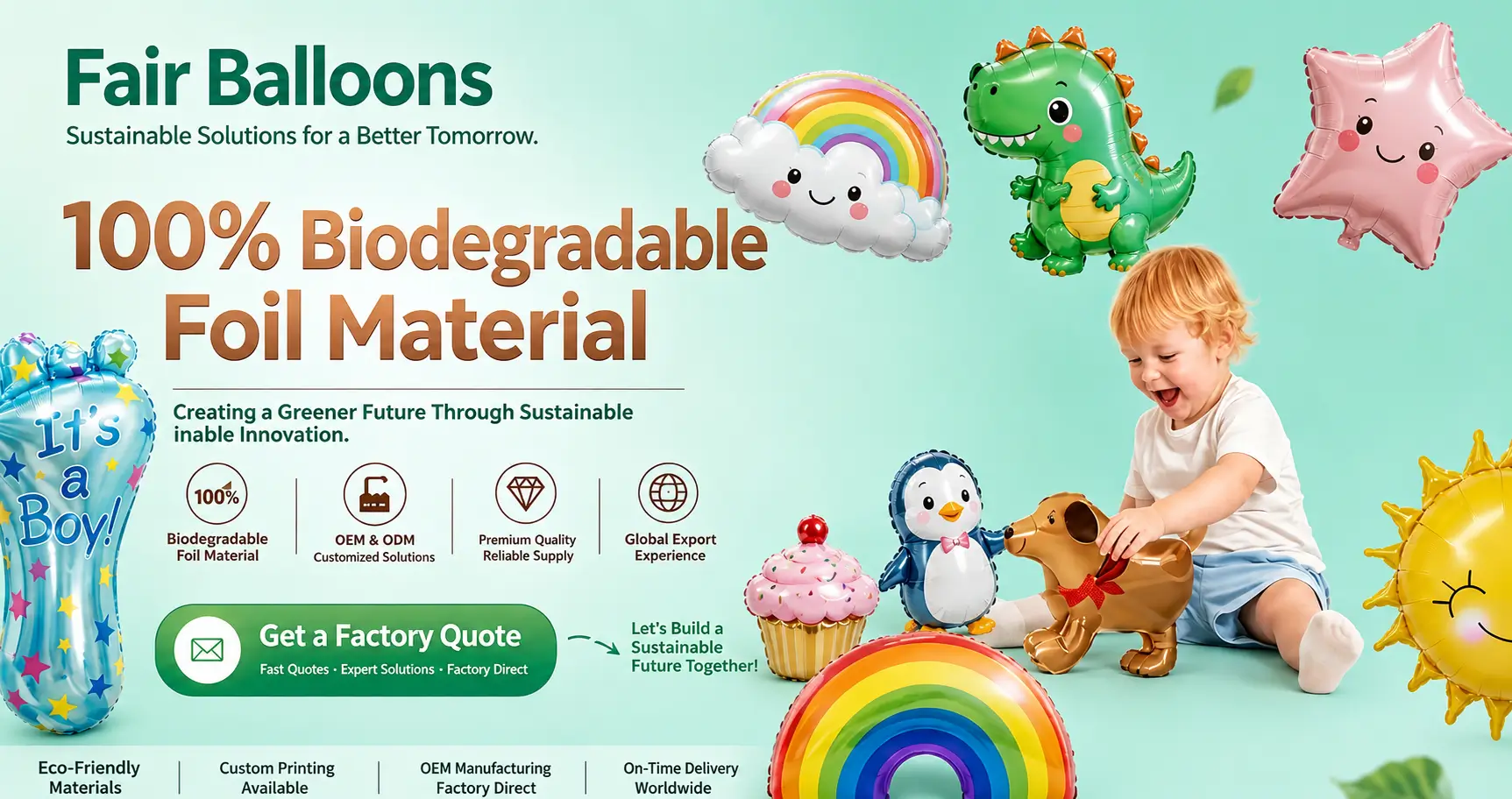
Biodegradable foil balloons factory price, premium wholesale mylar
OEM Manufacturing Custom Tooling

Biodegradable Foil Balloon Manufacturer: Advanced Engineering for OEM/ODM Custom Foil Balloons

This technical contract manufacturing whitepaper details our industrial engineering protocols for high-capacity Biodegradable Foil Balloon production lines, breaking down the custom workflows provided by an established Biodegradable Foil Balloon Manufacturer for international OEM/ODM Custom Foil Balloons procurement. As global retail procurement standards converge on unified environmental performance benchmarks and international regulatory frameworks tighten around single-use plastic commercialization pathways, the strategic importance of engaging a technically proficient, vertically integrated Biodegradable Foil Balloon Manufacturer capable of managing the full engineering lifecycle—from custom shape ideation through high-volume production—has become the defining competitive differentiator for international private label brands, supermarket syndicates, and promotional distribution conglomerates. Kunshan Fair Craft Products Co., Ltd., an established manufacturing enterprise incorporated in 2007 with 5 million RMB in registered capital, operates a purpose-built OEM/ODM production infrastructure that combines precision polymer extrusion, advanced CAD/CNC tooling fabrication, automated balloon forming and heat-sealing systems, and rigorous multi-point quality auditing—delivering Biodegradable Foil Balloon products that satisfy the most demanding international compliance frameworks while providing the fully customized geometric configurations that brand-exclusive private label programs require. This whitepaper provides the definitive technical and engineering reference for procurement decision-makers, product development managers, and supply chain directors evaluating OEM/ODM Custom Foil Balloons sourcing partnerships in the post-regulatory transformation of the global balloon industry.

Chapter 1: The Industrial Sourcing Matrix for Global Supermarket Syndicates

The global procurement landscape for private label celebration and promotional products has undergone a fundamental structural transformation over the past decade, driven by the convergence of tightening international environmental regulation, escalating ESG accountability mandates from institutional investors, and the progressive integration of sustainability criteria into tier-one retail conglomerate vendor qualification frameworks. International private label conglomerates—global supermarket syndicates, national retail chains, and wholesale club operators—now require a specialized Biodegradable Foil Balloon Manufacturer capable of managing extraordinarily complex logistical footprints that span multiple regulatory jurisdictions, multiple production批次 configurations, and multiple distribution channel requirements simultaneously. The days when a single supplier could qualify for private label balloon programs based on price competitiveness and basic quality compliance are definitively over; the modern procurement environment demands engineering depth, regulatory expertise, and supply chain infrastructure that only a purpose-built Biodegradable Foil Balloon Manufacturer with dedicated OEM/ODM capabilities can provide.

The strategic financial advantages of deploying tailored OEM/ODM Custom Foil Balloons contracts extend far beyond the obvious benefit of exclusive geometric configurations and brand-imprint confidentiality. A properly structured OEM/ODM engagement with an experienced Biodegradable Foil Balloon Manufacturer insulates tier-one commercial distribution assets from the escalating financial exposure associated with emerging western eco-tax boundaries, Extended Producer Responsibility (EPR) levy structures, and anti-plastic customs surcharge mechanisms that are proliferating across export markets. Under the EU Single-Use Plastics Directive (SUPD) and its derivatives in Asian and Americas markets, importers of non-certified foil balloon products face per-kilogram environmental levy assessments that can add 12–25 percent to landed costs for products classified under HS codes associated with non-biodegradable plastic articles. A certified Biodegradable Foil Balloon Manufacturer supplying verified compostable OEM/ODM Custom Foil Balloons eliminates this levy exposure entirely, creating a structural cost advantage that compounds with every successive shipment and regulatory tightening cycle.

Beyond eco-tax boundary insulation, the OEM/ODM Custom Foil Balloons procurement model delivers brand exclusivity protections that are commercially irreplaceable for premium private label programs. Custom Shape Biodegradable Foil Balloons featuring proprietary brand mascots, corporate logos, or co-branded characters represent high-margin SKUs that generate disproportionate revenue per unit compared to standard geometric balloon forms. A Biodegradable Foil Balloon Manufacturer with genuine ODM (Original Design Manufacturing) capability—operationally distinct from mere assembly or reprinting—owns the tooling, process know-how, and process optimization data for the custom geometry, creating a supplier switching cost that protects the private label brand's competitive differentiation. The financial value of this tooling ownership structure becomes particularly significant in high-velocity retail chain fulfillment contexts where promotional calendar windows are compressed and supplier substitution lead times represent existential business risk.

The procurement risk mitigation dimension of sourcing OEM/ODM Custom Foil Balloons from a dedicated Biodegradable Foil Balloon Manufacturer is equally compelling. International retail syndicate procurement teams managing large-scale private label programs must satisfy internal vendor scorecard requirements that increasingly weight environmental compliance credentials, chemical safety documentation, and third-party validated sustainability performance alongside traditional quality and delivery metrics. A Biodegradable Foil Balloon Manufacturer that maintains comprehensive EN ISO 14855-1 biodegradation test reports, PEBA alignment documentation, RoHS compliance declarations, and EN71 toy safety certifications for every production SKU provides the documentation infrastructure that procurement teams need to demonstrate compliance progress to internal ESG committees, external rating agencies, and regulatory oversight bodies. This documentation readiness translates directly into procurement risk reduction: brands sourcing from non-compliant or documentation-poor suppliers face potential delisting from retail syndicate vendor registers when periodic sustainability audits reveal gaps, while brands working with a fully documented Biodegradable Foil Balloon Manufacturer face no such exposure.

Chapter 2: Precision 3D CAD Geometric Modeling & CNC Tooling Fabrication

The engineering execution of Custom Shape Biodegradable Foil Balloons represents the most technically demanding aspect of the OEM/ODM manufacturing process, requiring a vertically integrated production capability that few manufacturers in the global balloon industry possess. Unlike standard geometric balloon forms—cylinders, spheres, hearts, stars—that can be produced using existing tooling libraries, Custom Shape Biodegradable Foil Balloons demand bespoke engineering from initial concept through mass production, encompassing 3D CAD geometric modeling, CNC tooling fabrication, prototype validation, process optimization, and high-volume production ramp. The Biodegradable Foil Balloon Manufacturer must maintain a dedicated tooling division with multi-axis CNC machining capability, polymer formulation expertise for the specific PLA/PBAT substrate grades required for the custom geometry, and the quality assurance infrastructure to validate that every production unit conforms to the dimensional and performance specifications established during the prototyping phase.

The physical tool-making division begins its work with the translation of complex brand mascot blueprints—provided by the client's design team as vector artwork, PDF illustrations, or physical concept sketches—into functional 3D chamber geometries using advanced 3D CAD geometric modeling software. This process is far more complex than simple 2D-to-3D extrusion: Custom Shape Biodegradable Foil Balloons must maintain consistent wall thickness throughout complex curved surfaces to ensure uniform helium distribution and structural integrity under internal pressure. Overly thin sections create burst failure risk; overly thick sections waste material and create excessive weight that compromises buoyancy. The 3D CAD modeling process requires iterative structural analysis to identify stress concentration zones in the proposed geometry, adjusting surface curvatures and internal ribbing structures to distribute pneumatic pressure loads evenly across the balloon's surface area. For brand mascots with appendages, protruding features, or asymmetric geometries, this stress engineering process is particularly intensive and requires specialized finite element analysis (FEA) capabilities that are rarely available in conventional balloon manufacturing operations.

The translation of 3D CAD models into functional production tooling is executed through precision CNC Tooling Fabrication, where the approved geometric model is converted into machine control (G-code) instructions for multi-axis CNC machining centers. Tooling for Custom Shape Biodegradable Foil Balloons is typically machined from aircraft-grade aluminum alloy billet stock—a material selected for its combination of high thermal conductivity (enabling rapid and uniform heat dissipation during the thermoforming process), excellent machinability for achieving micron-level surface finish accuracy, and sufficient hardness to withstand the repeated thermal cycling and mechanical wear of high-volume production tooling. The International Organization for Standardization (ISO) tooling metrics establish the dimensional tolerance frameworks that govern CNC tooling fabrication for balloon manufacturing applications: standard tooling tolerances of ± 0.05mm on critical sealing surfaces and ± 0.10mm on non-sealing structural surfaces, with surface finish requirements not exceeding Ra 1.6 micrometers on all forming surfaces to prevent material adhesion and surface defect generation during the thermoforming process.

The connection between advanced CNC tooling fabrication and the advanced CAD molds and agile micro-batch prototyping infrastructure represents a critical competitive differentiator for the fully integrated Biodegradable Foil Balloon Manufacturer. Conventional balloon manufacturers without in-house CNC tooling capability must outsource mold fabrication to third-party machine shops—a process that introduces 4–8 weeks of lead time addition, communication friction between design intent and machined output, and zero capability for rapid design iteration during the prototype validation phase. The manufacturer with integrated CAD/CNC capability can execute design iterations within days rather than weeks, enabling comprehensive micro-batch prototyping runs that validate not merely the cosmetic appearance of the Custom Shape Biodegradable Foil Balloon but also its pressure performance, helium retention duration, and seam integrity under simulated distribution handling conditions. This agile prototyping capability compresses the OEM/ODM development timeline dramatically while improving first-time-right rates when the design proceeds to full-volume production.

The geometric parameters of Custom Shape Biodegradable Foil Balloons must also satisfy strict European physical safety directive protocols that impose specific dimensional and structural requirements on balloon products marketed to or accessible by children under 36 months. These protocols, derived from EN71 Part 1 (Mechanical and Physical Properties) and the EU Toy Safety Directive 2009/48/EC, establish maximum dimensions for fully inflated balloons to prevent airway obstruction hazards, minimum wall thickness requirements to prevent accidental burst injuries, and requirements for valve design that prevents complete detachment and ingestion choking hazards. The Biodegradable Foil Balloon Manufacturer's engineering team must incorporate these safety parameters into the 3D CAD modeling phase from the outset—before tooling fabrication begins—to avoid costly design revisions that would delay the OEM/ODM project timeline. The integration of EN71 safety criteria into the initial geometric design process is a non-negotiable engineering requirement for any private label program targeting retail markets with pediatric end-user exposure.

Chapter 3: Thermal Seam Containment & Multi-Point Automated Temperature Calibration

The mechanical performance and commercial viability of every Biodegradable Foil Balloon—whether a standard geometric form or a Custom Shape Biodegradable Foil Balloon produced through OEM/ODM tooling—depends fundamentally on the structural integrity of its heat-sealed seam. The heat seal is not merely a closure mechanism; it is the load-bearing structural joint that contains the internal helium pressure, distributes mechanical stress across the balloon's geometry, and prevents the gas escape pathways that cause premature deflation. The engineering of the heat-sealing process for PLA/PBAT bio-derived film structures is materially more complex than the equivalent process for conventional PET/PE laminates, requiring specialized thermal management systems, precision pressure control, and rigorous multi-point automated temperature calibration to achieve the consistent seam quality that high-volume commercial applications demand.

The physics of heat-sealing bio-derived polymer films involves the controlled application of temperature and pressure to the overlapping film surfaces at the seam interface, inducing surface plasticization and polymer chain interdiffusion across the interface plane. For PLA/PBAT films, the sealing temperature window is narrower than for conventional PE films: PLA has a glass transition temperature (Tg) of approximately 55–60 degrees Celsius and a melting point (Tm) of approximately 155–170 degrees Celsius, while PBAT exhibits a Tg of approximately -30 degrees Celsius and a Tm of approximately 110–120 degrees Celsius. The sealant layer, being PBAT-rich, seals effectively in the 120–140 degree Celsius range, but the structural PLA outer layer must not reach temperatures approaching its melting point during the sealing cycle—exceeding 160 degrees Celsius on the PLA surface will cause surface deformation, gloss loss, and degradation of the metallization layer that provides the gas barrier performance. This asymmetric thermal sensitivity requires the sealing die to be engineered with independent temperature control zones that apply precisely calibrated thermal energy to each side of the film laminate, maintaining the PBAT sealant at sealing temperature while keeping the PLA outer surface below its degradation threshold.

The execution of a 5mm structural heat-sealing perimeter under premium eco-friendly foil balloon designs principles achieves total micro-fracture elimination through the integration of multi-point automated temperature calibration systems that maintain ± 1.0 degree Celsius temperature uniformity across the entire sealing die surface. Micro-fracture formation at the heat-sealed seam is caused by localized temperature excursions—whether hot spots from uneven heating or cold spots from thermal boundary effects—that create zones of incomplete polymer interdiffusion within the seal zone. Under internal helium pressure, these zones of incomplete bonding become crack initiation sites that propagate under cyclic fatigue loading, ultimately causing seam failure and premature deflation. Multi-point automated temperature calibration eliminates this failure mode by deploying an array of precision thermocouples (typically 8–16 points across a standard sealing die) that continuously monitor actual surface temperatures and feed back to a closed-loop controller that adjusts heating element power distribution in real time, maintaining thermal uniformity throughout the sealing cycle regardless of production speed, ambient temperature variation, or film thickness batch-to-batch variation.

The deflation risk mitigation objective for every Biodegradable Foil Balloon unit manufactured in high-volume production is achieved through the combination of the 5mm wide structural seal geometry and the automated thermal calibration system. A 5mm seal width provides a generous safety factor against partial seam failures—a 20 percent reduction in seal width due to normal production variation still leaves a 4mm seal that exceeds the minimum functional seam strength required for 5–7 day helium retention. The structural heat-sealing perimeter is programmed into the balloon forming machine's CNC control system, ensuring that every seam segment is sealed with identical thermal parameters across its entire length. Statistical process control (SPC) monitoring on the production line tracks seal strength data in real time, triggering automated alerts when parameter drift approaches the upper control limit—well before defective units would be produced in significant quantities. This SPC-driven quality system is validated against the benchmarks established for certified biodegradable Mylar balloons manufactured on the same production infrastructure, ensuring consistent quality across the full product portfolio.

The helium inflation system used in OEM/ODM Custom Foil Balloons production is equally engineered for precision and consistency. Automated gas filling equipment delivers calibrated helium volumes to each balloon unit, with fill volume verified by in-line pressure transducers that confirm proper inflation before the balloon exits the production station. For Self-Sealing (SSV) balloon products, the automated valve insertion system deposits the valve assembly into the balloon's neck prior to heat-sealing, with the heat-sealing die configured to capture and permanently weld the valve flange into the sealed seam structure. The valve retention pull-force—a critical quality parameter that determines whether the balloon will retain helium or suffer valve slippage—is measured on statistical samples at each production shift change and maintained above the 15 Newton minimum threshold specified in international balloon safety standards. This automated, measurement-driven helium inflation and valve integration system ensures that every unit of OEM/ODM Custom Foil Balloons leaving the production line meets the same helium retention performance specification, eliminating the unit-to-unit variability that plagues conventional balloon manufacturing operations using manual inflation and valve insertion processes.

Chapter 4: Financial Engineering: Industrial Tooling Amortization and Contract Prototyping Lines

The economic structure of OEM/ODM Custom Foil Balloons procurement programs presents unique financial engineering challenges that differ fundamentally from standard balloon purchasing. Custom Shape Biodegradable Foil Balloons require substantial upfront capital investment in bespoke tooling—CNC-machined aluminum forming dies specific to the custom geometry—and the amortization of this tooling cost across the production volume of a private label program determines whether the OEM/ODM model delivers favorable economics compared to sourcing standard balloon forms from catalog inventory. The Biodegradable Foil Balloon Manufacturer's ability to optimize industrial tooling amortization across complex Custom Shape Biodegradable Foil Balloons geometries is a direct function of its process engineering sophistication and production scheduling efficiency.

The tooling amortization model for a typical Custom Shape Biodegradable Foil Balloons OEM/ODM program follows a three-phase lifecycle. The initial phase encompasses the design, prototyping, and validation period—typically 6–12 weeks—during which CNC tooling is fabricated, initial production samples are manufactured and tested, and design refinements are incorporated into the production tooling through iterative machining adjustments. This phase represents the highest per-unit cost period for the OEM/ODM program, as the entire tooling investment is amortized across a small initial production run (typically 500–2,000 units for validation and market approval). The second phase—the volume ramp—amortizes the tooling across moderate production volumes during the market introduction and initial retail distribution period, typically spanning 10,000–50,000 units depending on the retail chain distribution footprint. The third phase—the mature production phase—amortizes the remaining tooling book value across high-volume replenishment orders that characterize successful private label balloon programs entering regular replenishment cycles with major retail syndicate accounts.

Intelligent gang-printing workflows represent the primary cost optimization mechanism available to the Biodegradable Foil Balloon Manufacturer for managing tooling amortization on Custom Shape Biodegradable Foil Balloons. Rather than dedicating separate forming tools to each unique balloon geometry in a multi-SKU private label program, the manufacturer can configure gang-printing layouts on shared forming equipment where multiple smaller balloon geometries are nested within a single thermoforming cycle, maximizing equipment utilization and spreading the tooling investment across a broader production volume base. This approach is particularly effective for seasonal promotional programs where multiple custom shapes are introduced simultaneously—holiday-themed geometries, sports team mascots, or branded characters from entertainment franchise partnerships—where the aggregate production volume across all SKUs justifies the tooling investment while the gang-printing workflow reduces per-unit tooling amortization charges. The capital efficiency gains from gang-printing workflows translate directly into more competitive unit pricing for OEM/ODM Custom Foil Balloons programs without sacrificing the custom geometry exclusivity that justifies the private label investment.

The agile scaling capabilities of the contract prototyping lines at Kunshan Fair Craft's manufacturing facility are specifically engineered to handle the rapid testing phases that precede massive global production deployments for high-velocity retail chain fulfillment. Our dedicated contract prototyping line operates at reduced throughput rates compared to full production equipment—typically 20–30 units per hour versus 100–150 units per hour on the main production lines—enabling engineering supervision of each unit during the initial process validation runs, immediate in-line adjustment of sealing temperature, pressure, and fill volume parameters based on observed quality indicators, and same-day sample submission to the client's product development team for approval before high-volume production authorization is granted. This separation of prototyping and production infrastructure prevents the quality compromises that occur when high-volume production equipment is used for low-volume development runs, where the economic pressure to maximize throughput creates incentives to bypass the careful parameter optimization that custom geometry validation requires.

The operational framework for OEM/ODM Custom Foil Balloons under strict private label specifications encompasses comprehensive intellectual property protection protocols, including design file security systems, production batch isolation from non-authorized SKUs, and contractual confidentiality provisions that bind the manufacturing facility's entire workforce to non-disclosure obligations covering all client design assets. For supermarket syndicate procurement teams and international private label brands, the IP protection dimension of the OEM/ODM relationship is as strategically critical as the pricing and quality parameters—design exclusivity is the primary value driver for custom balloon programs, and any risk of design leakage to competitors or unauthorized replication would destroy the commercial viability of the entire program investment. The Biodegradable Foil Balloon Manufacturer must operate a formally documented Information Security Management System (ISMS)—typically aligned with ISO 27001 standards—that governs design file access controls, electronic file storage protocols, physical security of CNC tooling during storage and maintenance, and employee onboarding and termination procedures that ensure design confidentiality is maintained throughout the multi-year lifecycle of a typical private label balloon program.

Chapter 5: Technical Engineering Specifications Table

The following B2B OEM/ODM Custom Engineering and Substrate Matrix provides the authoritative reference specification framework for international private label brands and supermarket syndicate procurement teams evaluating Custom Shape Biodegradable Foil Balloons sourcing programs. These specifications represent minimum qualification thresholds; Kunshan Fair Craft routinely establishes enhanced proprietary specifications in partnership with OEM/ODM clients whose application requirements exceed these baseline values in specific performance dimensions.

B2B OEM/ODM Custom Engineering and Substrate Matrix

Engineering Parameter Custom Biodegradable Foil Balloon Specification Standard Catalog Baseline
Core Material Layer Structure PLA/PBAT co-extruded bio-laminate; custom formulated per geometry requirements Standard PLA/PBAT grade; catalog formulation
Tooling Validation Platform Dedicated CNC-machined aluminum tooling; ISO 868 and ISO 472 material standards Universal shared forming tools; limited geometry range
Structural Seam Dimensions 5mm nominal width; ± 0.5mm tolerance; multi-point automated temperature calibration; ± 1.0°C uniformity 3–5mm width; manual temperature control; ± 3–5°C variation
Automated Quality Auditing Metrics Machine vision seam inspection; in-line helium leak testing; SPC trending on all critical parameters Statistical sampling; manual visual inspection primary
Prototype Turnaround (CAD to Sample) 7–14 days for first article; integrated CAD/CNC facility 21–35 days; outsourced tooling; no iteration capability
Helium Retention Performance 5–7 days certified minimum at 20–25°C; third-party validated per custom geometry 5–7 days; generic third-party test; no custom geometry validation
Valve Integration System Automated precision valving; 5mm structural heat-seal; SSV/NSSV dual capability; pull-force > 15N validated Manual valve insertion common; variable pull-force; higher defect rate
EN71 / Toy Safety Compliance Full EN71-1/2/3 testing for each custom geometry SKU; third-party accredited lab Representative SKU testing only; generic declaration common
IP and Confidentiality Protection ISO 27001 aligned ISMS; design file isolation; NDA-bound workforce; dedicated production batch separation No formal ISMS; shared tooling and production scheduling common
Minimum Order Quantity (MOQ) for Production Flexible based on program phase; prototyping from 500 units; volume production from 5,000 units per SKU Fixed high-volume MOQ; typically 20,000+ units per SKU

Strategic OEM/ODM Conclusion: Engineering Partnership for Global Private Label Excellence

The OEM/ODM Custom Foil Balloons procurement model represents the definitive strategic pathway for international supermarket syndicates and private label brands seeking to differentiate their balloon product portfolios in an increasingly regulated and environmentally conscious global market. The Biodegradable Foil Balloon Manufacturer that can deliver fully integrated engineering capability—3D CAD geometric modeling, CNC tooling fabrication, precision thermoforming, automated valving, and rigorous multi-point quality auditing—provides its OEM/ODM clients with a competitive moat that cannot be replicated by catalog-sourcing alternatives. The investment in custom tooling amortization, validated against the volume economics of gang-printing workflows and agile contract prototyping line scaling, generates sustainable unit economics that improve as private label programs mature into high-velocity retail chain replenishment cycles.

Kunshan Fair Craft Products Co., Ltd. has served the international private label industry since 2007, building 5 million RMB in registered capital into a purpose-built OEM/ODM manufacturing infrastructure that integrates every stage of the custom balloon engineering lifecycle under a single operational management system. Our state-of-the-art fully automated valving infrastructure, combined with multi-point automated temperature calibration heat-sealing systems and integrated CAD/CNC tooling fabrication capability, enables us to deliver Custom Shape Biodegradable Foil Balloons with the quality consistency, regulatory compliance, and intellectual property protection standards that the world's most demanding retail syndicate procurement teams require. We invite international private label brands and supermarket syndicate procurement directors to submit custom vector blueprints and engage our engineering team for a detailed OEM/ODM feasibility assessment and production cost proposal. The next generation of premium eco-friendly foil balloon designs is enabled by a manufacturing partnership built on engineering excellence, compliance depth, and long-term strategic alignment.