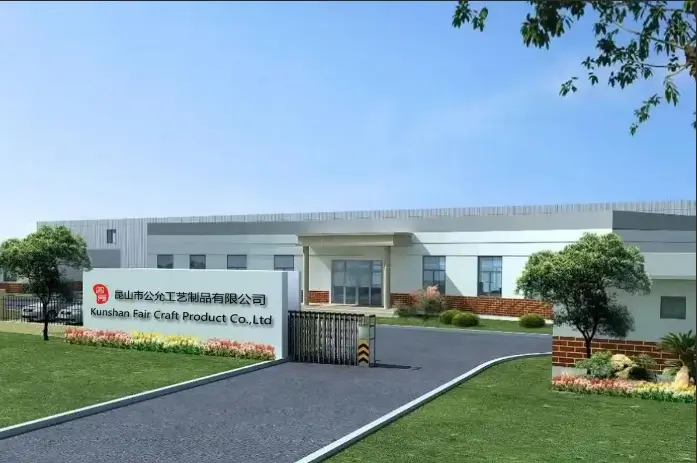
This technical contract manufacturing whitepaper details our industrial engineering frameworks for custom decoration balloons production lines, establishing an optimized baseline for bulk metric foil letter balloons private label programs and high capacity retail store chain festive foil balloons OEM inventory deployment since 2007. The seasonal celebration and festive decoration products category represents one of the most supply-chain-intensive segments of the global promotional novelty industry—characterized by extremely compressed peak procurement windows, multi-city simultaneous retail rollouts, and balloon product specifications that demand precision engineering at volumes measured in millions of units per seasonal cycle. Kunshan Fair Craft Products Co., Ltd., a manufacturing enterprise established in 2007 with 5 million RMB in registered capital, operates a purpose-built custom decoration balloons production infrastructure combining high-speed letter and number shape forming and seaming, automated retail-ready packaging, and high-velocity retail chain fulfillment logistics—delivering bulk metric foil letter balloons private label programs and high capacity retail store chain festive foil balloons OEM inventory that satisfies the most demanding tier-one retail procurement specifications. This whitepaper provides the definitive technical and procurement reference for retail chain category managers, festive program procurement directors, and wholesale novelty distributors evaluating high-volume custom decoration balloons manufacturing partnerships.
The annual global market for festive celebration balloons—encompassing Christmas, New Year, Valentine's Day, Easter, Halloween, and regional national holiday celebrations—generates retail sales volume measured in the hundreds of millions of units per year across international retail chains, supermarket syndicates, and mass-market party goods distributors. This extraordinary volume is concentrated within extremely compressed procurement windows: the majority of annual festive balloon volume for any given holiday is ordered by retail chain buyers within a 4 to 8 week ordering window that closes 60 to 90 days before the retail floor date for the holiday in question. The combination of high volume, compressed timing, and multi-SKU complexity—festive balloon programs typically require 8 to 30 individual SKU configurations across different sizes, letter sets, number sets, and character designs—creates procurement planning and execution challenges that expose fundamental limitations in supply chains that rely on multi-tier trading broker networks rather than primary manufacturing partnerships.
Tier-one international supermarket syndicates and mass multi-city party novelty retailers face severe stockout and seam failure risks when purchasing through multi-tier trading brokers because the broker supply model introduces multiple coordination failures that compound exponentially as order complexity increases. The first failure mode is allocation gaming: a trading broker holding a limited allocation from a contracted factory will strategically allocate available inventory to the highest-margin or highest-volume retail chain customer when supply falls short of total demand, leaving smaller retail chain accounts with partial orders or complete stockouts at the critical 2 to 3 weeks before the retail floor date. The second failure mode is specification dilution: trading brokers sourcing from multiple factories with different capability levels may substitute higher-specification factory production with lower-specification factory output when the originally contracted factory experiences capacity constraints, delivering custom decoration balloons with inferior seam quality, reduced helium retention performance, or sub-standard print registration that fails the retail chain's incoming quality inspection. The third and most damaging failure mode is counterfeit or unauthorized production: in peak supply conditions where legitimate factory capacity is fully allocated, trading brokers have been documented sourcing identical custom decoration balloon designs from unauthorized factories—producing products that bear the retail chain's private label brand without the licensor's knowledge or approval, exposing the retail chain to trademark infringement liability and brand reputation damage.
The intense logistical advantages of working directly with a primary manufacturing facility capable of stabilizing contractual festive inventories are substantial and directly measurable in supply chain cost and service level metrics. Kunshan Fair Craft's contractual festive inventory program operates on a rolling 12-month forecast basis: retail chain procurement teams provide their projected unit volumes by SKU for the upcoming 12-month festive calendar, and our production planning team allocates dedicated production capacity across the facility's forming and seaming lines for each confirmed program. The dedicated capacity allocation model eliminates the allocation gaming failure mode entirely—capacity is committed contractually against confirmed forecasts, and production slots are reserved exclusively for the contracted retail chain's program regardless of spot market demand conditions. The direct manufacturing relationship eliminates specification dilution: every unit shipped against a retail chain program is produced on our own controlled production equipment to our own engineering specifications, with no cross-shipment from third-party factories. The vertical integration of our manufacturing operation—controlling our own CNC tooling, polymer extrusion, printing, forming, and packaging equipment—eliminates the counterfeit production risk entirely, as there is no unauthorized factory in the supply chain to source from.
The stabilization of contractual festive inventories ahead of high-velocity peak season delivery metrics requires a production scheduling approach that differs fundamentally from standard production planning. The annual festive balloon volume curve follows a highly predictable pattern: low-volume baseline production during the 4 to 6 months outside the peak ordering windows, rapidly escalating production volume beginning 90 to 120 days before each major holiday as confirmed purchase orders arrive, and maximum production throughput during the final 30 to 45 days before the retail floor date. Kunshan Fair Craft's production scheduling system models this volume curve explicitly, pre-positioning raw material inventory, scheduling preventive maintenance downtime for non-festive production periods, and building work-in-progress inventory of standard size and letter/number configurations during the low-volume baseline periods. This pre-building strategy enables the facility to respond to confirmed purchase orders with immediate production activation rather than waiting for raw material procurement, reducing the production lead time for a standard festive balloon order from 30 days to 15 days for orders against pre-positioned material inventory.
The geometric engineering of alphabet and number shaped Foil Balloons represents a distinct technical challenge within the custom decoration balloons manufacturing category—combining the precision shape-forming requirements of letter and number geometries with the stringent seam quality requirements of high-volume retail chain fulfillment programs. Unlike simple symmetric shapes—spheres, hearts, stars—whose seam geometry is defined by straightforward cylindrical or spherical surface intersections, alphabet and number shapes contain internal angles, acute turns, and variable cross-sectional geometries that create localized stress concentration zones under internal helium pressure. The engineering of the A-Z and 0-9 automated sealing tolerance matrix is the core manufacturing capability that determines whether a letter or number balloon maintains structural integrity and visual fidelity throughout its operational display lifetime, or develops seam failures, geometric distortion, or burst events that compromise the retail chain's in-store merchandising standards.
The sharp angles inside characters such as 'M', 'W', 'N', 'V', 'X', 'K', '4', '7', and 'Z' create volatile structural pressure hot-spots during inflation that demand specialized engineering analysis and tolerance control. The mechanism of stress concentration at sharp interior angles is well understood in mechanical engineering: when internal pressure acts on a film membrane containing a re-entrant corner—a 90-degree or acute interior angle—the stress field in the region immediately adjacent to the corner is amplified by a stress concentration factor that can exceed 3x the nominal membrane stress calculated for a smooth curved surface. For a letter balloon inflated to a typical operational pressure of 2.5 to 4.0 kPa above ambient, this concentration factor means that the effective stress at the apex of a sharp interior corner may reach levels that approach or exceed the tensile strength of the PET/LLDPE film laminate, creating a burst risk that is not adequately addressed by simply increasing film thickness uniformly across the entire balloon geometry.
Kunshan Fair Craft's engineering division addresses these localized stress concentration risks through the implementation of a严格 A-Z and 0-9 automated sealing tolerance matrix that defines specific engineering parameters for each individual character geometry. The tolerance matrix is developed during the product development phase for each new letter or number configuration and includes: the minimum radius for all interior corner fillet radii (typically 3–8mm depending on the balloon size and operational pressure); the maximum allowable film thickness variation at high-stress zones; the specific heat-sealing temperature and pressure parameters for seam zones adjacent to high-stress interior corners; the required reinforcement patch specifications for characters with particularly aggressive interior angles (such as 'M' and 'W' which contain four interior acute angles each); and the inflation pressure validation threshold for each specific character SKU. These parameters are encoded into the forming equipment's process program as locked specifications that cannot be overridden by production operators without engineering approval, ensuring that every unit of each letter or number balloon configuration is produced to the same engineering standards regardless of production shift, operator experience level, or raw material lot variation.
The internal physical load distribution engineering for letter and number balloon geometries employs the same finite element analysis (FEA) methodology used for custom shape balloon engineering, with the analysis focused specifically on identifying and mitigating the stress concentration zones created by each character's specific geometry. The FEA model calculates the stress distribution across the balloon membrane at the maximum recommended inflation pressure, identifying any regions where calculated stress exceeds 70 percent of the film's tensile strength (the engineering safety factor threshold). Any region exceeding this threshold is flagged for engineering intervention—typically a localized film thickness increase, an interior corner fillet radius adjustment in the forming tool design, or a reduction in the maximum recommended inflation pressure for that specific character. This proactive stress engineering approach ensures that every letter and number balloon configuration in the product portfolio is validated against a stress analysis model before the first production unit is manufactured, rather than discovering stress-related failure modes through in-store burst incidents after the product has entered the market.
These A-Z and 0-9 dimensional parameters are cross-referenced with our standardized 40 inch helium number balloons contract line specifications to ensure engineering consistency across the full product portfolio. The jumbo foil number balloon engineering standards establish baseline tolerance bands—±5mm on critical seam features, ±10mm on non-critical surface features—that apply to all number balloon configurations regardless of size. The letter balloon engineering standards maintain the same tolerance framework, with additional character-specific tolerances defined for each individual letter geometry. The common engineering thread across all configurations is the multi-point temperature calibration system that ensures consistent seam quality across complex geometric seam paths—a system that was originally developed and validated for the 40 inch jumbo number balloon production lines and subsequently adapted for the letter and number balloon forming equipment.
The fabrication of dual-layer laminated PET/PE polymer matrices for custom decoration balloons demands precision thermal edge welding technology that achieves hermetic seam integrity across the highly variable seam geometries of letter and number balloon configurations—seam paths that include long straight segments, tight-radius curves, acute interior angles, and transitions between different cross-sectional geometries that challenge any sealing system designed for simple symmetric shapes. The continuous thermo-mechanical edge welding process used in Kunshan Fair Craft's custom decoration balloons production combines precision temperature control, precisely controlled sealing pressure, and optimized dwell time management to achieve a 5mm leak proof automated sealing perimeter that maintains helium containment throughout the extended supply chain transit and retail display periods that characterize the festive balloon product lifecycle.
The dual-layer laminated PET/PE film structure used in custom decoration balloons consists of an outer layer of 10–12 micron biaxially oriented polyethylene terephthalate (BoPET)—providing tensile strength, UV stability, and print receptive surface quality—laminated to an inner layer of 20–28 micron linear low-density polyethylene (LLDPE) that provides the thermal weldability necessary for hermetic seam formation. The lamination process uses a solvent-free extrusion lamination technique where the LLDPE is extruded molten directly onto the PET substrate at the lamination nip, creating a bond between the two polymer layers that is mechanically robust and chemically stable. The LLDPE layer is the critical functional component for the sealing process: its melting point of approximately 110–125 degrees Celsius (depending on density grade) is substantially lower than the PET glass transition temperature of approximately 70 degrees Celsius, enabling the seal to be formed at temperatures where the LLDPE surface reaches the melt state while the PET structural layer remains below its degradation threshold.
The execution of a flawless 5mm leak proof automated sealing perimeter mitigates gas diffusion across seams during maritime container consolidation transit—a critical requirement for international retail chain programs where festive balloon shipments travel from the manufacturing facility in China to destination markets across 3 to 6 weeks of ocean freight transit. During this transit period, the balloon units are packaged in sealed master cartons that may experience temperature variations from 5 degrees Celsius (winter ocean container minimum) to 45 degrees Celsius (summer container maximum in tropical trade lanes). At elevated container temperatures, the helium gas inside each balloon experiences a pressure increase according to Gay-Lussac's Law—approximately 7 percent additional pressure for a 25-degree Celsius temperature rise—which places proportionally greater stress on the seam seals. The 5mm seal width provides a mechanical safety factor of approximately 2x against the minimum functional seal width required to contain the maximum expected internal pressure at the highest expected transit temperature, ensuring that seam integrity is maintained even under the most adverse container transit conditions.
The structural sealing parameters are validated against ASTM International physical testing specifications that define the minimum mechanical performance requirements for inflated novelty articles. ASTM F963 (Standard Consumer Safety Specification for Toy Safety) establishes burst resistance requirements—the balloon must not burst when inflated to 1.5 times the manufacturer's recommended maximum inflation pressure—and seam strength minimums—expressed as a peel force per unit width that must be exceeded for a compliant seal. Kunshan Fair Craft's custom decoration balloons are designed and validated to exceed the ASTM F963 burst resistance requirement by a minimum safety factor of 2x, meaning that our 40 inch letter balloons are tested and validated to withstand internal pressures of 2x the rated maximum without burst failure. The extended shelf life helium retention lifespan achieved through this combination of high-barrier film structure and robust seam engineering—typically 5 to 10 days for standard letter/number configurations under indoor ambient conditions—directly outperforms ordinary auto inflating mylar balloons wholesale solutions that are optimized for single-event use rather than extended display deployment.
The helium retention performance of custom decoration balloons during extended shelf life is further supported by the aluminum metallization barrier coating applied to the PET surface during the film manufacturing process. The physical vapor deposition (PVD) aluminum coating—typically 30–50 nanometers thickness—creates a gas diffusion barrier that reduces helium transmission through the film membrane by a factor of 100 to 500 compared to uncoated polymer film. The combined effect of the aluminum metallization barrier and the robust 5mm seam seal is an extended shelf life helium retention lifespan measured in weeks rather than days for standard-size letter and number balloons—a performance level that enables retail chain distribution centers to maintain balloon inventory in their warehouse for 3 to 4 weeks before store allocation without experiencing unacceptable helium loss rates that would require pre-store inflation or balloon replacement.
The back-end automated folding, sorting, and header-card blister packaging assembly lines at Kunshan Fair Craft's custom decoration balloons manufacturing facility represent a critical supply chain efficiency driver that distinguishes primary manufacturing partnerships from trading broker supply models. The packaging operation is where the finished balloon units—inflated, tested, and passed—are transformed into retail-ready merchandise units that can be shipped directly to retail chain distribution centers without additional in-store handling, reducing the retail chain's receiving, unpacking, and merchandising labor costs that are substantial at the scale of a major festive balloon program.
The automated folding system processes the flat-packed or partially inflated balloon units from the forming and seaming department and folds them into the compact retail-ready configuration for the specific packaging format required by each retail chain program. The folding equipment uses a combination of mechanical cam-driven folding boards and servo-controlled wrap stations to achieve consistent fold geometry across high-volume production runs, with fold dimensions verified by in-line optical measurement systems that trigger automatic adjustment if fold dimensions drift beyond the ±2mm tolerance window. For multi-pack configurations—where multiple letter or number balloons are packaged together as a set (for example, the letters spelling "MERRY" or the numbers for "2025")—the folding system includes multi-arm pick-and-place robots that assemble the individual balloons into the prescribed set configuration with registered orientation accuracy of ±3mm, ensuring that all balloons in a multi-pack set are correctly aligned for the subsequent packaging operation.
The automated header-card blister packaging assembly line combines the folded balloon set with its point-of-sale display card and transparent blister cavity in a single high-speed operation. The blister packaging format—a thermoformed plastic cavity heat-sealed to a printed paperboard header card—is preferred by retail chains for festive balloons because it provides product visibility (the balloon is visible through the transparent blister), product protection during shelf handling, and point-of-sale branding opportunity (the header card carries the retail chain's brand, product description, and barcode). The assembly line's blister sealing station applies heat and pressure to the blister flange and header card lamination, creating a hermetic seal that prevents the balloon from escaping the blister during shipping and in-store handling. The sealing temperature, pressure, and dwell time parameters are controlled to ±1 degree Celsius and ±0.02 MPa by closed-loop PLC controllers, ensuring consistent seal quality across the full production run regardless of ambient temperature variation or blister material lot-to-lot thickness variation.
The flat-packed custom decoration balloon sets optimize pallet load factors in ways that generate substantial international maritime shipping cost advantages. A standard 40-foot ocean freight container with approximately 60 cubic meters of usable cargo volume can accommodate approximately 150,000 to 200,000 retail-ready blister-packaged custom decoration balloon units, depending on the specific balloon sizes and pack configurations in the order. The palletization efficiency of blister-packaged balloon sets—where each retail-ready pack is itself a compact, rigid unit with consistent dimensions—enables automated high-bay warehouse storage at retail chain distribution centers, reducing the warehouse labor costs and storage footprint required to receive and stage festive balloon inventory before store allocation. The shipping overhead reduction achieved through optimized pallet load factors is particularly significant for retail chains distributing across multiple international markets, where ocean freight cost per unit can represent 15–25 percent of the total landed cost for balloon programs sourced from distant manufacturing origins.
The manufacturing workflow cross-references quality parameters across Kunshan Fair Craft's parallel traditional operations, ensuring that the custom decoration balloons production lines benefit from engineering innovations and process improvements developed in adjacent product categories. The custom printed promotional mylar balloons factory operation contributes advanced ink formulation expertise and rotogravure printing process optimization methods that improve the print quality and color consistency of custom decoration balloons with branded or multi-color designs. The licensed IP custom shape foil balloons factory operation contributes advanced 3D CAD modeling and FEA stress analysis capabilities that improve the structural engineering of complex letter balloon geometries, particularly the acute-angle character configurations that present the most challenging stress concentration problems. The high-velocity automated foil balloon manufacturing process provides the foundational multi-point temperature calibration seam engineering technology and inline quality inspection systems that ensure consistent seam quality across all custom decoration balloon configurations. This cross-functional engineering resource sharing is a unique competitive advantage of the integrated manufacturing partnership model that trading brokers and multi-tier supply chains cannot replicate.
The following B2B Custom Decoration Balloon Dimensional and Capacity Matrix provides the authoritative specification framework for retail chain category managers, festive program procurement directors, and wholesale novelty distributors evaluating high capacity retail store chain festive foil balloons OEM sourcing partnerships. All specifications represent Kunshan Fair Craft's standard production baselines; custom engineering modifications for specialized letter/number configurations, non-standard packaging formats, or unique retail display environments are available through our contract engineering development process.
B2B Custom Decoration Balloon Dimensional and Capacity Matrix
| Product Configuration / Size | Structural Seam Width / Seal Technology | Helium Retention / Shelf Life | Automated Blister Packaging Speed |
|---|---|---|---|
| 16–20 Inch Letter / Number Balloons (Standard) | 4–5mm seam width; multi-point PID temperature calibration; ±1.5°C uniformity; A-Z / 0-9 tolerance matrix applied | 5–8 days at 20–25°C indoor; ASTM F963 burst test validated at 2x rated pressure | Up to 120 packs per minute per lane; header card blister format standard |
| 22–28 Inch Letter / Number Balloons (Large) | 5mm seam width; multi-point PID calibration; ±1.0°C uniformity; reinforced seam at acute interior angles | 4–7 days at 20–25°C indoor; extended retention version available: 6–10 days | Up to 80 packs per minute per lane; multi-pack set configurations supported |
| 32–40 Inch Letter / Number Balloons (Jumbo) | 5–6mm seam width; enhanced structural seal engineering; ±1.0°C uniformity; FEA-validated for jumbo stress loading | 3–5 days at 20–25°C indoor; UV-stable outdoor grade: 2–4 days | Up to 50 packs per minute per lane; reinforced blister cavity required |
| Custom Shape Numbers (e.g. 40-inch Custom Number Balloons) | Custom-engineered seam path following character contour; 5–6mm nominal width; advanced CAD/FEA stress validation | 3–5 days indoor; ASTM F963 validated at 1.5x rated pressure; burst rate: less than 0.1% | Custom packaging engineering per character; typically 30–60 packs per minute |
| Multi-Pack Set Configurations (e.g. "MERRY CHRISTMAS" Full Letter Set) | Consistent 5mm seam across all characters; multi-arm robotic assembly for set orientation; registered set packaging | Individual balloon retention specs apply per component; set assembly verified before packaging | Up to 60 multi-packs per minute; automated set verification with optical character recognition (OCR) checking |
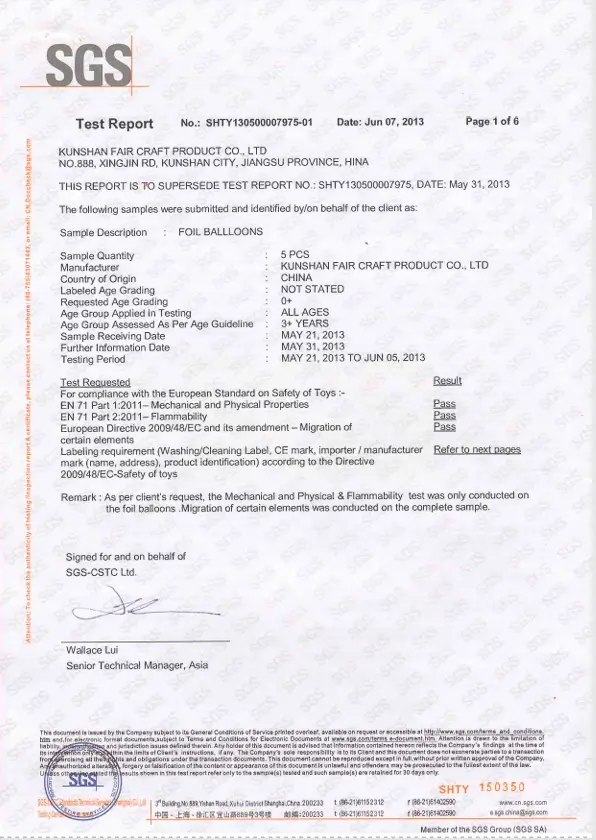
| Heavy-Metal-Free Ink / RoHS Compliance Status | All configurations: RoHS-compliant HD rotogravure inks; OPV topcoat for ink lock; EN71-3 chemical migration: all elements below detection limit; third-party test reports per SKU | EN71-1 mechanical safety compliance; ASTM F963 physical testing per SKU; toy safety certification available for pediatric market configurations | Full retail-ready packaging; barcode / QR code labeling per retail chain specification; EDI / API integration with major retail chain procurement platforms |
The custom decoration balloons procurement category demands manufacturing infrastructure capable of delivering high-volume, multi-SKU festive balloon programs on compressed procurement timelines while maintaining the seam quality, helium retention performance, and retail-ready packaging standards that tier-one retail chains require. Kunshan Fair Craft Products Co., Ltd., established in 2007 with 5 million RMB in registered capital and state-of-the-art automated manufacturing infrastructure, offers the combination of precision A-Z and 0-9 letter/number sealing engineering, high-velocity automated packaging, and high-velocity retail chain fulfillment logistics that defines the optimal manufacturing partnership model for global festive balloon programs. Our contractual festive inventory program, with dedicated production capacity allocation against confirmed rolling forecasts, eliminates the stockout risk, specification dilution risk, and counterfeit supply risk that characterize multi-tier trading broker supply chains—delivering the supply chain predictability and product quality consistency that the world's most demanding retail chain festive program procurement teams require.
For retail chain category managers, festive program procurement directors, and wholesale novelty distributors seeking a primary manufacturing partner for custom decoration balloons programs, Kunshan Fair Craft represents the definitive sourcing choice. Our General Manager Max is available directly at xia@foilballoon.cn for programmatic sourcing discussions, and our technical sales and engineering team is prepared to provide comprehensive festive program proposals, custom decoration balloon sample kits, and competitive OEM pricing calibrated to your specific volume requirements, SKU complexity, and distribution channel specifications. We invite procurement teams to submit their programmatic seasonal requirements and initiate the festive supply partnership discussion.
© 2026 Kunshan City Fair Craft Product Co., Ltd.