Custom Logo & Printed Artwork
Add company logos, brand graphics, campaign artwork, or promotional messages. Artwork placement and print details are reviewed against the selected balloon format to maintain visual clarity after inflation.
Source custom Mylar balloons directly from FAIR. We work with global importers, brand owners, and promotional businesses to develop custom printed Mylar balloons, proprietary shapes, and retail-ready private-label collections.
From artwork review and material selection to printing, product configuration, and packaging coordination, each project is reviewed according to its specific B2B requirements.
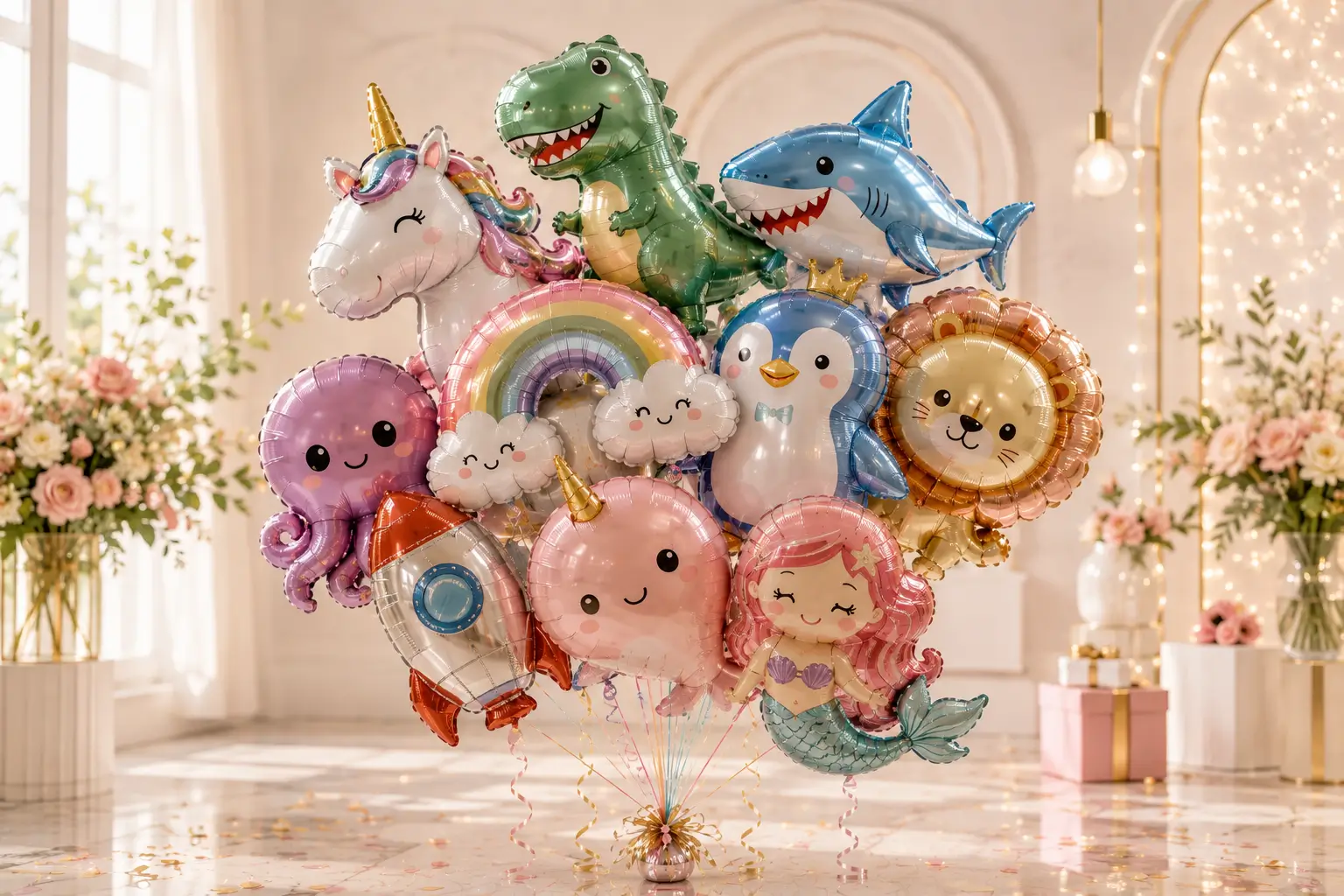
Custom Mylar balloons are developed around the buyer's product, branding and market requirements. For B2B projects, the critical decisions involve printed artwork, balloon dimensions, film construction and packaging rather than simply choosing a standard design.
Add company logos, brand graphics, campaign artwork, or promotional messages. Artwork placement and print details are reviewed against the selected balloon format to maintain visual clarity after inflation.
Develop product dimensions and proportions around the intended application. The finished size, balloon format, and available construction options are reviewed during product development.
Review suitable laminated film combinations, such as PET+PE or PA+PE, along with thickness, surface appearance, and construction requirements. The specification depends on the balloon design, performance requirements, and project cost considerations.
Discuss packaging presentation, printed product information, branding, and market-specific labeling as part of an OEM project. Final packaging details are confirmed according to the order scope.
Custom printed Mylar balloons help brands turn an existing balloon format into a branded product for promotions, events, and retail collections. Artwork should be reviewed together with the balloon's shape, print area, and inflated profile.
A graphic that looks correct on a flat screen may need adjustment before it is reproduced on an inflated balloon. FAIR's rotogravure printing capability supports custom printed designs, while artwork and product specifications should be reviewed together before production requirements are finalized.
Buyers can begin with an existing logo, campaign graphic, illustration, or an early product concept.
Editable vector files (AI, EPS, or PDF) are preferred because they make it easier to review outlines, text, and graphic details. High-resolution raster artwork can also be submitted for an initial assessment. Final artwork preparation and file requirements depend on the printing and prepress process.
The print layout should account for seams, balloon shape, and the inflation profile. Text near the seam, fine details in narrow sections, and logo elements close to the balloon edge may be affected by the finished shape. FAIR reviews the print layout against the intended balloon format.
Metallic films and printed surfaces can influence how colors appear. Buyers should provide Pantone references or brand color samples when color consistency is critical. The achievable appearance and approval method are reviewed against the selected design.
Artwork, dimensions, material construction, and project requirements should be reviewed together before production. Sample and approval arrangements are confirmed for each individual project.
The terms “Mylar balloon” and “foil balloon” are commonly used in the balloon trade to describe similar shiny film balloon products. However, the market name alone does not define the exact film construction.
Traditional foil balloons are made from flexible laminated film constructions. Different film combinations and thicknesses can affect appearance, forming, sealing, and gas retention. There is no single material specification that fits every custom balloon. The appropriate construction depends on the product dimensions, shape, intended inflation method, performance requirements, and project cost considerations.
| Project Consideration | What Needs to Be Reviewed |
|---|---|
| Film Structure | Suitable laminated film combinations, such as PET+PE or PA+PE, depending on the balloon design, performance requirements, and project cost considerations. |
| Balloon Shape | Outline complexity, narrow sections, corners, and the overall inflated profile. |
| Dimensions | Finished size, proportions, and how the design behaves when inflated. |
| Inflation Method | Whether the design is intended for helium or air filling, and the applicable valve configuration. |
| Application | Indoor display, promotional use, retail presentation, or another defined use environment. |
Buyers comparing traditional foil balloons with latex products may also find our Mylar vs. latex balloon comparison useful when planning a product range.
A clear development process helps reduce avoidable artwork changes and specification misunderstandings. The exact workflow depends on whether the project uses an existing balloon format or requires new product development.
Provide artwork, reference images, target dimensions, intended application, and estimated project requirements.
Review the product format, print area, material options, inflation requirements, and any tooling considerations.
Align on product details, artwork, sample or approval requirements, packaging, and quotation scope.
Proceed according to the approved product specification and the production schedule confirmed for the order.
A manufacturing partner should be able to discuss more than unit price. For custom projects, buyers need to understand how artwork, tooling, materials, production requirements, and inspection expectations fit together.
Kunshan Fair Craft Products Co., Ltd. (FAIR) was established in 2007 and is based in Kunshan, Jiangsu, China. Its manufacturing capabilities include custom balloon tooling, CAD/CNC mold development, rotogravure printing, film processing, balloon forming and assembly, quality inspection, and export coordination.
Quality expectations should be tied to the approved product specification. Shape, dimensions, print appearance, sealing, valve configuration, and packaging requirements need to be considered for the actual order. The appropriate valve design and placement depend on the balloon format and intended inflation method and should be confirmed during product development.
FAIR has testing documentation for selected balloon products and samples. Applicable RoHS and EN71 documentation can be discussed according to the specific product, sample, and destination-market requirements. Report scope should always be checked against the relevant product specification.
Learn more about Kunshan Fair Craft Products Co., Ltd. and its manufacturing structure on the FAIR company profile .
The more clearly a project is described at the beginning, the easier it is to review feasibility and prepare a relevant quotation. You do not need a finished technical drawing to start a discussion.
Sample arrangements, tooling requirements, pricing, and production lead time depend on the design, materials, printing requirements, and current production schedule. These details are confirmed after the project has been reviewed.
Answers to common questions from buyers developing custom foil balloon products, printed designs, and OEM collections.
Yes. Custom printed Mylar balloon designs can be developed using your company logo, campaign artwork, or other original graphics. The artwork and print layout need to be reviewed against the selected balloon format before the production specification is confirmed.
Custom printed balloons use customized graphics on a selected balloon format. Custom-shaped balloons require the balloon outline itself to be developed around the design, which may involve new tooling. A project can combine both requirements, but they involve different production considerations.
Editable vector files (AI, EPS, or PDF) are preferred because they make it easier to review outlines, text, and graphic details. High-resolution raster artwork can also be submitted for an initial assessment. Final artwork preparation and file requirements depend on the printing and prepress process.
Custom-printed projects commonly start from around 10,000 pieces. The final MOQ depends on the balloon format, dimensions, artwork and printing requirements, and packaging scope. FAIR confirms the applicable quantity in the project quotation.
Custom shapes can be reviewed for OEM and ODM development. Share a reference image, drawing, or vector outline so the proposed shape can be assessed for tooling, construction, sealing, and inflation considerations. For shape-focused projects, see our custom-shaped foil balloon page .
Sample requirements can be discussed during project review. The sample type, development arrangement, cost, and timing depend on whether the project uses an existing format or requires new tooling and custom artwork preparation.
Production timing depends on design approval, tooling, material preparation, printing requirements, order quantity, and the production schedule. A project-specific timeline is confirmed after the specifications and order details have been reviewed.
Some foil balloon designs are intended for helium inflation, while others are designed for air-filled display. Suitability depends on the finished shape, dimensions, construction, valve configuration, and required lift. Confirm the intended inflation method during product development.
Private-label requirements can be discussed as part of an OEM project. Buyers should provide their packaging artwork, branding guidelines, and destination-market requirements so the appropriate product and packaging specifications can be reviewed.
Send your artwork or reference image, approximate dimensions, preferred balloon format, print requirements, estimated quantity, packaging details, and delivery destination. If some details are not ready, an initial concept is still useful for starting the discussion.
Whether you have finished artwork or only an early product concept, send FAIR your reference design and project requirements. Our team can review the proposed printing, material, product configuration, and manufacturing details and discuss the next practical steps.
Contact FAIR About Your Project