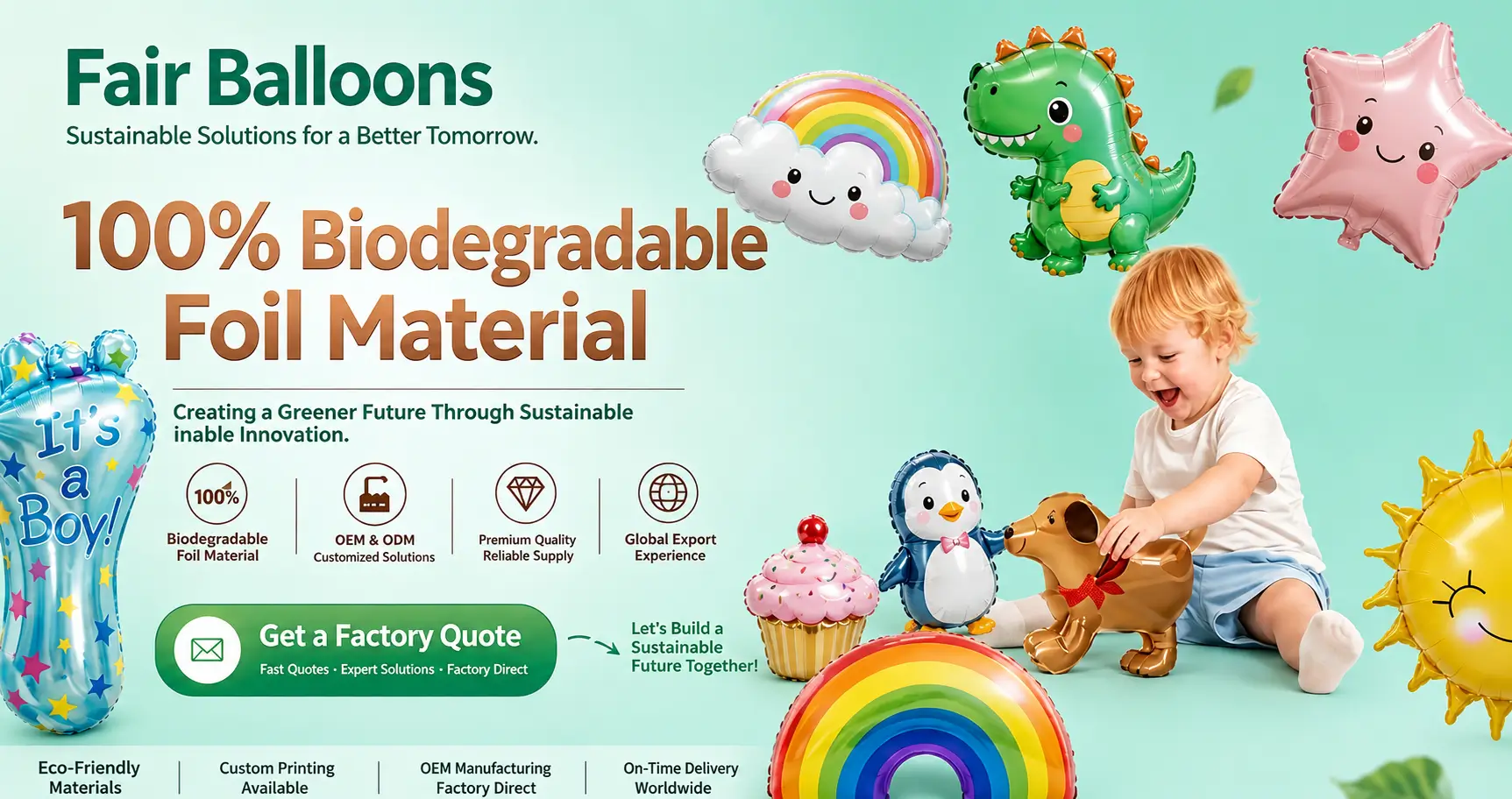
Traditional foil and Mylar balloons are made from a multi-layer polymer film that is difficult to recycle. That material profile is now the subject of plastic packaging taxes and Extended Producer Responsibility (EPR) levies in several markets. For a distributor or brand importer, the question is not only the unit price of the balloon but the total landed cost, which now includes packaging tax exposure. This briefing covers the main regulatory mechanisms, the cost comparison between a legacy BOPET film and a compostable PLA-PBAT film, and the production controls that affect total cost of ownership.
For Brand Owners
How EPR and plastic packaging taxes apply to a foil balloon program, what documentation a retail buyer will request, and how the material choice affects shelf access.
For Procurement Teams
Film and barrier structure behind the compostable line, the test reports we hold, and how shipping and storage affect a compostable program.
1. The Cost Structure of Legacy Polymers
Bulk importing of traditional Mylar balloons and metallized foil balloons has been a stable category for party distributors, supermarkets, and event agencies. The material properties of legacy biaxially-oriented polyethylene terephthalate (BOPET) and Nylon barrier layers gave long shelf life and predictable helium retention. That cost model is now changing under plastic packaging taxes and EPR programs.
The reason comes down to material composition. Traditional foil balloons are made by bonding petroleum-derived plastic films with a vapor-metallized aluminum layer. This multi-layer construction is difficult to recycle, so the material ends up in landfill or in the environment. Because the material does not decompose the way organic material does, several governments have introduced plastic taxes and disposal fees on the importers of these products.
For a distributor, importing conventional plastic-based balloons now carries a tax exposure in addition to the unit price. A compostable alternative can change that exposure. The classification and fee for a given product are confirmed at quotation stage against the applicable program rules.
Retail buyers are auditing supplier material profiles more closely than in past years. Under recently enacted packaging laws, placing non-compostable foil balloons on shelf can expose the brand owner to EPR compliance taxes and, depending on the market, to recall risk. The applicable classification for a given SKU is confirmed at quotation stage.
2. The EPR and Plastic Tax Matrix
EPR laws shift cleanup costs from municipalities to importers. The importer pays a levy based on the weight of non-recyclable plastic it places on the market. The table below compares how the main programs apply to a legacy petroleum polymer versus a compostable film. The figures quoted are as of publication and are subject to change.
| Jurisdiction | Program | Legacy BOPET Position | Compostable Film Position |
|---|---|---|---|
| United Kingdom | Plastic Packaging Tax (PPT) | Taxed at the applicable rate for the current period | May qualify for a different classification; confirmed at quotation stage |
| European Union | Single-Use Plastics Directive (SUPD) | EPR levy on non-recycled plastic | May qualify for a different classification; confirmed at quotation stage |
| California, USA | SB 54 Producer Responsibility Act | Source reduction targets and eco-modulated EPR fee class | May qualify for a more favorable class; confirmed at quotation stage |
Plastic Packaging Tax Exposure: Illustrative Example
For a program importing several hundred thousand standard 18-inch legacy BOPET foil balloons, the packaging tax exposure in a single market can run into four figures per year at the current UK PPT rate. Switching to a compostable film changes the classification, which can reduce that exposure. The actual figure for a given program is confirmed at quotation stage against the current HMRC guidance and the applicable EPR program rules.
3. Material Economics: Compostable PLA-PBAT Film
When procurement directors evaluate a sustainable alternative, the first question is whether it matches the retention performance of the traditional film. Earlier biodegradable films did not hold helium well. Our co-extruded PLA-PBAT-nanoclay film is designed to address that.
The barrier mechanism is the nanoclay dispersion in the core layer. The clay platelets force helium molecules to travel a longer, less direct route through the film, which slows gas migration. That is what allows the compostable line to reach a commercial retention window rather than a short one. The retention window for a given design is confirmed at quotation stage.
Barrier mechanism
The nanoclay platelets are dispersed in the PLA-PBAT matrix in a parallel arrangement. Helium atoms have to navigate a longer, less direct route through the film. That reduces the effective diffusion coefficient and slows gas loss.
Retention window
The compostable line reaches a commercial retention window that supports a typical event program. The retention window for a given SKU is confirmed at quotation stage against the applicable film grade and valve configuration.
Total landed cost
The bio-polymer resin carries a raw material premium. That premium can be offset, in part, by the packaging tax classification and by shelf access in markets where the retailer requires a documented material profile. The net effect for a given program is confirmed at quotation stage.
4. Compliance and Test Reports
Sustainability claims require independent laboratory verification to pass a customs or retail audit. Importers should confirm the reports a supplier holds before committing to a program.
RoHS (EU) 2015/863
Covered under SGS report SHAHG2207652301. The report documents restriction testing for lead, cadmium, mercury, hexavalent chromium, PBBs, and certain phthalate plasticizers. Coverage of a specific SKU is confirmed at quotation stage. See our RoHS coverage page.
Compostability (ISO 14855-1:2012)
Covered under SGS report SHMR220700361301. The report covers a PLA degrading balloon sample tested under controlled industrial composting conditions. Test material average biodegradation was 77.8% within a 45-day test period. ISO 14855-1:2012 is the standard we hold; it is distinct from EN 13432. See our SGS report coverage page.
Certifications and test reports we do NOT hold:
- ISO 9001 — not held
- EN 13432 — not held. The report we hold for the biodegradable line is ISO 14855-1:2012, which is a distinct standard.
- ASTM D6400 — not held
- ASTM F963 — not held
- REACH — not held
- US CPSIA — not held
- California Prop 65 — not held
5. Supply Chain Controls and Sourcing Notes
At Kunshan Fair Craft Products Co., Ltd. (FAIR), we work on the film and valve design that determines how a balloon performs on a program. Three production factors matter most for a compliant balloon program.
Batch Pressure Inspection
Samples from each finished batch are held under pressure for a controlled inspection window before packing. Units that show a pressure drop are isolated. The inspection window and pass criteria for a given order are confirmed at quotation stage.
Ink and Pigment Control
Water-based pigment systems and film grade used on a given run are matched against the specification sheet. Reports available on request.
Moisture-Protected Freight
Compostable film has hydrolytic sensitivity, so bulk shipments are packed with moisture-barrier materials and desiccant. Packing configuration for a given order is confirmed at quotation stage.
FAIR is a member of the Pro Environment Balloon Alliance and supports the alliance's code of conduct. For company background and production capability, see our About FAIR page.
6. Regulatory and Scientific References
- European Committee for Standardization (CEN). EN 13432: Requirements for packaging recoverable through composting and biodegradation.
- International Organization for Standardization. ISO 14855-1:2012: Determination of the ultimate aerobic biodegradability of plastic materials under controlled composting conditions.
- SGS Laboratory Services. Test Report SHMR220700361301: Evaluation of Industrial Aerobic Biodegradability and Compost Quality of PLA-PBAT Co-extruded Films.
- SGS Environmental Testing Group. Test Report SHAHG2207652301: Heavy Metal and Phthalate Restriction Verification (RoHS Compliance Audit).
- California State Assembly. Senate Bill No. 54 (SB 54): Plastic Pollution Prevention and Packaging Producer Responsibility Act.
- Pro Environment Balloon Alliance (PEBA). Standard Member Guidelines and Global Sourcing Code of Conduct.
7. Sourcing and Tax FAQ
Requesting a landed cost estimate, test report copies, or a quotation for a compostable balloon program?
Email xia@foilballoon.cnResponse within one business day · Sample service available
About FAIR — Kunshan Fair Craft Products Co., Ltd.
FAIR is a balloon manufacturer based in Kunshan, China, producing foil balloons, custom shaped foil balloons, PLA-based biodegradable foil balloons, and custom printed balloon products for global brands, event companies, retail chains, and wholesale novelty distributors. For inquiries: xia@foilballoon.cn