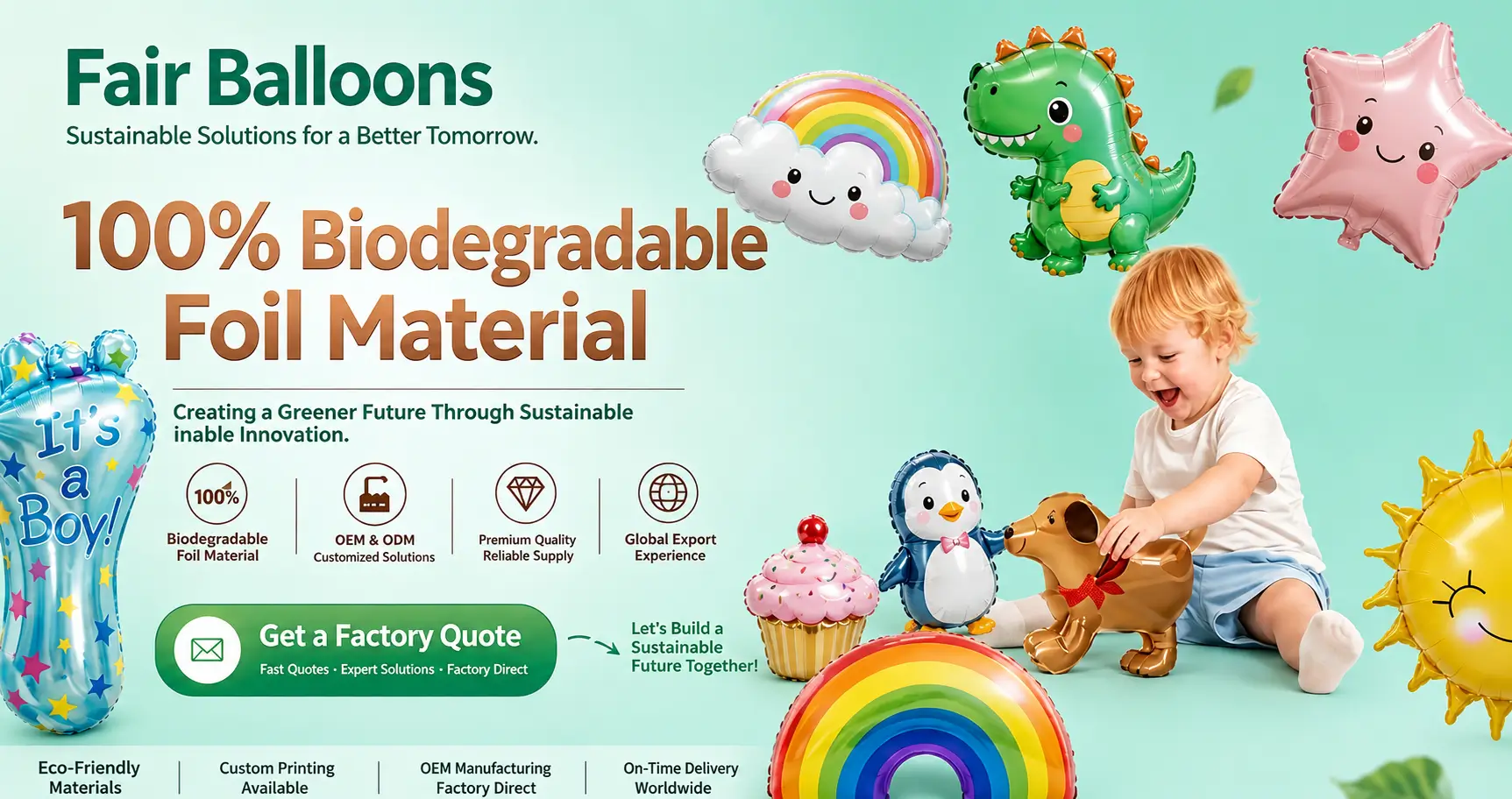
Biodegradable foil balloons do exist, under specific test conditions. Our PLA-PBAT compostable foil balloon line is tested under SGS ISO 14855-1:2012, report number SHMR220700361301, showing 77.8% biodegradation in 45 days under controlled industrial composting conditions. This is a measurement report, not a certification scheme — we do not hold EN 13432 or ASTM D6400.
Most commercial latex and Mylar balloons are not biodegradable in the scientific sense. The three-material comparison below explains why, and where the difference comes from.
This briefing compares the degradation behavior of three balloon materials: vulcanized natural latex, a metallized BOPET film (commonly called Mylar), and our compostable PLA-PBAT film. The standards we hold for the compostable line are EN71 (SGS report SHTY130500007975-01), RoHS (EU) 2015/863 (SGS report SHAHG2207652301), and ISO 14855-1:2012 (SGS report SHMR220700361301). We do not hold ASTM D6400, BPI, EN 13432, ISO 9001, ASTM F963, REACH, US CPSIA, or California Prop 65 documentation. For a program that requires one of those, tell us up front and we will confirm whether it can be arranged.
For Brand Owners
Why a "biodegradable" claim has to match a test report, what happens to each material in a managed waste stream, and what language a retail program should use.
For Procurement Teams
The polymer chemistry behind each material, the barrier engineering behind the compostable line, and the standards we hold.
1. Why a Biodegradability Claim Has to Match a Test Report
Biodegradable foil balloons are a real product category, not a marketing claim. But most suppliers cannot back the claim with a test report. This briefing compares three materials — vulcanized natural latex, a traditional metallized Mylar film, and a compostable PLA-PBAT film — and shows where the difference comes from.
The consumer goods supply chain is under more scrutiny on environmental claims. The EU Green Claims Directive, once in force, will require third-party verification for a range of environmental marketing claims. A "degradable", "eco-friendly", or "green" descriptor without independent substantiation is a greenwashing risk. For a procurement team, a supplier declaration is not enough on its own.
The specific report we hold for the compostable line is ISO 14855-1:2012 under SGS report number SHMR220700361301. The report covers a PLA degrading balloon sample tested under controlled industrial composting conditions. Test material average biodegradation was 77.8% within a 45-day test period. ISO 14855-1:2012 is a distinct standard from EN 13432.
Under the EU Green Claims Directive, a self-issued factory claim is not acceptable evidence. Enforcement authorities will expect documentation from an accredited laboratory. SGS reports are one form of evidence that meets that threshold. A supplier's verbal or written assurance without the underlying report is a compliance risk for the importer of record.
2. Vulcanized Latex: Why Commercial Latex Is Not Fully Biodegradable
Sulfur cross-linking
A commercial latex balloon is a vulcanized rubber product. Vulcanization introduces sulfur cross-links between natural rubber polymer chains and forms a three-dimensional network. That network is what gives the balloon its tensile strength and elastic recovery, and it is also what makes the material resistant to rapid biological breakdown. A microbial enzyme has to be able to reach and cleave a specific bond. The cross-link network reduces chain mobility and isolates large chain segments from enzyme access.
Several studies have measured the degradation rate of vulcanized natural rubber under composting conditions. The rate is much slower than cellulose or a compostable biopolymer under the same conditions. A buyer should ask a latex supplier for the underlying study and the test conditions before accepting a "biodegradable" claim for a latex balloon.
Additives and residue
A commercial latex formulation is not pure rubber. It typically includes sulfur as a vulcanization agent, zinc oxide as an activator, stearic acid as a processing aid, an antioxidant, and a filler such as calcium carbonate. These additives do not disappear when the balloon reaches the end of its service life. Zinc oxide is a heavy metal compound and can accumulate in soil. Sulfur and vulcanization byproducts can transform into hydrogen sulfide under anaerobic conditions. Both the EU RoHS Directive and the REACH Regulation set limits on some of these substances, which is relevant for an EU program.
Composting conditions
A claim about latex degradation usually cites industrial composting conditions. An industrial facility holds a thermophilic range through forced aeration and co-mingling with other organic waste. A home compost bin does not reach that range. In a dry, anaerobic landfill, the rate of sulfur cross-link scission is very low. A latex balloon in that environment can remain structurally intact for a long period.
3. Traditional Mylar Balloons: A Non-Recyclable Composite
Film structure
A conventional Mylar balloon uses a biaxially-oriented polyethylene terephthalate (BOPET) film with a vacuum-deposited aluminum layer. The aluminum gives the mirror finish and acts as the helium barrier. The bond between the BOPET substrate and the aluminum layer is not a simple physical adhesion; a plasma surface treatment introduces functional groups that form a chemical bond at the interface. That bond is why no common mechanical recycling process can separate the aluminum from the PET substrate cleanly. Standard Mylar film in a PET recycling stream introduces aluminum contamination and degrades the recovered material. That is why the material is not accepted in most municipal recycling programs.
Photo-oxidative degradation
In the open environment, UV exposure breaks ester bonds in the BOPET chain. Molecular weight drops, the film becomes brittle, and mechanical forces fracture it into small particles. Those particles have a high specific surface area and can adsorb persistent organic pollutants from water. The film thickness of a Mylar balloon is small compared to a rigid plastic, so it reaches the micron-scale particle range faster than a thicker product would.
Additive-based "degradable" films
Some suppliers market a "degradable" film that is a polyethylene or polypropylene base with a small loading of starch or a photo-initiator. The material does become brittle and fragment faster in an open environment. The polymer chains retain their chemical structure and do not mineralize under anaerobic conditions. The material persists as microplastics. The European Chemicals Agency has raised concerns about this approach, and amendments to the EU Packaging and Packaging Waste Directive exclude additive-based degradation promoters from a compostable classification. The US FTC Green Guides take a similar position: a material with a degradation promoter that cannot be shown to reach complete degradation under controlled composting conditions cannot use a "biodegradable" label. See our compostable vs latex comparison for the material background.
4. The Compostable PLA-PBAT Film: What It Is and What It Does
Film composition
Polylactic acid (PLA) is derived from renewable plant feedstock such as corn starch or sugarcane. Its ester bonds are a substrate for microbial lipases and esterases, which is why PLA can be designed to degrade in a managed composting environment. On its own, PLA is brittle and has a narrow processing window for a balloon film.
Polybutylene adipate terephthalate (PBAT) is a copolyester with a low glass transition temperature and high flexibility. Blending PBAT with PLA gives the film the flexibility a balloon needs, and its amorphous domains provide enzyme access sites. PBAT on its own does not have the barrier a helium-filled balloon needs.
Our production line uses a ternary blend of PLA, PBAT, and a compatibilizer, with a co-extruded layer structure. The blend ratio and layer thickness for a given film grade are confirmed at quotation stage.
Hydrolytic degradation in a managed environment
Under industrial composting conditions, the film degrades in three stages. First, moisture and elevated temperature drive hydrolysis of the ester bonds at the amorphous regions, which lowers molecular weight and roughens the surface. Second, extracellular enzymes from thermophilic microorganisms cleave the remaining ester bonds and depolymerize the film into monomers and oligomers. Third, the monomer products are metabolized by microorganisms into carbon dioxide, water, and biomass. The specific report we hold is ISO 14855-1:2012 under SGS report number SHMR220700361301. Test material average biodegradation was 77.8% within a 45-day test period.
Test Reports We Hold for the Compostable Line
- EN71 — SGS report number SHTY130500007975-01. Coverage: foil balloon sample, EN71 Parts 1, 2, and 3. Coverage of a specific SKU is confirmed at quotation stage.
- RoHS (EU) 2015/863 — SGS report number SHAHG2207652301. Coverage: tested DEGRADING BALLOON sample. The report documents restriction testing for lead, cadmium, mercury, hexavalent chromium, PBBs, and certain phthalate plasticizers.
- Biodegradation (ISO 14855-1:2012) — SGS report number SHMR220700361301. Coverage: PLA degrading balloon sample under controlled industrial composting conditions. Test material average biodegradation 77.8% within a 45-day test period.
- PEBA member — Pro Environment Balloon Alliance member. See our PEBA compliance guide.
5. Barrier Engineering for Helium Retention
The retention window of a foil balloon comes down to the helium transmission rate of the film. A helium atom can migrate through a polymer film over time. A film with a lower transmission rate holds gas longer. That is the difference between a film that holds gas for a few days and one that does not.
A conventional metallized BOPET film has a low helium transmission rate, which is why a Mylar balloon holds gas for a longer window. An unmodified biodegradable film has a higher transmission rate, which is why an early biodegradable balloon lost helium within a short window. That was a performance problem for a commercial event program.
Our film uses two technical controls to reduce the transmission rate. The first is a graded co-extrusion structure: the core layer has a higher PLA content, which provides a denser molecular packing and a better barrier, and the surface layers have a higher PBAT content, which provides heat-seal performance and enzyme access. The second is a mineral filler dispersion, which extends the diffusion path for a helium molecule through the film. The specific helium transmission rate and retention window for a given SKU are confirmed at quotation stage.
Samples from each finished batch are held under pressure for a controlled inspection window before packing. Units that show a pressure drop are isolated. The inspection window and pass criteria for a given order are confirmed at quotation stage against the buyer's QC profile.
6. Material Comparison Matrix
The matrix below summarizes the parameters a procurement team should compare. The specification for a given order is confirmed at quotation stage.
| Parameter | Vulcanized Natural Latex | Traditional Mylar (BOPET + Al) | Compostable PLA-PBAT (FAIR) |
|---|---|---|---|
| Structure | Sulfur cross-linked network | Aluminum on BOPET substrate | PLA-PBAT co-extruded film with nanoclay barrier |
| Degradation mechanism | Microbial and photo-oxidative; slower than cellulose | Photo-oxidative fragmentation; not biodegradable | Hydrolytic and enzymatic degradation under managed composting |
| Compostability report coverage | Not covered | Not covered | Covered under ISO 14855-1:2012 (SGS SHMR220700361301); SKU coverage confirmed at quotation stage |
| Chemical restriction coverage | Vulcanization additives vary by supplier | Material profile varies by supplier | RoHS (EU) 2015/863 coverage under SGS SHAHG2207652301; SKU coverage confirmed at quotation stage |
| Retention window | Shorter window | Longer window; confirmed at quotation stage | Confirmed at quotation stage |
| Regulatory position | Restricted in some markets | Higher fee class under some EPR programs | May qualify for a different classification; confirmed at quotation stage |
7. Material Science FAQ
8. Test Reports: What We Have and What We Do Not
Test reports we hold:
- EN71 — SGS report number SHTY130500007975-01. Coverage: foil balloon sample, EN71 Parts 1, 2, and 3. Coverage of a specific SKU is confirmed at quotation stage.
- RoHS (EU) 2015/863 — SGS report number SHAHG2207652301. Coverage: tested DEGRADING BALLOON sample. Coverage of a specific SKU is confirmed at quotation stage.
- Biodegradation (ISO 14855-1:2012) — SGS report number SHMR220700361301. Coverage: PLA degrading balloon sample under controlled industrial composting conditions. Test material average biodegradation 77.8% within a 45-day test period.
- PEBA member — Pro Environment Balloon Alliance member.
Certifications and test reports we do NOT hold:
- ISO 9001 — not held
- EN 13432 — not held. The report we hold for the biodegradable line is ISO 14855-1:2012, which is a distinct standard.
- ASTM D6400 — not held
- BPI — not held
- ASTM F963 — not held
- REACH — not held
- US CPSIA — not held
- California Prop 65 — not held
Download Our SGS Test Reports
Full SGS reports available for download. These are the same documents we share with importers at quotation stage.
Sample: PLA degrading balloon
Result: 77.8% biodegradation in 45 days Download PDF → SGS RoHS (EU) 2015/863 Restricted Substances Test Report Report No. SHAHG2207652301
Sample: Degrading balloon
Result: Cd, Pb, Hg, Cr(VI), PBBs, PBDEs, phthalates — all Not Detected Download PDF →
Specific SKU coverage confirmed at quotation stage · Reports updated as new testing is completed.
Requesting test report copies, a material sample set, or a quotation for a compostable balloon program?
Email xia@foilballoon.cnResponse within one business day · Sample service available
About FAIR — Kunshan Fair Craft Products Co., Ltd.
FAIR is a balloon manufacturer based in Kunshan, China, producing foil balloons, custom shaped foil balloons, PLA-based biodegradable foil balloons, and custom printed balloon products for global brands, event companies, retail chains, and wholesale novelty distributors. For inquiries: xia@foilballoon.cn