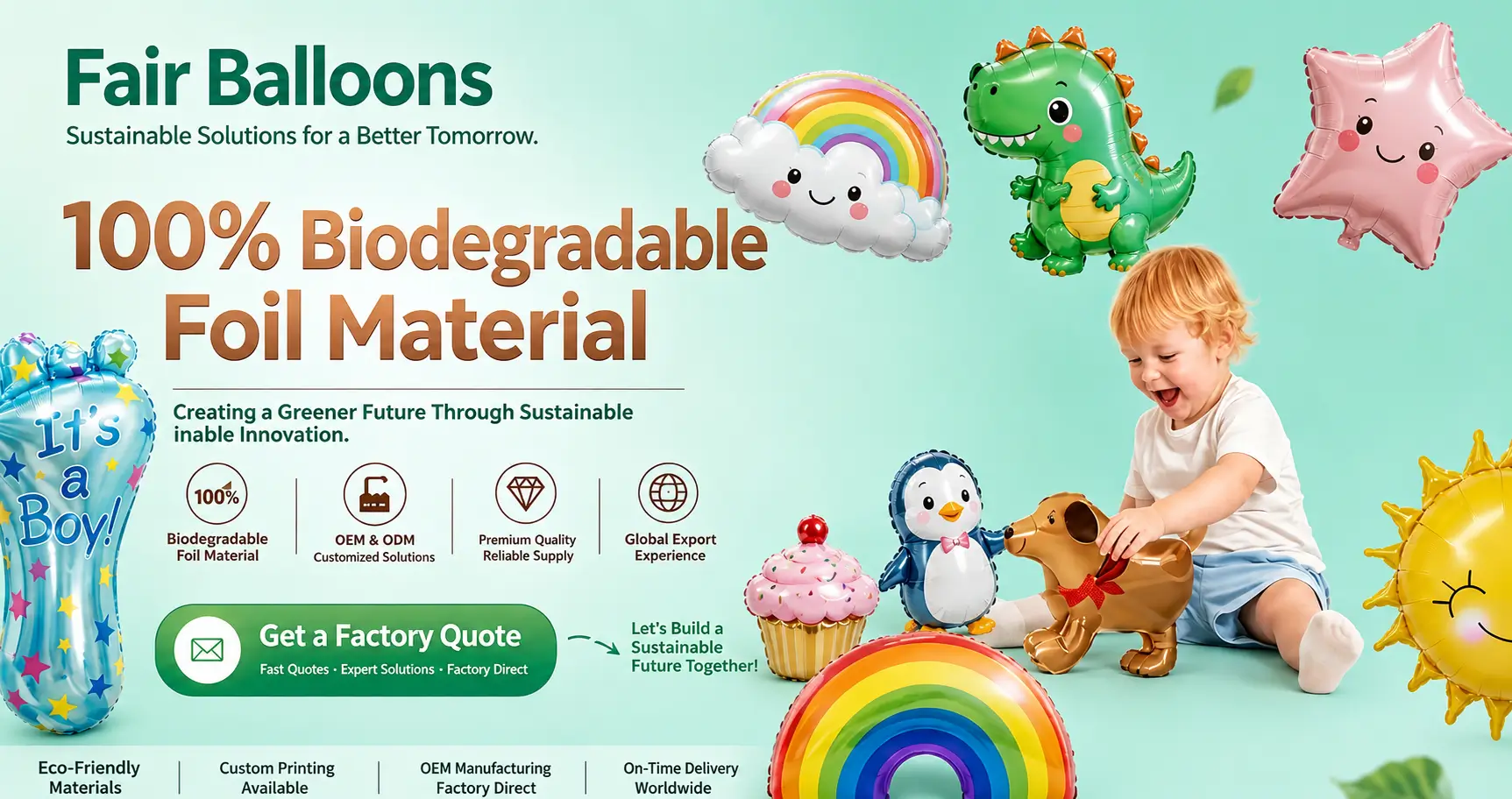
Modern floristry pairs cut flowers with balloon accents. That combination has a material contradiction: the flowers are organic, while the balloon is often a persistent petrochemical film. A foil balloon holds helium longer than a latex balloon and does not cloud under a misting system, which is why florists rely on it. The question for a buyer is which foil film matches the brand and stays compliant with the packaging rules of the destination market. This guide covers the material comparison, the barrier structure, the compliance points, and the storage conditions a florist shop should follow for the compostable line.
For Retail Florists
Why a foil balloon holds up better than a latex balloon under a misting system, how to pair it with a bouquet, and how to store the compostable line.
For Wholesale Buyers
Film and barrier structure behind the compostable line, the test reports we hold, and how a florist distribution program should be specified.
1. The Material Contradiction in Modern Floristry
Modern floristry is a competitive B2B and retail landscape. Bouquets, floral arrangements, and premium gift hampers are no longer standalone products. To raise invoice values and meet demand for celebration milestones and corporate events, floral designers have added balloon accents to arrangements. That pairing has a material contradiction.
The core product of a florist is cut flowers: organic, compostable, and carbon-neutral. The decorative enhancement is often a synthetic film. Traditional balloon options fall into two categories: natural rubber latex and metallized polyester (BOPET), commonly called Mylar. Both come with trade-offs in an eco-conscious market. When a traditional balloon is discarded, it accumulates in landfill and in the environment, which does not match the organic branding a florist builds around.
The response is not to remove balloon accents from the catalog. It is to change the material. A compostable alternative keeps the visual and functional value of a foil balloon while changing the end-of-life profile. The classification and fee for a given product are confirmed at quotation stage against the applicable program rules.
Hotel florists, floral wholesalers, and multi-site networks are facing more questions from buyers about the material profile of the balloon in an arrangement. Moving to a documented compostable film changes the answers a retail florist can give at the counter, and it can change the packaging tax classification of a program.
2. Why Florists Use Foil and Mylar Balloons
In everyday floristry, reliability drives profitability. For hotels, corporate banquets, and long-duration residential installations, decorative accents have to hold up for several days. That is where the material properties of a foil balloon differ from a latex balloon.
Purchasing directors generally evaluate two materials: latex and a Mylar balloon. The performance differences explain why the metallic and foil categories dominate retail displays.
Float time and helium retention
Latex is permeable to helium and loses lift quickly. A foil film blocks gas migration for longer, which is why the retention window on a foil balloon is measured in days rather than hours. The retention window for a given SKU is confirmed at quotation stage.
Moisture and misting resistance
A latex balloon clouds and dulls when exposed to light, heat, or moisture, which are routine conditions in a florist shop. A metallized Mylar balloon or foil design holds its gloss and print definition under misting and in a refrigerated display case.
Shape and print control
Latex stretches in all directions, so it cannot hold a fixed geometry. A foil film is non-elastomeric and is formed with heat-seal tooling, which allows a florist to source star, heart, number, and custom shapes that match a theme. See our custom shaped foil balloons page for examples.
That combination of benefits is also what creates the waste management issue. A legacy polyester film does not biodegrade, so importers are looking for materials that deliver the same helium retention and print quality while matching the end-of-life profile of the rest of the arrangement.
3. Helium Barrier Engineering: Co-Extrusion and Nanoclay
Helium is a small monoatomic gas that migrates through many polymer films over time. Keeping helium inside a thin polymer envelope is a barrier engineering problem. A legacy PET-based film solves it with a vacuum-deposited aluminum layer, which acts as a gas barrier.
Our compostable line reproduces that barrier behavior with a bio-sourced polymer system. The film is a PLA-PBAT-nanoclay co-extruded film. The composite is built on three components.
| Metric | Metallized BOPET | Vulcanized Latex | PLA-PBAT-Nanoclay |
|---|---|---|---|
| Sourcing origin | Petroleum-derived polymer | Hevea brasiliensis tree sap | Corn starch or sugarcane feedstock |
| Retention window | Longer window; confirmed at quotation stage | Shorter window | Confirmed at quotation stage |
| Misting resistance | Water-resistant | Clouds and dulls under water mist | Water-resistant |
| End-of-life behavior | Very long persistence; fragments into microplastics | Slower decay than the marketing claim suggests | Verified under ISO 14855-1:2012 (SGS SHMR220700361301) |
PLA provides stiffness and barrier properties, but on its own it is brittle. Blending it with PBAT adds flexibility and impact strength. The nanoclay dispersion is what slows helium migration: the clay platelets align during film blowing and force gas molecules to travel a longer, less direct route. That is the mechanism that lets a compostable foil balloon hold helium for a commercial retention window rather than a short one. The retention window for a given design is confirmed at quotation stage.
4. Compliance and Test Reports
When a buyer procures foil or Mylar balloons in bulk, the purchase carries a compliance dimension. The material composition has to meet the rules of the destination market. Choosing a product without documentation exposes the distributor or retailer to penalties and, depending on the market, to a recall.
Our production line runs to the documentation below. See the report coverage pages for the specific standard and sample coverage.
Compostability (ISO 14855-1:2012)
Covered under SGS report SHMR220700361301. The report covers a PLA degrading balloon sample tested under controlled industrial composting conditions. Test material average biodegradation was 77.8% within a 45-day test period. ISO 14855-1:2012 is the standard we hold; it is distinct from EN 13432.
RoHS (EU) 2015/863
Covered under SGS report SHAHG2207652301. The report documents restriction testing for lead, cadmium, mercury, hexavalent chromium, PBBs, and certain phthalate plasticizers. Coverage of a specific SKU is confirmed at quotation stage.
Certifications and test reports we do NOT hold:
- ISO 9001 — not held
- EN 13432 — not held. The report we hold for the biodegradable line is ISO 14855-1:2012, which is a distinct standard.
- ASTM D6400 — not held
- ASTM F963 — not held
- REACH — not held
- US CPSIA — not held
- California Prop 65 — not held
PEBA Code of Conduct
As a member of the Pro Environment Balloon Alliance (PEBA), we support the alliance's code of conduct on balloon releases. No balloon, including a compostable bioplastic balloon, should be released into the environment.
Florists can pass this on to end customers: secure inflated balloons with a weight, and dispose of them through the appropriate waste stream after the event.
5. Storage Conditions for the Compostable Line in a Florist Shop
A legacy petrochemical film is durable. A compostable film is designed to be chemically active under the right conditions, which is what allows it to break down in an industrial composting environment. That also means storage conditions matter more than they do for a traditional foil balloon.
A florist shop is a naturally high-humidity zone because of misting, refrigeration, and transpiration from fresh foliage. If a compostable balloon pack is left open and exposed, ambient moisture can begin the hydrolytic process and age the film prematurely.
Storage Guidelines for the Compostable Line
- Humidity. Keep the storage area below the humidity limit set for the specific film grade. The limit for a given order is confirmed at quotation stage.
- Temperature. Keep storage within the temperature range set for the film grade. The range for a given order is confirmed at quotation stage.
- Packaging. Keep bulk balloon packs sealed in their original moisture-barrier bags until the balloons are ready for inflation.
- Rotation. Use a first-in, first-out inventory rotation to keep stock fresh.
A short training note for floristry staff on these storage rules keeps the retention and print quality of a compostable stock in good condition. For logistics detail on bulk shipments, see our shipping and storage FAQ.
6. Sourcing Notes: OEM/ODM Programs for Florist Channels
At Kunshan Fair Craft Products Co., Ltd. (FAIR), we run OEM and ODM programs for commercial buyers, supermarket chains, and floral distribution networks. The production factors that matter most for a florist channel program are film, print, and inspection.
Film Extrusion
The compostable line runs a co-extruded PLA-PBAT film with a nanoclay barrier layer. Film grade, layer thickness, and retention specification for a given order are confirmed at quotation stage.
Rotogravure printing supports multi-color graphics for a floral or corporate brand program. Ink system and print coverage for a given design are confirmed at quotation stage.
Batch Inspection
Samples from each finished batch are held under pressure for a controlled inspection window before packing. Units that show a pressure drop are isolated. The inspection window and pass criteria for a given order are confirmed at quotation stage.
7. Florist Sourcing FAQ
Requesting florist program samples, test report copies, or a quotation for a compostable balloon line?
Email xia@foilballoon.cnResponse within one business day · Sample service available
About FAIR — Kunshan Fair Craft Products Co., Ltd.
FAIR is a balloon manufacturer based in Kunshan, China, producing foil balloons, custom shaped foil balloons, PLA-based biodegradable foil balloons, and custom printed balloon products for global brands, event companies, retail chains, and wholesale novelty distributors. For inquiries: xia@foilballoon.cn