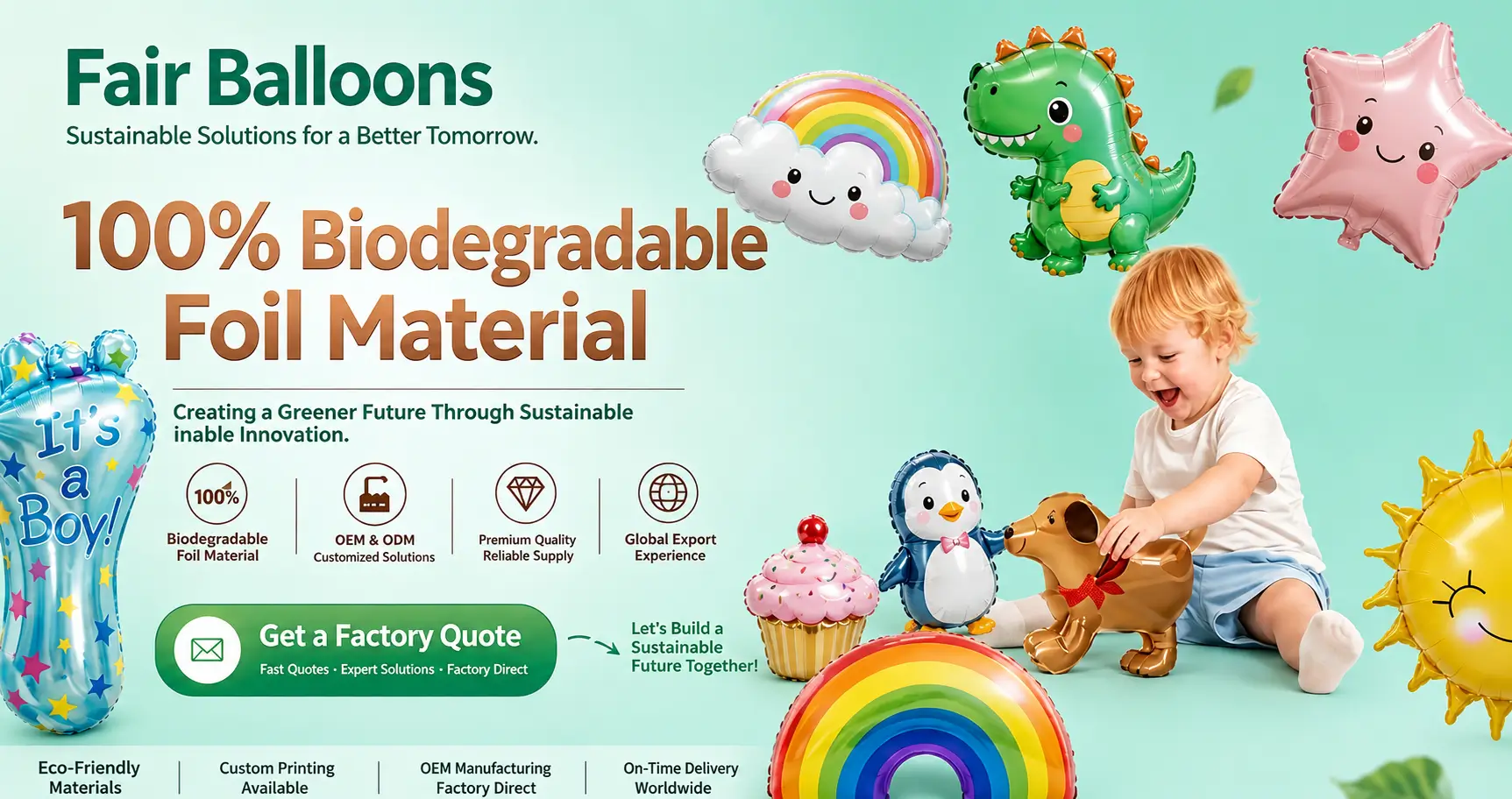

We Did It. Here Is the Proof.
For years, the promotional and celebrations industry was told that a truly biodegradable foil balloon was technically impossible. The engineering logic seemed ironclad: helium retention requires an aluminum gas barrier, and aluminum barriers are fundamentally incompatible with compostable materials. Kunshan Fair Craft Products Co., Ltd. has proven otherwise — and we have the SGS laboratory reports to prove it.
Traditional foil balloons are manufactured from a multilayer composite — typically a biaxially-oriented nylon (BON) layer sandwiched between two layers of polyethylene terephthalate (PET), with a vapor-deposited aluminum coating applied to the interior surface. This structure is bonded using polyurethane-based adhesive lamination, creating covalent interfaces that are chemically indissoluble. No recycling stream can separate these layers. No composting environment can break them down. The result is a material that persists in the environment for centuries, fragmenting into microplastic particles with no pathway to natural remediation.
When regulatory pressure began mounting — California's balloon safety law and its newer AB 847 non-conductivity manufacturing standard, the EU Single-Use Plastics Directive, Australian state-level bans — the industry responded with familiar half-measures. Latex balloons offered biodegradability, but only 8–14 hours of helium float time, poor print quality for corporate branding, and documented anaphylaxis risks in school environments. "Eco-friendly" coatings applied to traditional PET-aluminum structures claimed partial biodegradability while retaining the same non-recyclable composite core. None of these solutions addressed the fundamental engineering conflict between gas-barrier performance and material compostability.
Through years of proprietary research, Kunshan Fair Craft Products Co., Ltd. developed a fundamentally different approach: a co-extruded film structure based on a Polylactic Acid (PLA) and Polybutylene Adipate Terephthalate (PBAT) blend, reinforced with a nano-clay barrier layer. The aluminum gas barrier was replaced by a metallized PLA coating — a critical innovation that retains the essential helium-retention performance while remaining fully biodegradable at end of life. There are no PET layers. No nylon components. No indissoluble adhesive bonds. Only biodegradable polymers that break down cleanly under industrial composting conditions.
The result is a biodegradable foil balloon that performs identically to its traditional counterpart in every commercial respect — helium float time, print quality, mechanical durability, visual appearance — while achieving verified biodegradation under controlled composting conditions, with zero toxic residue in the resulting compost medium. This is not a prototype or a pilot product. It is a commercially available product line, and it has been independently verified by the world's most respected testing authority.
Two SGS Reports. One Unambiguous Conclusion.
Biodegradation Certification
RoHS EN Chemical Safety
What the Biodegradation Test Actually Proved
The document bearing test report number SHMR220700361301 was issued by SGS-CSTC Standards Technical Services (Shanghai) Co., Ltd., following a testing period spanning July 26 to October 8, 2022 — a 74-day evaluation window that is itself a mark of scientific rigor. Polymer biodegradation testing is not a 48-hour assay. It is a multi-month process that tracks material degradation under controlled conditions simulating the thermal, moisture, and microbial environments of industrial composting.
The sample submitted for testing was designated on the official report as a "PLA degrading balloon" — manufactured by Kunshan Fair Craft Products Co., Ltd. This explicit product designation is critical: SGS sampling protocols require that test specimens be drawn from production stock, with chain-of-custody documentation maintained throughout the submission process. There is no ambiguity about whether the laboratory tested a specially prepared prototype versus a commercial production unit. The report confirms: what we sell is what was tested.
The test methodology — Aerobic Biodegradation under Controlled Composting Conditions — aligns with ASTM D5338 (the standard test method for determining aerobic biodegradation of plastic materials under controlled composting conditions) and ISO 14855 (determination of the ultimate aerobic biodegradability of plastic materials under controlled composting conditions). These standards mandate measurement intervals across the full duration of the test, capturing the complete degradation profile.
The report documents:
- Extent and rate of polymer breakdown — confirming that the material fully converts to biological byproducts, not merely fragments
- Carbon dioxide evolution (CO₂ conversion) — measuring the degree to which the material's carbon content is converted to CO₂, the terminal state of aerobic biodegradation
- Mass loss profile — tracking the progressive reduction in material mass as biodegradation proceeds
- Compost medium toxicity testing — verifying that the resulting compost contains no toxic residue that would prevent safe return to the biological cycle
When a regulatory authority, a customs officer, or a corporate sustainability committee asks for evidence that your biodegradable foil balloons are what you claim, SGS Report SHMR220700361301 is the answer.
Chemical Safety: Why RoHS Testing Is Non-Negotiable
Biodegradability and chemical safety are not the same thing — and conflating them is one of the most dangerous errors in the eco-friendly product space. A balloon that degrades into harmless byproducts is a meaningful environmental achievement. But only if those byproducts are, in fact, harmless. If a product labeled "eco-friendly" releases lead, cadmium, phthalates, or polybrominated flame retardants as it breaks down in soil or compost, the sustainability claim is not merely inaccurate — it is a dangerous misrepresentation that exposes every actor in the supply chain to severe regulatory, legal, and environmental liability.
SGS Report SHAHG2207652301, formally issued on June 27, 2022, provides the definitive empirical answer to these concerns. The testing was conducted under the authorization of Alicia Lu, an SGS-approved signatory whose signature confers institutional accountability for the accuracy and completeness of the findings. The test applied — RoHS Directive (EU) 2015/863 amending Annex II to Directive 2011/65/EU — is the most comprehensive chemical safety standard applicable to consumer products entering the European market, screening for ten substance categories:
- Lead (Pb) — cumulative neurotoxin, particularly hazardous to children
- Mercury (Hg) — persistent bioaccumulative toxicant
- Cadmium (Cd) — carcinogenic heavy metal with no safe exposure threshold
- Hexavalent Chromium (Cr VI) — known carcinogen via inhalation
- Polybrominated Biphenyls (PBB) — flame retardant with endocrine disruption properties
- Polybrominated Diphenyl Ethers (PBDE) — flame retardants with documented bioaccumulation
- Bis(2-ethylhexyl) Phthalate (DEHP) — reproductive toxicant
- Butyl Benzyl Phthalate (BBP) — developmental toxicant
- Dibutyl Phthalate (DBP) — endocrine disruptor
- Diisobutyl Phthalate (DIBP) — reproductive toxicant
The SGS report confirms that the DEGRADING BALLOON manufactured by Kunshan Fair Craft Products Co., Ltd. contains none of these restricted substances above EU thresholds. The result is not a self-assessment or a supplier declaration — it is a forensic laboratory analysis conducted by the world's most widely recognized product testing institution. View the full RoHS test report on biodegradableballoon.com.
No Compromises. Full Commercial Grade.
Achieving biodegradation without sacrificing the performance characteristics that B2B balloon buyers demand was the core engineering challenge. Our proprietary PLA-PBAT-nanoclay co-extruded film solves this conflict — delivering the helium retention, print quality, and mechanical durability of traditional metallized balloons, in a fully biodegradable material.
The Molecular Engineering: Why PLA + PBAT + Nanoclay
Each component of our proprietary film was selected for a specific performance function:
- Polylactic Acid (PLA) — Derived from fermented plant starch (typically corn), PLA provides the structural backbone. It offers tensile strength and clarity, and is industrially compostable. Its brittleness limitation is addressed by blending with PBAT.
- Polybutylene Adipate Terephthalate (PBAT) — A biodegradable aliphatic-aromatic copolyester, PBAT provides the flexibility and impact resistance that PLA lacks. Its lower melting point means faster biodegradation, complementing PLA's stiffness with ductility.
- Nano-clay barrier layer — Montmorillonite clay nanoparticles dispersed uniformly throughout the PBAT matrix create a tortuous path for gas molecules, dramatically improving helium retention — the key performance parameter — without adding weight or bulk.
- Metallized PLA coating — Instead of the aluminum vapor-deposited layer used in traditional foil balloons (which creates the non-biodegradable composite), our film uses a metallized PLA coating. This retains the required gas-barrier properties for helium retention while remaining fully biodegradable — the critical innovation that distinguishes our biodegradable foil balloon from every other "eco" balloon on the market.
The result is a co-extruded film with no PET, no nylon, no indissoluble adhesive bonds, and no aluminum composite — only biodegradable polymers that break down cleanly under composting conditions. This is not a coating applied to a traditional structure. It is a fundamentally different material architecture, purpose-built for both performance and end-of-life environmental responsibility.
Custom Shapes, Colors, and Branding
Our biodegradable foil balloons are available in any shape, size, or color configuration. High-definition digital printing delivers photographic quality for corporate branding, event personalization, or retail packaging. Contact Kunshan Fair Craft Products Co., Ltd. directly to discuss custom fabrication for your B2B order.
Why the Timing of This Breakthrough Could Not Be Better
The global regulatory environment for traditional foil balloons has shifted dramatically from tolerance to active enforcement — and this shift is accelerating. For B2B distributors and procurement officers, the question is no longer whether to address the sustainability question, but how to do so without sacrificing the product characteristics that drive customer satisfaction.
United States
California's balloon safety law has long required weighted anchors, printed warnings, and conductive-string restrictions on metallized balloons, and the state's newer Assembly Bill 847 (AB 847) adds a stricter manufacturing standard: balloons sold after 2027 must meet IEEE non-conductivity requirements at distribution voltages up to 38 kilovolts, citing power grid interference and widespread litter. The Federal Trade Commission's Green Guides have been intensifying enforcement against unsubstantiated environmental marketing claims in the promotional products sector, with multiple enforcement actions resulting in significant civil penalties in recent years. Distributors who market products as "eco-friendly" without third-party verification face direct legal exposure. (B2B buyers should confirm the current text of applicable state and federal regulations with their own legal counsel, as requirements continue to evolve.)
European Union
The EU Single-Use Plastics Directive, fully operational since January 2025, designates metallized balloon products as restricted items, requiring manufacturers and distributors to fund public awareness campaigns and establish end-of-life collection systems. The EU Green Claims Directive, which took effect in January 2026, now requires that all environmental marketing claims be supported by independently verified scientific evidence — a standard that effectively mandates third-party laboratory certification for any sustainability claim to be legally defensible.
Australia
Several Australian states have implemented restrictions on metallized balloons, with civil penalty schedules that vary by jurisdiction. The Australian Competition and Consumer Commission has signaled intensifying scrutiny of imported eco-products carrying certifications that cannot be independently verified.
From Concept to Certified Commercial Product
- Jun 21 – Jun 27, 2022 SGS RoHS Chemical Safety Testing Conducted Report SHAHG2207652301 issued, confirming zero restricted substances in the DEGRADING BALLOON product across all ten RoHS substance categories.
- Jul 26 – Oct 8, 2022 SGS 74-Day Biodegradation Testing Completed Report SHMR220700361301 issued, confirming verified biodegradation under controlled composting conditions and zero toxic residue in the compost medium.
- Q3 2026 Commercial Production Fully Operational Certified biodegradable foil balloon product line available for B2B orders worldwide in all standard and custom configurations. Learn more at biodegradableballoon.com
Ready to Source the World's First Certified Biodegradable Foil Balloon?
Contact our sales team to request certification copies, product samples, and a B2B price list. We work directly with distributors, event supply companies, and promotional products wholesalers worldwide.