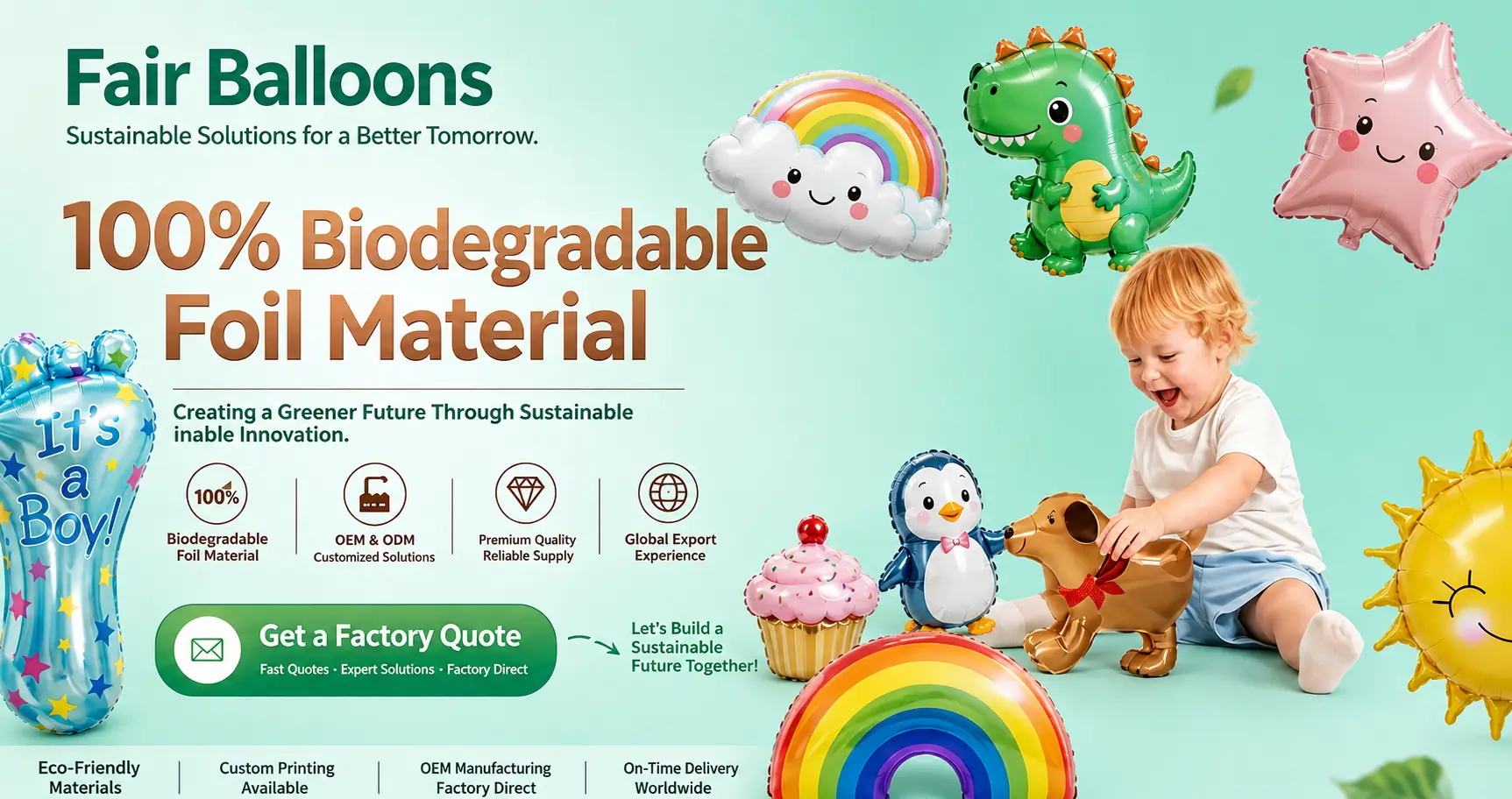
Foil balloons can pop when the film or sealed edges experience more stress than they can withstand. Overinflation, heat exposure, sharp objects, rough handling and product defects can all contribute to failure. Prevention starts with following product-specific inflation instructions, allowing for changes in the surrounding environment, and checking the condition of the balloon before use. No general procedure can guarantee that every balloon will remain intact under all conditions.
For Retail Decorators
Learn how to recognize excessive inflation, manage temperature changes, protect balloons during installation and reduce avoidable damage at events and retail displays.
For Procurement Teams
Understand product specifications, incoming inspection, batch traceability, supplier documentation and practical quality-control questions for wholesale and private-label programs.
1. Why Do Mylar and Foil Balloons Pop?
Mylar is a commonly used name for polyester film, including biaxially oriented polyethylene terephthalate (BOPET). Decorative foil balloons may use a metallized film or a multilayer structure, depending on the product design. Their behavior is different from that of latex balloons, which can stretch substantially as they inflate.
Many foil balloon constructions have limited stretch once the balloon has reached its intended shape. If internal gas pressure or external handling creates excessive stress, the film, sealed perimeter, valve area or a locally damaged section may fail.
Overinflation and Excessive Stress
Adding more gas after a balloon has reached its intended shape can increase stress on the film and seals. A surface that looks very taut is not necessarily evidence of better quality or better inflation. Follow the product's instructions and stop when the intended shape has been achieved.
Seam and Valve Weakness
The perimeter seal and valve are important parts of the balloon's structure. Inconsistent sealing, damage during handling, or a defect in the film or valve may contribute to leakage or rupture. A visible seam irregularity alone does not prove that a balloon will fail, but repeated failures around the same area should be investigated.
Punctures and Abrasion
Sharp packaging edges, exposed fasteners, scissors, tools and rough display frames can puncture or tear the film. Pulling a balloon by its valve or forcing it into a confined space can also create unnecessary stress.
- Film composition, thickness and construction.
- Balloon shape, size and available expansion space.
- Quality and condition of the perimeter seals and valve.
- Inflation method and the amount of gas added.
- Temperature, surrounding pressure and handling conditions.
- Damage or variation affecting an individual product or production batch.
For a broader comparison of material behavior, see our Mylar vs. Latex Balloons Guide. Please verify that the linked page is the intended live URL before publishing.
2. Three Environmental and Operational Risks
A balloon may be inflated correctly and still experience changing conditions after preparation. Heat, transport conditions and unsuitable inflation equipment can all affect its performance.
Risk 1: Heat Trapped Behind Storefront Glass
Direct sunlight can heat a balloon and its surrounding environment. As the gas warms, the balloon may expand or experience an increase in internal pressure, depending on how much its volume can change. If the balloon has already been inflated too tightly, the additional stress may contribute to a rupture.
For window displays, avoid prolonged direct sunlight where possible. Keep balloons away from hot lighting equipment, heaters and other concentrated heat sources. If a display is exposed to strong sunlight during the day, inspect it under the actual operating conditions rather than assuming that room temperature reflects the temperature near the glass.
For material and finish selection, see our Metallic Color and Balloon Finish Sourcing Guide. Verify the URL before publishing.
Risk 2: Changes in Altitude and Surrounding Pressure
When a pre-inflated balloon moves to an environment with lower atmospheric pressure, the pressure difference between the gas inside the balloon and the surrounding air can increase. The balloon may expand if its construction permits, placing additional stress on the film and seams.
Temperature and pressure may both change during a journey. The outcome depends on the balloon design, its initial inflation level, the transport environment and how much the balloon can expand. Do not assume that every aircraft cargo compartment is unpressurized; transport conditions vary.
For long-distance shipments or routes involving substantial changes in altitude, consult the supplier and carrier. Where appropriate, transporting balloons uninflated may simplify handling and reduce exposure to pressure-related changes.
Risk 3: Unsuitable Inflation Equipment
Using equipment that is poorly matched to the balloon valve can damage the opening or introduce gas too quickly for controlled inflation. High output alone does not establish the pressure that reaches the balloon; the equipment, nozzle, regulator, valve and operator technique all affect the result.
Choose equipment designed for the intended balloon type. Train operators to inflate gradually, observe the shape and stop at the product's intended form. Do not rely on compressor sound or a generic regulator setting as a substitute for product-specific instructions.
3. Practical Inflation Controls to Reduce Popping
There is no universal fill percentage, pressure setting or hand test that is suitable for every foil balloon. Appropriate inflation depends on the product's size, shape, construction, valve and intended environment. The following process provides a practical starting point for controlled handling.
- Inspect before inflation. Check the film, perimeter seals and valve for visible damage. Do not inflate a product that is already torn or visibly defective.
- Use compatible equipment. Choose an appropriate nozzle and inflation method for the valve and product design. Avoid forcing the nozzle into the opening.
- Inflate gradually. Observe the balloon as it fills. Stop if it develops unusual distortion, excessive tautness or visible stress around the edges.
- Follow product-specific instructions. Do not use an arbitrary fill percentage or pressure threshold unless it has been established for the specific product.
- Consider the destination environment. Account for foreseeable changes in temperature and surrounding pressure when planning inflation and transport.
- Check the valve after inflation. Remove the nozzle carefully and follow the product's instructions for closing the valve. Avoid pulling or twisting the valve area.
- Remove questionable products from use. If a balloon shows a split seam, damaged valve or other structural fault, do not continue inflating it or use it in a display.
Avoid forceful pinching, pressing hard on the balloon, deliberately overinflating it, or attempting to judge internal pressure by sound. These methods do not provide a reliable measurement and may damage the product. Use the manufacturer's instructions and appropriate equipment instead.
For further practical guidance, see How to Inflate Foil and Mylar Balloons.
4. Material, Seam and Production Quality Considerations
The material structure, sealing process and valve design all contribute to a foil balloon's performance. However, material names alone cannot establish a product's burst resistance or gas-retention performance. Those characteristics depend on the complete construction and should be evaluated using product-specific evidence.
Film Construction
Review the actual film structure, intended application, sealing compatibility and handling requirements. Do not assume that every product described as Mylar uses the same material layers.
Seam and Valve Design
Seal geometry, processing conditions and valve construction should be appropriate for the product. Inspection criteria must be based on the approved specification rather than visual appearance alone.
Product-Specific Testing
Ask which test methods, sample configurations, acceptance criteria and records apply to the actual SKU. Do not infer performance for an entire product range from an unrelated sample.
Questions to Ask Your Manufacturer
- What film construction and valve design are used for the selected product?
- What inflation and storage instructions apply to this size and shape?
- What procedures are used to inspect the seams, valves and finished balloons?
- Are product-specific test records available for the intended application?
- How are defects documented, investigated and traced to the relevant production order?
- What corrective-action process applies if a repeated quality issue is identified?
For procurement teams, the most useful evidence is documentation that corresponds to the actual product, material, manufacturing process and order. A supplier's general statement about material strength or quality control should not be treated as a substitute for a defined specification and supporting records.
5. B2B Quality-Control Checklist for Wholesale Orders
For importers, wholesalers, retailers and private-label brands, preventing balloon popping involves more than the inflation process. Product specifications, packaging, incoming inspection, storage and supplier communication all play a role.
| Control Area | What to Check | Useful Records |
|---|---|---|
| Product specification | Size, shape, material structure, valve and intended use | Approved specifications and SKU references |
| Incoming inspection | Packaging condition, visible damage, seams and valves | Inspection notes and photographs |
| Storage and handling | Exposure to heat, moisture, sharp objects and compression | Storage instructions and incident records |
| Defect tracking | Failure location, affected quantity and recurring patterns | Batch, order or shipment references |
| Supplier follow-up | Inspection methods, product-specific evidence and corrective action | Supplier responses and relevant test records |
When Several Balloons Fail
If multiple balloons from one order show similar damage, separate the affected stock and record the circumstances before attempting repairs. Note the product reference, shipment details, storage conditions, inflation method and the location of each visible defect.
This information helps the supplier investigate whether the issue may relate to handling, storage, inflation, transport or product quality. Do not assume the cause without reviewing the evidence.
6. Frequently Asked Questions
Related Foil Balloon Resources
Looking for a Foil Balloon OEM Partner?
For importers, wholesalers, event suppliers and private-label brands, a reliable balloon program starts with clear product specifications, suitable packaging, practical handling instructions and a consistent process for investigating defects.
Contact FAIR to discuss your product requirements, custom designs, material options and quality-control documentation relevant to your order.
Contact Our TeamEmail: xia@foilballoon.cn
About FAIR Balloons
FAIR provides foil balloon products and custom sourcing options for brands, retailers, event companies and wholesale distributors. Product specifications, available testing records and quality-control arrangements should be confirmed for the specific product and order. For inquiries, contact xia@foilballoon.cn.
Disclaimer: This article provides general product-handling information and does not establish a universal inflation pressure, fill percentage, temperature limit or burst-resistance rating. Actual performance depends on the balloon construction, inflation level, environmental conditions and intended use. Follow the manufacturer's instructions and request product-specific documentation where performance requirements apply.