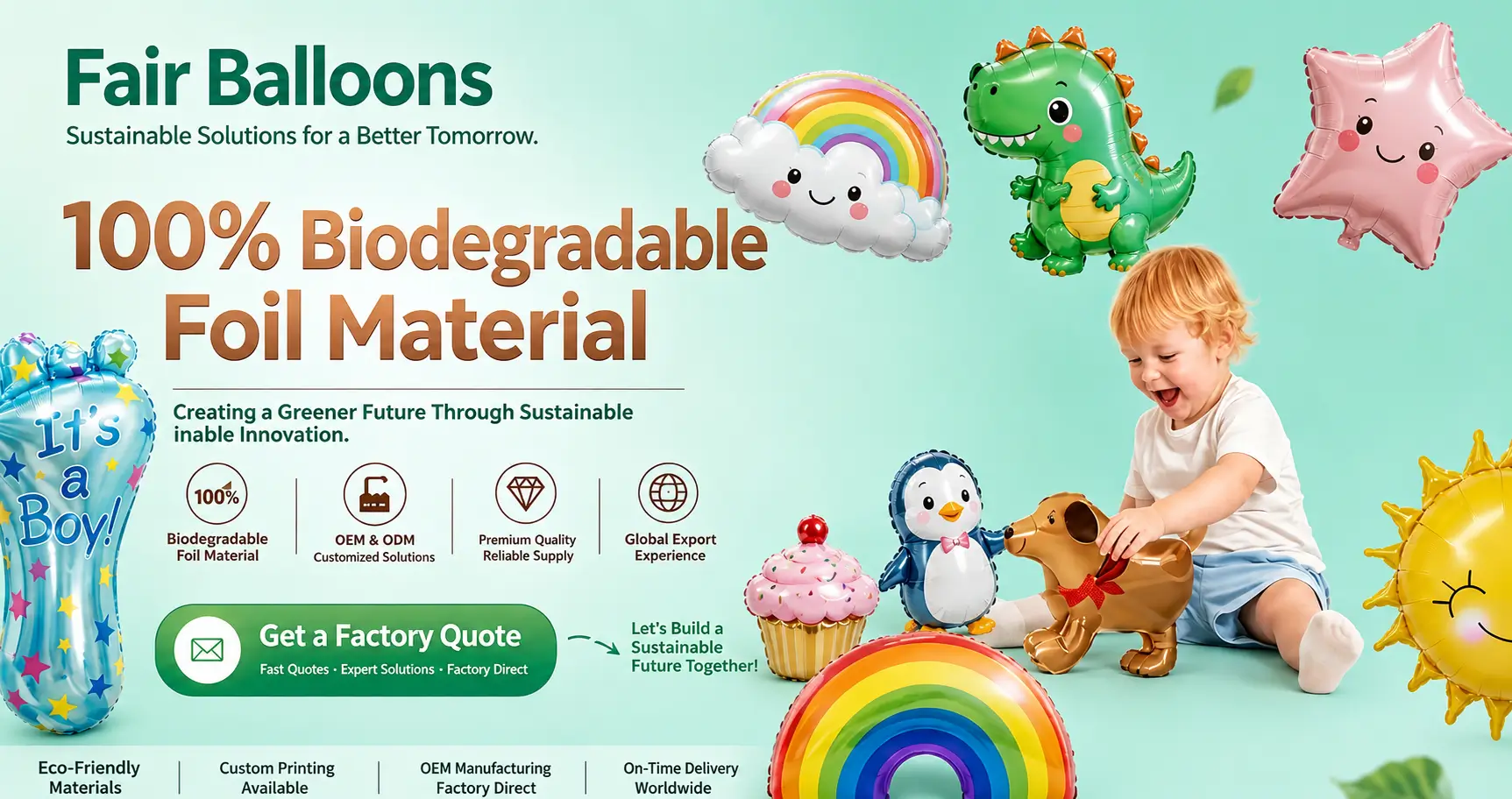
A biodegradable foil balloon is a real commercial product. The material build is a multi-layer co-extruded PLA-PBAT film, and the end-of-life behaviour is documented in a material test report. This whitepaper covers the film build, the helium retention profile, the manufacturing process, the custom shape tooling workflow, and the test reports we hold for the biodegradable line.
This guide is written for importers, procurement managers, and product development teams who are evaluating a PLA-PBAT biodegradable foil balloon program. Numeric specifications, MOQ thresholds, tooling parameters, and storage conditions in this briefing are confirmed at quotation stage against a specific program.
For Importers
The film build, the helium retention profile, the storage parameters for a PLA-PBAT film, and the test reports that support the compostability claim.
For Procurement Teams
The manufacturing workflow, the custom shape tooling structure, the MOQ framework, and how SKU-level report coverage is confirmed at quotation stage.
1. Why Certified Biodegradable Foil Balloons Matter
Foil balloons, referred to in commercial retail as Mylar balloons, are a global segment across celebrations, corporate branding, retail promotions, and seasonal decor. Their market position rests on metallic luster, dimensional stability, custom shape flexibility, and long helium retention.
The conventional build uses a non-biodegradable multi-layer film, typically a BOPET substrate bonded to a polyethylene sealant layer. When a BOPET balloon is released or landfilled, the material persists in the environment for a long period and fragments into microplastics over time.
Regulatory pressure on the category has increased. The EU Single-Use Plastics Directive, the UK Plastic Packaging Tax, and North American frameworks such as California SB 54 each affect how a balloon SKU can be sold into a major market. A B2B buyer that is developing a new balloon program now has an incentive to build it on a compostable film rather than on a conventional film that may need to be re-tooled later.
Kunshan Fair Craft Products Co., Ltd. (FAIR) has been producing balloons from Kunshan, Jiangsu Province, China, since 2007. We are a member of the Pro Environment Balloon Alliance (PEBA). Our approach to the biodegradable line has been to develop a film that holds helium and takes a seam weld, because a compostable balloon that does not perform over the display window is not a commercial product.
2. Material Technology: Co-Extruded PLA-PBAT Film
The core of a biodegradable foil balloon is the film build. A single-layer bioplastic film tends to be brittle and to leak helium quickly, so the film has to be a multi-layer co-extruded structure that combines a structural polymer with a flexible sealant layer and a barrier layer.
| Film Component | Material | Function in the Film Build |
|---|---|---|
| Structural layer | PLA (polylactic acid) | Provides tensile strength, clarity, and dimensional stiffness. PLA is an aliphatic polyester with ester linkages that are susceptible to hydrolytic chain scission and to enzymatic breakdown. |
| Toughening layer | PBAT | Raises film flexibility and puncture resistance, and supports a reliable heat-seal. Unmodified PLA is brittle, so the PBAT blend is what allows the film to take the multi-axial strain of helium inflation. |
| Barrier layer | Metallized layer | Reduces the helium transmission rate by forcing the gas atom to take a longer, less direct route through the film. The barrier layer is what gives the film its reflective finish. |
The layer configuration, the layer ratio, and the film thickness for a given design are confirmed at quotation stage. For a discussion of storage and hydrolytic stability, see the PLA balloon shelf life and storage guide.
3. Performance Benchmarks
A B2B buyer purchases a finished balloon, not a resin. The two performance questions that matter most are helium retention and seam integrity. The retention window determines how long a retail bouquet stays buoyant on a shelf and how long a decoration holds its impact at an event. The seam integrity determines whether the balloon fails during inflation or over the display window.
| Metric | Test or Measurement | Specification |
|---|---|---|
| Helium retention window | Helium permeation test on the film build | Confirmed at quotation stage per configuration. |
| Seam tensile strength | Multi-directional pull test on the seam weld | Confirmed at quotation stage per design. |
| Heat-seal integrity | Inflation pressure inspection on batch samples | Batch samples held under inflation pressure for a controlled inspection window. Sampling plan confirmed at quotation stage. |
| Biodegradation | ISO 14855-1:2012, SGS report number SHMR220700361301 | Test material average biodegradation 77.8% within a 45-day test period, under controlled industrial composting conditions. |
A PLA-PBAT film is hydrolytically sensitive. Uninflated stock should be stored in a cool, dry warehouse away from direct sunlight. The storage temperature and humidity range for a given program are confirmed at quotation stage. Prolonged exposure to high humidity can affect the film before inflation. For shipping and storage parameters, see the logistics and shipping FAQ.
4. Manufacturing Workflow
A biodegradable foil balloon runs through the same production sequence as a conventional foil balloon, with the film and ink systems changed. The sequence has eight stages.
Bio-Resin Formulation
Blending of the PLA and PBAT grades with the additive package under controlled humidity. The blend ratio for a given film grade is confirmed at quotation stage.
Multi-Layer Co-Extrusion
Co-extrusion of the film to the target thickness. Film thickness and layer ratio for a given design are confirmed at quotation stage.
Rotogravure Printing
Printing with water-based, heavy-metal-free inks. Color count and registration tolerance for a given program are confirmed at quotation stage.
Shape Cutting
Cutting of the balloon perimeter to the design file. Die geometry and the corner radius for a given design are confirmed at quotation stage.
Valve Insertion
Insertion of the self-sealing valve into the neck seam. See the anti-leak valve design guide.
Heat Sealing
Closed-loop temperature control on the sealing dies, matched to the film grade. Weld temperature and dwell time for a given design are confirmed at quotation stage.
Batch Inspection
Inflation pressure inspection on batch samples, held for a controlled inspection window before packing. Sampling plan confirmed at quotation stage.
Moisture-Proof Packaging
Packaging in moisture-control master cartons for ocean freight. Packaging specification for a given program is confirmed at quotation stage.
For a step-by-step visual walkthrough, see the foil balloon manufacturing process guide.
5. Scaling from Prototype to Commercial Production
A laboratory prototype and a reliable B2B supply chain are two different things. The sourcing question is whether the factory can hold the material spec across repeated production runs.
We run batch traceability on the film grade, the print registration, and the seal strength for each production run. A buyer evaluating a supplier should ask for the batch record from a previous order before placing a new one. The test reports we hold for the foil and biodegradable lines are listed in Section 7.
6. Custom OEM and ODM Capabilities
A custom shape program requires shape tooling and a print setup. We run an in-house CAD/CNC tooling center that builds aluminum sealing and forming dies for custom shapes.
| Parameter | Specification |
|---|---|
| MOQ | Confirmed at quotation stage. The threshold depends on the design, the print complexity, and the tooling required. |
| CAD/CNC tooling fee | Indicative range. Confirmed at quotation stage. A tooling amortization program is available for committed annual volume programs. |
| Sample lead time | Confirmed at quotation stage. |
| Printing | Rotogravure. Color count and color match method confirmed at quotation stage. |
| Custom shape engineering | Custom shapes, letters, numbers, cartoon shapes. See the custom shape engineering guide. |
7. Test Reports We Hold
A compostability or chemical safety claim is only as strong as the test report behind it. The reports we hold for the foil and biodegradable lines are below. Each one answers a different question, and they are separate items in a compliance file.
- EN71 — SGS report number SHTY130500007975-01. Coverage: foil balloon sample, EN71 Parts 1, 2, and 3. Coverage of a specific SKU is confirmed at quotation stage. See the EN71 safe foil balloons guide.
- RoHS (EU) 2015/863 — SGS report number SHAHG2207652301. Coverage: tested DEGRADING BALLOON sample. Coverage of a specific SKU is confirmed at quotation stage. See the RoHS compliance report.
- Biodegradation (ISO 14855-1:2012) — SGS report number SHMR220700361301. Coverage: PLA degrading balloon sample under controlled industrial composting conditions. Test material average biodegradation 77.8% within a 45-day test period. See the SGS certification verification report.
- PEBA member — Pro Environment Balloon Alliance member.
If a destination market requires a standard outside this list, tell us at the quotation stage and we will confirm whether it can be arranged for the program.
8. PLA-PBAT Bio-Balloons vs Traditional PET/BOPET Balloons
The matrix below compares the two film categories on the variables that matter to a procurement manager who is evaluating a material transition.
| Feature | Traditional PET / BOPET Foil | PLA-PBAT Biodegradable Foil |
|---|---|---|
| Primary raw material | Petroleum-derived BOPET film bonded to a polyethylene sealant layer. | PLA-PBAT co-extruded film with a metallized barrier layer. |
| End-of-life pathway | Conventional plastic disposal. Not compostable. Literature estimates for BOPET persistence in the environment vary and are typically measured in decades or longer. | Biodegradation under controlled industrial composting conditions, documented under ISO 14855-1:2012. |
| Helium retention window | Multi-day window on a standard metallized BOPET film. | Multi-day window on the PLA-PBAT metallized film. Retention window confirmed at quotation stage. |
| Plastic tax and EPR exposure | Inside the plastic tax scope in several markets. | Compostability pathway available where the destination framework accepts it. Market-specific. Confirmed at quotation stage. |
| Custom shape tooling | Aluminum and copper sealing dies. Standard production workflow. | CAD/CNC tooling with a tooling amortization option. See the OEM cost and ROI guide. |
9. What to Audit When Evaluating a Bio-Balloon Factory
Before issuing a purchase order for a compostable balloon program, a procurement manager should confirm the following items with the supplier.
- Does the factory produce finished balloons or only supply resin? A vertical factory runs the extrusion, the print, and the balloon-forming lines on the same site, which keeps the chain from material to finished envelope inside one entity.
- Does the factory hold the test report for the film formulation? Ask for the report number and the sample name on the report, and confirm the SKU coverage question.
- What is the inflation inspection protocol on batch samples? The sampling plan and inspection window for a given order should be confirmed at the quotation stage.
- Does the manufacturer offer custom CAD/CNC tooling? Confirm the tooling lead time, the tooling cost, and whether a tooling amortization option is available.
- How are uninflated bio-balloons packaged for ocean freight? Confirm the packaging specification for the destination market and the transit time.
- Can the factory provide a container loading plan? Use the container loading optimizer to model the load for a given order.
10. Commercial Applications
A PLA-PBAT bio-balloon program serves several commercial sectors.
Corporate Brand Campaigns
Custom printed bio-balloons for a brand activation or a product launch. The print and packaging for a program are confirmed at quotation stage.
Private-Label Retail Programs
Private-label retail packaging for a sustainable party chain in a market where the destination framework accepts the compostability pathway.
Wedding and Event Decor
Jumbo letters, numbers, and shaped balloons for event planners. See the wedding balloon sourcing guide.
Promotional Giveaways
Handheld stick balloons for outdoor festivals and municipal campaigns. See the mini foil balloons with sticks category.
11. Roadmap for the Compostable Film Line
The current biodegradable line is documented for controlled industrial composting conditions. Home compost conditions differ in temperature, microbial population, and residence time. A home compostable film matrix is one of the directions our R&D center is working on. The development timeline and the test program for a home compostable film are confirmed at quotation stage for any buyer who is interested in that pathway.
12. B2B Sourcing FAQ
13. Conclusion
A PLA-PBAT biodegradable foil balloon is a real commercial product. It runs on the same production lines as a conventional foil balloon, with a compostable film build and a water-based ink system. The end-of-life behaviour is documented in a material test report under ISO 14855-1:2012, and the file combines with the RoHS and EN71 reports for a destination market that requires the full package.
For a buyer evaluating the transition from a BOPET foil balloon to a compostable foil balloon, the sourcing decision comes down to three questions. Does the factory hold the test report for the film formulation. Can the factory hold the material spec across repeated production runs. And does the destination framework accept the compostability pathway for the SKU being imported.
We can answer all three at the quotation stage.
Requesting a factory quotation, a sample set, or a test report copy for a compostable foil balloon program?
Email xia@foilballoon.cnResponse within one business day · Sample service available
About FAIR — Kunshan Fair Craft Products Co., Ltd.
FAIR is a balloon manufacturer based in Kunshan, China, producing foil balloons, custom shaped foil balloons, PLA-based biodegradable foil balloons, and custom printed balloon products for global brands, event companies, retail chains, and wholesale novelty distributors. For inquiries: xia@foilballoon.cn