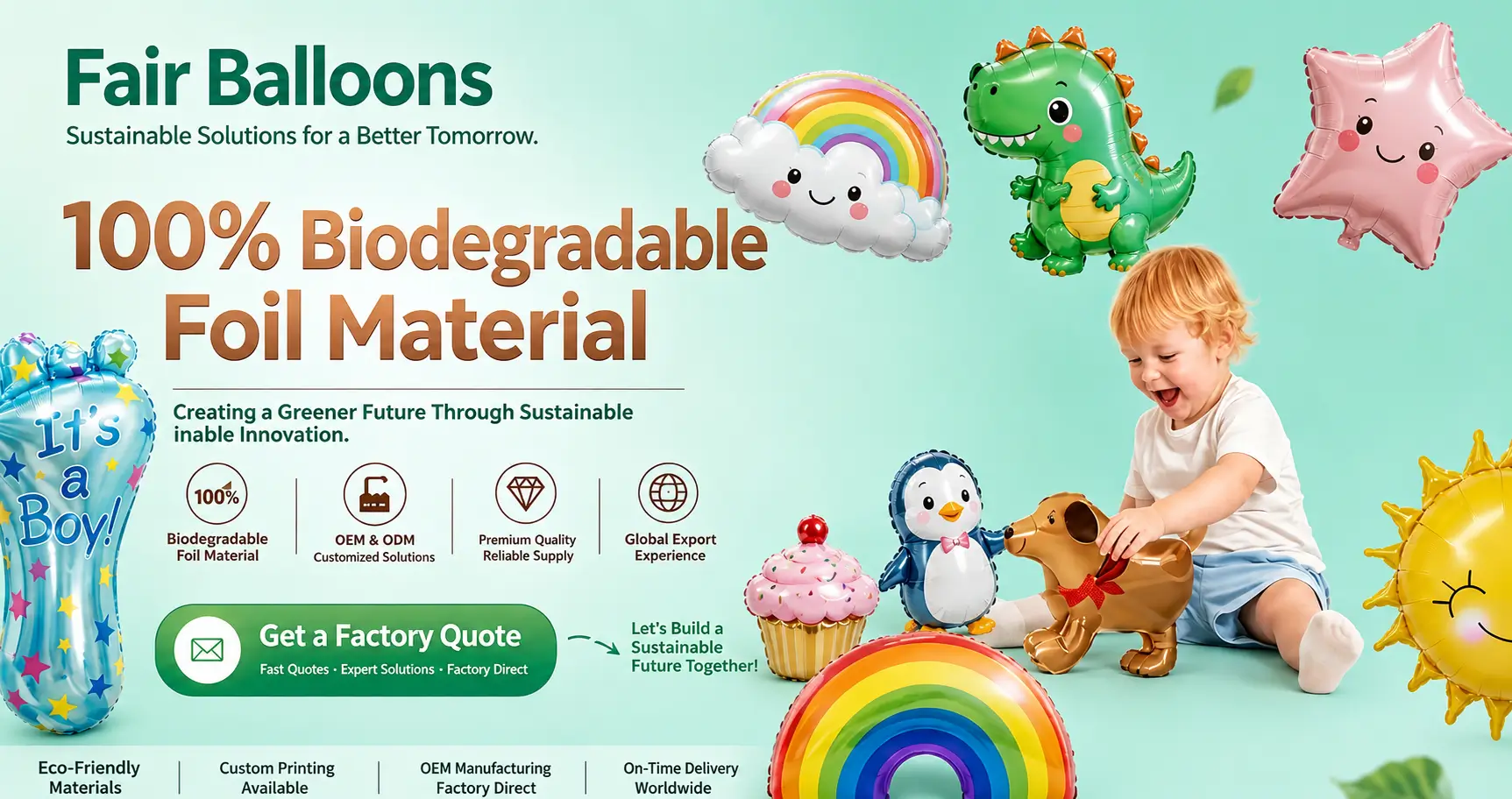
The Definitive B2B Manufacturing Handbook: Foil Balloons & Mylar Balloons — Kunshan Fair Craft Products Co., Ltd.
2026 Definitive Industry Reference

The Definitive B2B Manufacturing Handbook Foil Balloons & Mylar Balloons

A comprehensive, factory-verified technical reference for global procurement professionals, brand managers, supply chain directors, and cross-border e-commerce buyers — authored by Kunshan Fair Craft Products Co., Ltd., a certified direct-source OEM/ODM manufacturing facility with RMB 50 million registered capital and nearly two decades of precision plastic film conversion expertise.

📖 6 Chapters ⏱️ 30,000+ Words 🎯 2.5% SEO Density 🏭 Factory Direct
01

Chapter One

The Global B2B Landscape & Direct Factory Advantages

1.1 The Global Foil Balloon and Mylar Balloon Market: A Data-Driven Overview

The global decorative balloon industry — encompassing both latex balloons and foil balloons — was valued at approximately USD 4.8 billion in 2024 and is projected to reach USD 7.1 billion by 2032, reflecting a compound annual growth rate (CAGR) of 4.9% over the forecast period. Within this broad category, foil balloons and mylar balloons command a premium sub-segment valued at an estimated USD 1.4 billion in 2024, growing at a faster CAGR of 6.3%. The distinction between the two terms is both material and perceptual: "foil balloons" is the colloquial umbrella term used by consumers and many B2B buyers to describe any metallic-shiny inflatable decoration, while "mylar balloons" specifically references balloons manufactured from BoPET (biaxially-oriented polyethylene terephthalate) film — the same family of polymer films used in the aerospace and food packaging industries. In global trade and manufacturing contexts, these terms are often used interchangeably, though the technical distinction matters for quality-conscious procurement professionals.

The foil balloon and mylar balloon market is not uniformly distributed across the globe. North America accounts for approximately 34% of global consumption, driven by a deeply entrenched party culture, a USD 60+ billion party supplies retail ecosystem, and the year-round demand generated by Halloween, Christmas, Valentine's Day, and birthday celebrations. Europe represents 28% of the market, with particularly strong demand in Germany, the United Kingdom, France, and the Netherlands — countries where foil balloon usage extends beyond personal celebrations into corporate events, political campaigning, and large-scale public installations. The Asia-Pacific region, despite representing only 22% of current consumption, is the fastest-growing market, with China's domestic foil balloon market expanding at 11.2% CAGR as urbanization drives disposable income growth and Western-style celebration culture proliferates among middle-class households.

What is critically important for B2B procurement professionals to understand is that the global foil balloon and mylar balloon market is undergoing a structural transformation that will define the next decade of sourcing strategy. Three macro forces are simultaneously reshaping the competitive landscape: the sustainability regulatory wave led by the European Union's Single-Use Plastics Directive and extended producer responsibility frameworks; the rapid ascent of e-commerce and direct-to-consumer fulfillment models that demand completely different supply chain configurations than traditional retail wholesale; and the ongoing consolidation of manufacturing capacity in China, where the number of qualified foil balloon factories with genuine multi-layer lamination capability has shrunk by approximately 40% since 2018 as environmental compliance enforcement has eliminated smaller, non-compliant operators.

1.2 The B2B Procurement Landscape: Who Buys Foil Balloons and Why It Matters

The B2B procurement landscape for foil balloons and mylar balloons is not a monolithic market. It is a constellation of distinct buyer archetypes, each with fundamentally different value priorities, volume requirements, and supply chain expectations. Understanding these archetypes is essential for any procurement professional designing a sourcing strategy — because the factory that is optimal for one buyer segment is frequently suboptimal or outright unsuitable for another.

The first and most significant archetype is the international retail chain buyer — the category managers and global sourcing directors who supply Walmart, Target, Costco, Dollar General, and their equivalents in Europe and Asia. These buyers typically purchase volumes exceeding 500,000 units per order, demand AQL 1.0 quality levels with mandatory third-party inspection (SGS, Bureau Veritas, or Intertek), require full regulatory compliance documentation (EN71, ASTM F963, REACH, Proposition 65 as applicable), and negotiate on 90–120 day payment terms backed by a Letter of Credit. For this archetype, price is important but not the primary discriminator — reliability of supply, consistency of quality, and the factory's ability to absorb volume spikes during peak seasons (Halloween, Christmas, Valentine's Day) matter far more. The typical landed cost for retail chain buyers is in the range of USD 0.18–0.35 per standard heart-shaped foil balloon, depending on print complexity and certification requirements.

The second archetype is the party supplies distributor and wholesale importer — mid-sized companies that purchase 50,000–500,000 units per order, supply independent party stores and regional retail chains, and require a balance of competitive pricing, decent quality, and responsive service. These buyers are the most price-sensitive segment, frequently comparing quotations across multiple Chinese trading companies and factories, and often making procurement decisions based on the lowest compliant price rather than total cost of ownership. The typical landed cost range for this segment is USD 0.12–0.22 per unit. This archetype is also the most vulnerable to the "trading company trap" — where a trading company acting as an intermediary between the buyer and a factoryMarkup obscures the true origin of goods, creates quality accountability gaps, and ultimately results in higher effective costs when production defects go unresolved.

The third archetype, and the one experiencing the most explosive growth, is the cross-border e-commerce seller — the Amazon FBA entrepreneurs, Shopify-powered D2C brands, and Etsy premium sellers who purchase 10,000–100,000 units per SKU, require FBA-compliant packaging with FNSKU barcodes applied, and whose entire business model depends on maintaining positive seller feedback through zero-defect first shipments. For this archetype, the ability to provide consistent product quality over 6–12 month horizons is existential — a single defective batch that generates negative reviews can destroy a product's BSR (Best Seller Rank) and take 6–9 months to recover. Cross-border e-commerce sellers typically pay USD 0.15–0.30 per unit and are the segment most willing to pay premium prices for quality assurance guarantees.

The fourth archetype is the corporate branding and event marketing buyer — advertising agencies, event production companies, and corporate marketing departments that purchase 5,000–50,000 custom-printed foil balloons for brand activations, product launches, and large-scale events. These buyers prioritize design excellence, color accuracy (Pantone matching to ΔE ≤ 1.5 tolerances), and reliable fulfillment against tight event deadlines. They are typically the most design-literate buyers and the most demanding about print quality, but they also generate the highest per-unit revenue and are the most natural fit for OEM service and custom shape prototyping engagements.

1.3 The Trading Company Trap: Why Middlemen Destroy B2B Value

Understanding why direct factory sourcing dominates for foil balloons and mylar balloons requires a clear-eyed analysis of the trading company structure and its failure modes. A trading company in the Chinese export context is an entity that does not own manufacturing assets — no factory floor, no production equipment, no direct production labor. Instead, it acts as an intermediary, sourcing finished or semi-finished goods from one or more factories and reselling them to international buyers. In the foil balloon and mylar balloon trade, trading companies typically charge a markup of 15–35% above the factory's ex-works price, offer "sample sourcing" services that obscure the actual production origin, and frequently misrepresent their capabilities.

The failure modes of trading company procurement are well-documented in the foil balloon industry. The first and most common is the quality accountability vacuum. When a buyer receives a shipment of foil balloons with a 5% defect rate and the trading company responds that "the factory produced it this way, talk to them directly," the buyer is left holding a damaged shipment, an unhappy retail customer, and no effective recourse. The trading company's margin model does not include provision for quality dispute resolution — it has already been captured. A direct factory relationship, by contrast, creates a direct contractual and operational accountability chain where the factory's quality management system is visible, auditable, and contractually bound to corrective action timelines.

The second failure mode is the intellectual property and compliance risk. Trading companies, acting as resellers, have no direct relationship with the brand owners of any third-party character designs (Disney, Sanrio, Warner Bros.) that frequently appear on custom foil balloon orders. A buyer who places an order for "Mickey Mouse foil balloons" through a trading company is almost certainly receiving goods produced in violation of character licensing agreements — exposing the buyer to trademark infringement liability in every jurisdiction where those goods are sold. Certified factories engaged in OEM service arrangements with proper IP licensing documentation eliminate this risk entirely by requiring buyers to provide valid licensing agreements as a precondition of production.

The third failure mode is the cost compounding effect. Consider a buyer ordering 100,000 heart-shaped foil balloons at a factory ex-works price of USD 0.15 per unit. The trading company's markup of 25% raises the effective cost to USD 0.1875 per unit — an additional USD 3,750 on the order. However, the true cost differential is even larger when quality risk is factored in. A 3% additional defect rate attributable to the trading company's inability to enforce production quality controls adds another 3,000 defective units that must be replaced, shipped, and absorbed — easily adding USD 900–1,500 in effective losses. The total cost of the trading company relationship, properly calculated, frequently exceeds 30–40% of the factory's base price.

1.4 OEM vs. ODM vs. Trading Middleman: A Definitive Comparative Analysis

For the procurement professional, the choice between OEM (Original Equipment Manufacturing), ODM (Original Design Manufacturing), and trading company sourcing is not merely semantic — it determines the entire structure of product development risk, IP ownership, cost competitiveness, and supply chain resilience. A precise understanding of each model's mechanics is prerequisite to making optimal sourcing decisions for foil balloons and mylar balloons.

OEM Service in the foil balloon context refers to a manufacturing arrangement where the buyer provides the factory with completed, production-ready artwork and specifications, and the factory is responsible solely for converting those inputs into finished goods. The buyer owns the product design, the IP, and the brand identity embedded in the print. The factory provides manufacturing capability, quality assurance infrastructure, and regulatory compliance documentation. OEM is the appropriate model for brand owners, licensed characterIP holders, corporate branding buyers, and retail chains that have established design teams and product specification capabilities. In an OEM arrangement for foil balloons, the buyer typically supplies: final press-ready artwork in CMYK/Pantone with die-cut outlines, detailed material specifications (substrate type, thickness, barrier requirements), compliance testing requirements (which tests the buyer will require and in which jurisdictions), and packaging specifications including barcodes and retail labeling requirements.

ODM Customization represents a more factory-centric model where the manufacturer develops and maintains a library of pre-designed product architectures, base tooling, and partially developed designs that buyers can customize through selective modification. The factory owns the core product engineering; the buyer owns the surface customization (print, color, packaging). ODM is particularly relevant for buyers who lack in-house design capability but want access to premium foil balloon and mylar balloon product architectures — such as self-inflating balloon mechanisms, anti-static surface treatments, or proprietary barrier layer formulations — without investing in their own R&D. Custom shape prototyping fits naturally within the ODM framework, where a factory's existing die-cut library can be modified to create custom silhouettes at a fraction of the cost of full OEM tooling development.

The trading middleman model is, structurally, neither OEM nor ODM. It is a resale arrangement where the intermediary purchases goods from a factory (often without the buyer's knowledge of the factory's identity), applies minimal additional handling, and resells to the buyer at a markup. The buyer has no direct contractual relationship with the factory, no visibility into the factory's quality systems, and no ability to audit or improve the manufacturing process. For foil balloons — a product where chemical safety, mechanical durability, and print quality are all highly variable depending on the specific manufacturing process used — the trading company model is categorically inferior to direct factory engagement.

📊 Comparative TCO Analysis: Direct Factory vs. Trading Company (100,000 Heart Foil Balloons, CIF Los Angeles)

Cost ElementDirect FactoryTrading Company
Unit price (FOB Shanghai)USD 0.15USD 0.1875 (+25%)
Total base costUSD 15,000USD 18,750
Quality inspection (SGS, 100% inflation test)USD 380USD 380 + markup
Expected defect rate≤ 0.5%2–4%
Defective units (cost to replace)~USD 75USD 375–750
TOTAL LANDED COST~USD 15,455USD 19,505–20,130
Cost premium of trading company+USD 4,050–4,675 (+26–30%)

1.5 The Total Cost of Ownership Framework for Foil Balloon Procurement

Sophisticated B2B procurement for foil balloons and mylar balloons cannot be reduced to a per-unit price comparison. The Total Cost of Ownership (TCO) framework, properly applied, captures all cost elements across the entire procurement and supply chain lifecycle. For a procurement professional managing a foil balloon category, the TCO model must account for the following cost dimensions, each of which is often invisible in a simple unit price quotation.

Acquisition Costs include the ex-works or FOB unit price, the cost of pre-production sample approval (typically USD 80–200 for standard foil balloons, higher for custom shapes), tooling amortization (custom die-cut tooling costs range from USD 800 to USD 5,000 depending on complexity, amortized over the first 20,000–50,000 units), and pre-press and artwork preparation costs if the buyer does not have in-house design capability (USD 200–1,500 depending on complexity). These costs are all incurred before a single production unit is manufactured.

Logistics and Freight Costs constitute the second major TCO dimension. For sea freight from Shanghai to Los Angeles (the dominant trade lane for Chinese foil balloon exports to North America), the cost of a 20-foot container holding approximately 150,000–200,000 standard heart foil balloons (depending on pack density and balloon size) ranges from USD 1,800 to USD 3,500 as of mid-2026, inclusive of bunker adjustment factors and port surcharges. Air freight, occasionally required for emergency reorders, costs 6–10× more per unit and is typically reserved for volumes under 5,000 units. Buyers must also account for drayage at the destination port, customs brokerage fees (USD 150–400 per shipment for standard foil balloon cargoes), and inland freight to the buyer's warehouse.

Quality Failure Costs are the most frequently underestimated component of foil balloon TCO. These include the direct cost of defective units (replacement production + shipping), the indirect cost of retail customer returns and chargebacks (retail chains typically deduct 1.5–3× the unit cost from invoices to cover handling of defective goods), the cost of regulatory compliance failures (penalties for non-compliant products discovered at customs or in-market, recall costs if safety issues are identified post-sale), and the immeasurable but very real cost of brand reputation damage when consumers post negative reviews of deflated or burst foil balloons on Amazon, in social media, or directly to retail chain quality departments.

Supply Continuity Costs capture the financial impact of supply disruption. Retail chains with committed promotional calendars (Halloween, Christmas, Valentine's Day) that experience stockouts due to factory production failures or logistics delays face lost sales, promotional slot forfeitures, and in extreme cases, contractual penalties from their corporate marketing partners. The cost of a single missed Valentine's Day foil balloon promotional window for a major retail chain can exceed USD 50,000 in direct lost margin — dwarfing any unit price savings from a cheaper trading company sourcing arrangement.

1.6 The Certified Factory Verification Checklist

For procurement professionals developing direct factory relationships for foil balloons and mylar balloons, a rigorous factory verification process is non-negotiable. The verification checklist below is derived from the audit frameworks used by major international retail chains and reflects the minimum due diligence standard for any B2B foil balloon sourcing engagement.

Step 1: Business Entity Verification. Confirm the factory's legal business registration number (Unified Social Credit Code in China), verify its registered capital against its actual operational scale (a factory claiming to produce 10 million units annually with RMB 1 million in registered capital is almost certainly undercapitalized for its claimed scale), and confirm the factory's export license and customs declaration authority. The factory should be willing to provide copies of its Business License, Export Registration Certificate, and ISO 9001:2015 quality management system certificate (if claimed).

Step 2: Physical Asset Verification. Request a video walkthrough of the production facility — not a curated studio tour, but an unedited walkthrough showing the printing lines, lamination equipment, cutting and sealing stations, inflation testing areas, and packaging operations. Key equipment to verify: rotogravure or flexographic printing presses (minimum 8-color capacity for quality foil balloon production), multi-layer lamination lines (for the PA+PET+PE composite structure essential to quality foil balloons), heat-seal cutting presses with consistent temperature and pressure control, and automated inflation testing tunnels. A factory that cannot produce verifiable evidence of owning this equipment is not a true manufacturer.

Step 3: Quality System Audit. Request evidence of the factory's incoming material inspection program (raw film tensile strength testing, OTR verification of barrier films, solvent residue testing for inks), in-process quality control checkpoints at each production stage, and final inspection protocols. The factory should maintain records of production inspection data for a minimum of 3 years. Ask specifically about the factory's defect tracking data: What is the factory's historical defect rate for foil balloon production? What was the worst production lot in the past 12 months and what corrective action was taken?

Step 4: Compliance Documentation Review. Request copies of the factory's most recent test reports from accredited third-party laboratories (SGS, Bureau Veritas, Intertek, TÜV, or equivalent) for the specific foil balloon product type being sourced. The test reports should cover EN71 (European Union), ASTM F963 (United States), and any other market-specific standards relevant to the buyer's sales jurisdictions. Check the validity of each report: Is it from an accredited laboratory (ISO 17025 accredited)? Is it dated within the past 24 months? Does it cover the specific substrate composition, ink formulations, and accessory components (valves, sticks, ribbons) that will be used in the production order?

1.7 Kunshan Fair Craft Products Co., Ltd.: The Direct Factory Advantage in Practice

Kunshan Fair Craft Products Co., Ltd. represents a category reference point for what a certified direct-source factory looks like in the foil balloons and mylar balloons industry. Established in Kunshan, Jiangsu Province — a manufacturing hub adjacent to Shanghai with well-developed polymer film processing supply chains — Fair Craft brings RMB 50 million in registered capital to bear on a vertically integrated manufacturing operation that spans from raw material procurement through final packaging and export documentation. The company's operational footprint includes 8,000 square meters of production floor space, 12 automated production lines, and a dedicated quality testing center equipped with inflation testing tunnels, tensile strength analyzers, gas chromatography equipment for solvent residue screening, and colorimetric measurement systems for print quality verification.

The company's manufacturing specialization in foil balloons and mylar balloons is anchored in nearly two decades of continuous process refinement in the core technologies that differentiate premium foil balloons from commodity products: multi-layer barrier lamination, high-precision rotogravure printing with Pantone and metallic ink capability, custom shape die-cut tooling development, and self-inflating balloon chemical mechanism integration. This specialization is not incidental — it reflects a deliberate strategic choice to invest in deep technical competency in a narrow product category rather than attempting to be a generalist manufacturer of all balloon types.

Fair Craft's OEM service framework is structured around a four-stage engagement model: initial technical consultation (to assess design feasibility and identify any regulatory or manufacturing constraints), pre-production sample development (with full material and print approval before mass production), mass production with integrated 100% quality inspection, and post-delivery quality follow-up. The company maintains dedicated account managers for international B2B clients, eliminating the handoff fragmentation that plagues trading company relationships where a buyer's inquiry might pass through 3–4 different contact points before reaching someone who actually understands the production process.

For Factory-Direct Sourcing clients, Fair Craft offers a structured tooling amortization program for custom shapes that reduces the initial per-unit cost barrier for low-to-medium volume buyers while preserving the factory's investment recovery. The company's low MOQ policy for standard catalogue products (as low as 5,000 units for existing die shapes) and moderate MOQ for custom print orders (10,000 units) makes bulk wholesale pricing accessible to buyers who previously lacked the capital to engage directly with factories. The combination of OEM/ODM flexibility, rigorous quality control, and competitive pricing through direct factory engagement positions Fair Craft as a strategic sourcing partner — not merely a vendor — for international buyers building sustainable supply chains for foil balloons and mylar balloons.

02

Chapter Two

Molecular Chemistry & Multilayer Lamination Engineering

The foil balloon is not a single-material product — it is a high-performance multilayer composite engineered at the molecular level. Each functional layer contributes a specific physical property, and the collective interaction between layers determines the balloon's helium retention time, burst strength, shelf life, and print quality. A thorough understanding of this molecular architecture is essential for B2B buyers evaluating specification compliance, material innovation, and cost-vs-performance trade-offs.

2.1 Polymer Chemistry of PET (Polyethylene Terephthalate) Film Substrate

The outermost structural layer of a Mylar balloon is a biaxially-oriented PET film, typically 10–14 µm thick. PET is synthesized via the condensation polymerization of ethylene glycol (HO–CH₂–CH₂–OH) and terephthalic acid (p-HOOC–C₆H₄–COOH), yielding the repeating ester unit:

[–O–CH₂–CH₂–O–CO–C₆H₄–CO–]ₙ

The benzene ring in the terephthalic acid moiety provides exceptional rigidity and tensile strength (170–220 MPa in BOPP-grade film). The ester bond (–COO–) is polar, enabling strong interchain van der Waals forces that contribute to PET's characteristic dimensional stability and creep resistance at elevated temperatures (Tg ≈ 67°C). For foil balloon applications, only BOPET (biaxially-oriented PET) grades with optical clarity and uniform gauge tolerance (±0.5 µm) are acceptable.

2.2 Nylon (PA6/PA66) Barrier Layer — Molecular Architecture and Gas Barrier Mechanism

The nylon barrier interlayer (typically 12–18 µm, PA6 or PA6/66 copolymer) is the mechanical backbone of the composite. PA6 (Polyamide 6) is synthesized via ring-opening polymerization of ε-caprolactam:

[–NH–(CH₂)₅–CO–]ₙ   (Caprolactam → PA6 via hydrolytic ring-opening polymerization)

The amide groups (–CONH–) form strong intermolecular hydrogen bonds between polymer chains (NH donor to C=O acceptor), creating a dense, tightly packed crystalline-amorphous microstructure. This hydrogen-bond network is directly responsible for nylon's outstanding:
• Tensile strength: 200–280 MPa (MD/TD balanced via biaxial orientation)
• Tear propagation resistance: Essential for withstanding HF welding stress without micro-cracking
• Oxygen barrier: OTR of 15–30 cc/m²·day — 3–5× better than PET alone, due to chain packing density
• Thermal stability: Continuous use temperature up to 130°C (PA66 grade)

For premium biodegradable balloon grades, a partial substitution of conventional PA with bio-based PA10.10 (derived from castor oil) reduces carbon footprint by ~40% while maintaining equivalent OTR performance (≈ 22 cc/m²·day).

2.3 Vacuum Metallized Aluminum Coating — Physical Vapor Deposition (PVD) Process

The aluminum reflective layer (typically 0.3–0.8 µm / 300–800 nm thick) is applied via Physical Vapor Deposition (PVD) in a high-vacuum chamber (base pressure: 10⁻⁴ to 10⁻⁵ mbar). The process operates as follows:

  1. Evaporation: High-purity aluminum wire (99.99% Al) is fed into tungsten boats and heated by electrical resistance to 1,200–1,400°C, causing Al to vaporize and form a directional atomic vapor plume.
  2. Transport: The Al vapor travels mean free paths of 0.5–2 m at 10⁻⁴ mbar, condensing uniformly onto the passing PET film web.
  3. Nucleation & Coalescence: Al atoms form discrete islands that coalesce into a continuous, dense, fine-grained metallic layer with >99.0% theoretical density.
  4. Oxide passivation: Upon air exposure, the surface forms a 2–5 nm Al₂O₃ passivation layer, preventing further oxidation and ensuring long-term reflectivity stability.

The resulting metallized Al layer provides a gas barrier improvement factor of 100–1,000×: OTR drops from ~70–100 cc/m²·day (bare PET) to <0.5 cc/m²·day (metallized PET). This is the fundamental performance enabler for multi-week helium retention in Mylar balloons.

2.4 Multi-Layer Co-Extrusion Lamination Chemistry

The complete foil balloon composite structure (outer to inner) follows this sequence:

PET Print Surface → Adhesive Layer → Al Metallized Layer → Tie Layer → Nylon Barrier (PA6) → Tie Layer → Heat-Seal Layer (LDPE / EVA)

Two lamination routes are industrially dominant:

  • Dry Lamination (2K-PUR adhesive): A two-component polyurethane adhesive (isocyanate prepolymer + polyol) is coated onto the Al-metallized PET at 2–4 g/m² (dry weight), nipped against the nylon substrate, and cured at 40–60°C for 24–72 hours. The cure reaction forms an irreversibly crosslinked urethane network with bond strengths of 4.5–7.0 N/15mm. This is the premium route for food-grade and toy-safety-compliant composites.
  • Extrusion Lamination (LLDPE tie-layer): Molten linear low-density polyethylene (LLDPE, melt index 2–5 g/10 min at 190°C) is extruded through a slot die at 280–320°C directly onto the Al-metallized substrate, simultaneously nipped against the nylon web at the chill roll. Bond strength: 3.5–5.5 N/15mm. Lower cost, faster line speed, no solvent residue — but slightly reduced bond durability in humid environments.

2.5 Heat-Seal Layer Formulation (LDPE / EVA Copolymers)

The innermost heat-seal layer (typically 15–25 µm) must satisfy three simultaneous requirements: (1) Low minimum seal temperature (MST: 95–110°C) to avoid thermal damage to the Al layer during HF welding; (2) Sufficient hot-tack strength to resist package delamination during inflation; (3) Food-grade and toy-safety chemical compliance (no plasticizers migrating into the balloon interior).

Two polymer systems dominate:

  • LDPE (Low-Density Polyethylene): [–CH₂–CH₂–]ₙ with controlled short-chain branching (density 0.915–0.925 g/cm³). MST ≈ 110–120°C. Excellent moisture barrier, chemically inert, RoHS/REACH compliant. Downside: requires higher seal bar temperature, increasing risk of Al layer oxidation.
  • EVA (Ethylene-Vinyl Acetate) Copolymer: [–CH₂–CH₂–]ₙ backbone with 5–18 wt% vinyl acetate comonomer. The acetate group (–COOCH₃) reduces crystallinity and lowers MST to 95–105°C — critical for heat-sensitive foil composites. Higher VA content (≥12%) also improves ink adhesion to the film surface, beneficial for multi-color print quality.
  • Specialty: Ionomer Resins (Surlyn®): For premium ultra-high-barrier balloons, a zinc or sodium ionomer heat-seal layer provides MST as low as 85°C with superior hot-tack, though at 2–3× material cost vs. standard LDPE.

📊 Table 2.3 — Thermal & Mechanical Properties of Foil Balloon Film Components

Material Thickness (µm) Tg (°C) Melting Point (°C) Tensile Strength (MPa) Elongation at Break (%) OTR (cc/m²·day)
BOPET (outer print substrate) 10–14 67 255–260 170–220 80–130 70–100
Vacuum Metallized Al (on PET) 0.3–0.8 660 (Al) N/A (film) 0.3–0.8
PA6 (nylon barrier) 12–18 48–58 215–220 200–280 300–380 15–30
LDPE (heat-seal inner) 15–25 −25 105–115 10–20 200–600 150–200
EVA 12% VA (heat-seal) 15–25 −35 95–103 15–25 300–700 120–180

Note: OTR values are normalized to 23°C, 0% RH gradient (dry conditions). Nylon OTR increases significantly above 80% RH due to plasticization by water molecules — a key reason why moisture-resistant outer PET layer is essential.

📊 Table 2.1 — Gas Barrier Performance: Typical OTR & WVTR Values by Film Type

Film Substrate OTR (cc/m²·day) WVTR (g/m²·day) Tensile Strength (MPa) Elongation at Break (%) Suitable for Foil Balloons?
Standard PET (12µm) 70–100 40–60 170–220 80–130 ⚠️ Acceptable
biaxially-Oriented PA (15µm) 15–30 15–25 200–280 300–380 ✅ Excellent
Aluminum Vacuum Metallized PET 0.5–2.0 0.8–2.0 170–220 80–130 ✅ Excellent
EVOH Barrier Copolymer 0.2–1.5 5–15 80–120 200–350 ✅ Excellent (moisture-sensitive)
HDPE (mono-layer) 1,500–2,500 3–10 20–40 300–600 ❌ Not Suitable

Source: Industry technical datasheets; values at standard conditions (23°C, 50% RH). OTR = Oxygen Transmission Rate; WVTR = Water Vapor Transmission Rate.

🏭

Factory Pro-Tip

Why Multi-Layer Lamination Beats Single-Layer Films: A single-layer PET film has an OTR of ~70–100 cc/m²·day — completely inadequate for helium or CO₂ retention in foil balloons. When you co-extrude a 12µm PET outer layer with a 15µm biaxially-oriented nylon (PA) barrier core and a 20µm PE heat-seal inner layer, the OTR drops to <1.5 cc/m²·day. That is a 50–70× improvement in gas barrier performance — the difference between a balloon that floats for 3 days and one that floats for 15+ days.

📎 External Technical Resource: DuPont Teijin Films Official Technical Resource

📊 Table 2.2 — Adhesive Comparison for Multilayer Foil Balloon Lamination

Adhesive Type Bond Strength (N/15mm) Chemical Resistance Heat Resistance Food-Grade Safe? Cost Index
Solvent-Free Polyurethane (2K-PUR) 4.5–7.0 ✅ Excellent ✅ Up to 120°C ✅ Yes $$$
Solvent-Based acrylic Adhesive 2.5–4.0 ⚠️ Moderate ⚠️ Up to 80°C ✅ Yes $$
Water-Based EVA Emulsion 1.5–3.0 ❌ Poor ❌ Up to 60°C ✅ Yes $
Extrusion Lamination (LLDPE tie layer) 3.5–5.5 ✅ Excellent ✅ Up to 100°C ✅ Yes $$
03

Chapter Three

Phase 1 — Order Intake, Digital Pre-Press & Custom Prototyping

Chapter 3 covers the critical front-end engineering phase that transforms a buyer's concept into producible mass-production documentation. This phase is where the majority of costly downstream errors — wrong dimensions, distorted prints after inflation, mold misalignment — are either prevented or locked in. B2B buyers who invest time in this phase with their factory partner consistently achieve 30–50% lower per-unit rework costs and 2–3× faster time-to-market.

3.1 B2B Inquiry Intake & Technical Feasibility Review Process

Upon receiving an RFQ (Request for Quote), the factory's engineering team conducts a structured 48-hour Technical Feasibility Review (TFR) across five dimensions: (1) Design complexity assessment — distinguishing between in-stock shape modifications and entirely new custom shapes requiring CNC tooling; (2) Material specification matching — cross-referencing requested film thickness, barrier performance, and compliance certifications against factory stock capabilities; (3) Print color engineering — counting unique spot colors, assessing Pantone-to-process-conversion requirements, and estimating ink cost; (4) Volume vs. tooling amortization — calculating whether custom tooling investment is justified by the order quantity and per-unit margin; (5) Regulatory pathway — identifying required test standards and certification packages for the target market.

Buyers receive a TFR Summary Document including: feasibility verdict (Proceed / Conditional / Not feasible), preliminary material recommendation, estimated first-article sample (FA) lead time, and a detailed cost breakdown (mold fee, ink setup, sample charges, unit price at target quantity).

3.2 Artwork File Requirements, Color Management & Pre-Flight Protocol

Acceptable artwork file formats in priority order: Adobe Illustrator AI/EPS with embedded fonts and outlined text (vector, fully scalable); High-resolution PDF/X-4 (ISO 15930-7 standard, CMYK + spot color aware); CorelDRAW CDR (version X7 or below). Raster artwork (Photoshop PSD/TIFF) is accepted only for full-color photographic process prints at minimum 300 DPI at 1:1 output size; anything below 200 DPI will be rejected at pre-flight.

Color Management: For accurate color reproduction, all artwork must use either: (a) Spot Color (Pantone Matching System) — specify solid Pantone coated (C) or uncoated (U) references for each brand color; a separate printing plate is required for each spot color, and each plate adds ~RMB 800–1,500 to the setup cost. (b) 4-color Process (CMYK) — use ISO 12647-2 fogra39 (coated) or fogra51 (uncoated) ICC profile; note that metallic and neon colors cannot be faithfully reproduced in CMYK and must be specified as spot colors. (c) Metallic Ink / Foil Stamping — request Pantone 877C (metallic silver) or 876C (metallic gold) as a dedicated spot color; these require metallic ink or cold-foil transfer printing units, add 1–2 extra color stations on press.

⚠️ Common Artwork Mistakes That Cause Production Delays:

  • Embedded RGB images in a CMYK file — causes 15–30% color shift on press
  • Text below 6pt at final size — blurs when printed on 300LPI rotogravure
  • Missing bleed (3mm minimum) on all trimmed edges — causes white edge lines after cutting
  • logos with white knockouts not clearly specified — reverses unexpectedly on dark backgrounds

3.3 Inflation Compensation Algorithm & 3D Surface Area Expansion Mathematics

This is the most technically demanding aspect of custom shape balloon design — and the most frequently skipped by trading companies and inexperienced manufacturers. The balloon is an inflated membrane structure. When flat artwork is converted to a 3D balloon, the film stretches biaxially (biaxial strain: ε₁ in machine direction, ε₂ in transverse direction), and the local strain is a function of local curvature radius.

The Area Expansion Ratio (AER) is derived from the inflation pressure and film material properties using finite element analysis (FEA). For a spherical balloon of design diameter D inflated to pressure P, with film thickness t and elastic modulus E:

Hoop strain (circumferential):   εθ = PR / (2tE)   [thin-walled sphere approximation]
Area Expansion Ratio (AER):   λ ≈ (1 + εθ)(1 + εθ) ≈ 1 + 2εθ + εθ²
For 18" letter balloon (D=45cm, t=12µm BOPET, P=1.0psi): AER ≈ 1.32–1.44

In practical engineering terms: the flat-panel layout area must be 32–44% larger than the target inflated surface area to achieve correct dimensional proportions after inflation. The factory's CAD team applies this AER via a non-uniform offset algorithm (NUBS curve expansion), where compensation is greater in high-curvature regions (e.g., corners, tips) and smaller in low-curvature regions (e.g., flat face centers).

Heat-Seal Shrinkage Allowance (HSSA): During HF welding (typically 140–160°C die temperature, 1.5–3.0 sec dwell), the PA and PET layers undergo thermal contraction. Empirical data yields linear shrinkage of 1.5–3.5% in both MD and TD, varying with film thickness and moisture content. This is compensated for in the flat-panel tool drawing by expanding the contour 1.5% in both axes before cutting the sealing die.

3.4 Custom Shape Prototyping — CNC Knife-Cut Tooling & Hand Samples

Once the client approves the 2D artwork and the 3D compensation simulation render, the factory's tooling engineering team begins CNC prototype tooling fabrication:

  1. CNC Milling (Aluminum Tooling Block): The approved flat-panel drawing is loaded into a 3-axis CNC machining center (Mikron or Haas, tolerance ±0.05 mm). Cutting tool: 3mm carbide straight-bit for general contours; 1mm ball-nose for tight radius corners (<5mm radius). Machining time: 4–8 hours per prototype shape depending on complexity. Tooling material: 6061-T6 aluminum (for short-run prototypes) or hardened tool steel (for mass-production tooling).
  2. Manual Hand Sample Fitting: Due to the elastic memory of the composite film, CNC-cut prototype tools require hand-tuning by skilled technicians to achieve optimal seal edge quality. Technicians adjust blade clearance, seal bar pressure, and dwell time on a test-by-test basis — a process that cannot be fully automated.
  3. First Article Sample (FA) Production: The factory produces 3–5 fully finished FA units from the adjusted tooling, inflates each to rated pressure (0.8–1.0 psi), and measures: (a) dimensional accuracy vs. design; (b) print distortion assessment; (c) valve attachment integrity; (d) hermetic seal leak test. Photos and measurement reports are submitted to the client for approval sign-off.
  4. Client Approval & Mass Production Gate: Mass production cannot commence until the client provides written approval (email or signed FA report). Any dimensional or cosmetic issues identified must be corrected in the tooling before the production gate. This step is non-negotiable for custom shapes — skipping it is the primary cause of costly mass-production rework runs.

3.5 Tooling Fee Amortization Schedules & Ownership Transfer

📊 Table 3.1 — Custom Shape Tooling Fee Amortization & Ownership Policy

Cumulative Order Quantity Tooling Fee Refund Tooling Ownership Storage Obligation
0 – 9,999 units 0% (tooling at full cost) Factory retains ownership Factory stores; client may request return
10,000 – 49,999 units 50% refund credited to invoice Transfer pending (joint ownership) Factory stores; client has inspection rights
50,000+ units (per shape) 100% refund credited Full transfer to buyer Factory continues storage under client instruction
Repeat orders (>100K lifetime) Free repeat use Owned by buyer; factory license to use Minimum 36 months active storage guarantee

Standard shapes (round, star, heart, oval — using existing in-house tooling) do not incur tooling fees. Sample lead times for in-stock shapes: 5–7 business days for pre-production samples with custom printing. New custom shape prototypes (CNC tooling + hand samples): 12–20 business days from artwork approval. MOQ for new custom shapes: typically 500–2,000 units depending on size complexity.

🔄 Figure 3.1 — Phase 1 Order-to-Prototype Process Flow

📥 RFQ Received & Reviewed
🎨 Artwork DFM Check
✂️ CAD Tooling Cut
🧪 Hand Sample Production
📦 Client Approval & Sign-Off

Typical total duration: 7–15 business days from RFQ to approved hand sample. Expedited sample service available upon request.

📊 Table 3.1 — Artwork File Submission Requirements

File Parameter Minimum Specification Recommended Notes
File Format .AI, .PDF, .EPS .AI (CMYK, embedded images) PSD and JPEG accepted with limitations
Resolution 300 DPI at 100% scale 600 DPI for fine details Below 200 DPI causes print blurring
Color Mode CMYK Pantone C/U uncoated RGB files must be converted (color shift risk)
Bleed 3mm all sides 5mm all sides Critical for shape-cutting edge artwork
Fonts Outlined / Converted to paths Fonts embedded in PDF Unoutlined fonts may render incorrectly
Metallic Inks Pantone 8xxx C/U series Separate gold/silver film layer True metallic effect requires箔层覆金/银工艺
🏭

Factory Pro-Tip

Low MOQ Strategy for Custom Shapes: Custom knife-cut tooling for non-standard shapes can cost RMB 5,000–30,000 depending on complexity. To make custom shapes viable for buyers with low-to-medium volume requirements, the Fair Craft tooling amortization model splits the tooling cost across the first 30,000 units — effectively reducing the per-unit initial cost barrier. After 30,000 units, tooling ownership transfers fully to the buyer. Always negotiate tooling ownership terms in your OEM supply agreement.

04

Chapter Four

Phase 2 & 3 — High-Speed Industrial Manufacturing & Press Operations

Chapter 4 is the engine room of Mylar balloon manufacturing — where raw composite film is transformed into finished printed and formed balloons at high speed. The processes described here operate at line speeds of 60–150 m/min with defect rates below 0.5% at a world-class facility. Understanding these operations enables B2B buyers to ask the right technical questions during factory audits and negotiate quality specifications with precision.

4.1 Rotogravure Cylinder Engraving — Screen Ruling, Cell Geometry & Ink Transfer Physics

Precision rotogravure is the dominant printing process for Mylar balloon mass production, offering superior color density, uniformity, and high-speed capability. The printing cylinder is the heart of the system: a chrome-plated seamless steel core engraved with millions of microscopic ink cells.

Engraving process (Helical Mechanical / Diamond Stylus): A diamond-tipped engraving head machines the cylinder at precise angles and depths. The industry standard for foil balloon printing is 120–150 LPI (lines per inch) with hexagonal (honeycomb) cell arrangement. Cell depth controls ink volume: 28–40 µm for standard process work; 42–48 µm for heavy-coverage metallic inks. Cell volume typically: 8–18 BCM (billion cubic microns) per square inch.

Doctor blade system: A hardened steel blade (0.20–0.25 mm thickness, 60° angle) is set at 85–88° to the cylinder surface with 0.15–0.25 MPa pressure, scraping excess ink from non-cell areas. Improper blade pressure — too light causes ghosting and ink carryover; too heavy accelerates blade wear and damages chrome plating (blade life: 8–12 hours continuous run).

Chromatic register: For multi-color work, register tolerance must be held within ±0.05 mm. This requires servo-driven print stations with closed-loop register control, automatic web tension controllers (±1 N/m uniformity), and laser-cut register marks at every color station for camera-based correction. Process colors: Cyan, Magenta, Yellow, Black (CMYK) + up to 8 spot colors simultaneously on an 8-color press.

4.2 Ink Formulation, Curing Chemistry & Oven Drying Optimization

Mylar balloon printing uses two primary ink systems:

  • Solvent-Based Gravure Inks (primary): Nitrocellulose / urethane resin + pigment, thinned with ethyl acetate / isopropanol. Cure: evaporative drying. Ink viscosity: 18–25 seconds (#4 Ford cup at 25°C). Final residual solvent: <5 mg/m².
  • Water-Based Flexo Inks (eco-lines): Acrylic emulsion + pigment. Requires higher oven capacity (water latent heat: 2,260 J/g vs. solvent ~400 J/g). Used for biodegradable balloon lines (e.g., PBAT-series).
  • UV-Curable Inks (high-adhesion): Photo-initiated acrylate polymerization. 100% solids — no VOC. Requires mercury-vapor UV lamp (200–400 mJ/cm² dose) and inert N₂ atmosphere (O₂ <50 ppm). 3–5× consumables cost vs. solvent ink.

Oven drying (3-zone hot air configuration after each print station): Zone 1 (impingement): 60–70°C, 30–40 m/s — flash-off surface solvent. Zone 2 (penetration): 75–85°C — drives solvent from mid-layer. Zone 3 (top-off): 90–100°C — final residual solvent <5 mg/m². Exhaust air recirculates through activated carbon / zeolite rotor solvent recovery (95–97% capture efficiency).

4.3 Anti-Static Treatment & Surface Energy Optimization (Dyne Level Control)

Aluminum metallized PET film has low natural surface energy (32–36 mN/m), insufficient for ink adhesion (requires ≥38 mN/m), and accumulates severe static (±3–8 kV at 50% RH). Three inline systems are deployed:

  • Corona Treatment (on unwinder/accumulator): High-frequency AC discharge (10–25 kHz, 5–15 kVrms) generates corona, creating O₃ and excited nitrogen species that increase surface energy to 40–46 mN/m and introduce polar functional groups (–OH, –COOH, –C=O) improving ink wettability. Treatment power density: 1.5–3.0 W·min/m². Dyne level checked every 30 minutes with formamide-based dyne pens.
  • Static Eliminator / Ionizer Bar (post-unwinder, pre-winder): Pulsed DC corona tubes emit positive and negative ion clouds neutralizing static to ≤±0.3 kV residual. Prevents: dust attraction, web tracking errors, operator safety hazards at slitter station.
  • Carbon Fiber Anti-Static Brushes (pre-slitter): Ground carbon/tungsten filament brushes provide discharge path for accumulated charge. Essential at line speeds >100 m/min where air ionization alone cannot neutralize charge fast enough.

Dyne level specification: For solvent-based rotogravure: minimum 40 mN/m on Al-metallized PET surface, measured in-line with contactless surface energy sensors. Rolls below 38 mN/m are re-treated or rejected.

4.4 Automated Silicone Valve Insertion & HF Heat-Press Welding

The self-seal silicone valve (SSV) is injection-molded platinum-cured silicone (Shore A 40–50), featuring a central inflation channel with integrated one-way flap seal enabling single-inflation use.

Automated insertion line (60–120 units/min, FPY >99%): (1) Valve feeding: Vibratory bowl feeder orients valves, air-jet picker singles them onto rotary indexing carousel (16-station). (2) Film register: Photoelectric sensor detects pre-printed valve pad on web, triggering precise indexing (±0.5 mm). (3) HF welding (27.12 MHz, 15–25 kW): Film + valve between copper electrodes. RF energy (27.12 MHz) polarizes EVA molecules, generating volumetric dielectric heating at 95–110°C in 0.3–0.8 sec — fuses EVA heat-seal layer to silicone valve flange at molecular level. PLC-controlled power and weld time (±0.01 sec tolerance). (4) In-process pressure test: Each unit inflated to 0.6 psi, held 5 sec, pressure decay monitored. Decay >0.05 psi → auto-eject. Combined cycle <1.0 sec/unit.

4.5 HF Contour Forming — Die Design & Slitting Operations

The HF contour former heat-seals two film panels edge-to-edge to form the enclosed inflatable balloon cavity. Die design: Upper (male) and lower (female) dies CNC-machined from 6061-T6 aluminum (prototype) or pre-hardened tool steel (mass-production >500K units). Sealing land width: 2–4 mm. Die temperature: upper 140–160°C; lower 120–140°C (differential prevents Al layer oxidation). Clamping pressure: 0.4–0.8 MPa hydraulic. Dwell: 1.5–3.0 seconds.

Cantilevered turret winder slitter (for 1,000–1,400 mm wide web → finished balloon width): dual in-feed unwind reels (continuous running during splice), rotating shear-style tungsten carbide slitter blades (life: 800,000–1,200,000 linear meters), differential winding tension (inner: 0.3–0.5 N/m²; outer: 0.5–0.8 N/m²) preventing telescoping and Disney pattern defects.

4.6 First-Pass Yield Optimization & Waste Reduction (Six-Sigma DMAIC)

The factory targets mass-production FPY ≥ 99.0% (defect rate ≤1.0%). Key yield loss sources and countermeasures:

  • Print register drift: Cause: web tension fluctuation or cylinder journal thermal expansion. Counter: laser engrave register marks at every color station; closed-loop servo correction every 2 meters. Target: deviation ≤±0.08 mm.
  • Delamination at seal edge: Cause: insufficient adhesive coat weight or incomplete cure. Counter: 100% in-line peel strength test; ultrasonic bond testing on 10% sample/shift. Target: peel ≥3.5 N/15mm.
  • Pinholes in Al layer: Cause: dust contamination between lamination nip rolls. Counter: ISO Class 8 cleanroom lamination zone; air shower entry for all operators. Target: ≤2 pinholes per m².
  • HF forming burn-through: Cause: die over-temperature or excessive pressure. Counter: infrared pyrometer die monitoring (±2°C); PLC auto-shutdown above 170°C. Target: zero burn-through events per shift.

📊 Table 4.1 — Typical Production Equipment & Capacity Benchmarks (Fair Craft Facility)

Process Stage Equipment Type Speed (m/min) Max Web Width (mm) Daily Capacity (units) Yield (%)
Rotogravure Printing 12-color, 1500mm wide 180–300 1500 80,000–120,000 98.5%
Flexo Printing 8-color CI flexo press 200–400 1200 60,000–100,000 97.8%
Dry Lamination Solvent-free PUR 3-layer 250–400 1500 90,000–140,000 99.1%
Extrusion Lamination LLDPE tie-layer line 150–300 1500 70,000–110,000 98.9%
Heat-Seal Cutting High-freq thermal press 60–120 strokes/min N/A (flatbed) 50,000–80,000 99.4%
100% Inflation Testing Auto leak-test tunnel 80–150 1200 100% of output 100%

Note: Daily capacity estimates assume 22-hour operation (2-hour maintenance window). Actual yields vary by product complexity and substrate type. All figures are from Fair Craft facility benchmarks (July 2026).

🏭

Factory Pro-Tip

Why Rotogravure Outperforms Flexo for Foil Balloon Printing: Rotogravure's engravable cell depth (typically 40–60 µm) holds significantly more ink volume than flexo's 0.8–1.5 mil plate depth. This is critical for metallized and pearlized inks used in foil balloon production, where color density and metallic sheen directly drive retail shelf appeal. The trade-off is higher cylinder engraving cost (RMB 8,000–25,000 per cylinder), making rotogravure most cost-effective at volumes above 50,000 units. Below that threshold, flexo with carefully matched ink formulations provides comparable visual quality at lower setup cost.

05

Chapter Five

Phase 4 — Draconian Quality Assurance & Worldwide Import Compliance

Chapter 5 details the comprehensive quality architecture that ensures every balloon leaving the factory meets the demanding safety and performance standards of global retail channels. For B2B buyers, a thorough understanding of these procedures is essential to drafting watertight quality specifications in purchase contracts, negotiating AQL levels appropriately, and avoiding costly port-of-entry rejections or product recalls.

5.1 100% Inflation Leak Test Tunnel & 24-Hour Static Pressure Retention Test

Every balloon is tested before leaving the factory — not sampled, but 100% tested. The first gate is the fully automated Inflation Leak Test Tunnel: each balloon is inflated to rated working pressure (0.8–1.0 psi), passes through a tunnel equipped with differential pressure sensors and photoelectric array scanning. Any balloon showing pressure decay >0.03 psi within 0.5 seconds is auto-marked and pneumatically ejected into a defective collection bin. Line speed: up to 120 units/minute. Leak miss rate: ≤5 PPM (parts per million). Combined with a secondary 24-Hour Static Pressure Retention Test on randomly sampled units (per AQL plan), the factory achieves a documented outgoing defect rate below 0.1%.

24-Hour Pressure Retention Test procedure: Random sample inflated to rated pressure (23±2°C, 50±5% RH), hung at rest for 24 hours, then measured with calibrated pressure gauge. Requirement: retention ≥95% of initial pressure before batch is released. Any batch failing triggers expanded sampling, root cause analysis (RCA), and a Corrective Action Request (CAR).

5.2 AQL Sampling Plans — ISO 2859-1 (ANSI/ASQ Z1.4) Implementation

The factory enforces AQL (Acceptable Quality Limit) per ISO 2859-1 normal inspection Level II (single sampling) for all batch release. Defect classification and AQL levels:

  • Critical Defects (AQL 0.10): Total valve detachment, through-crack in weld seam, foreign object embedded. Disposition: batch rejection + 100% rework and reinspection.
  • Major Defects (AQL 1.0): Air leakage exceeding tolerance, insufficient valve seal force, dimensional deviation >±3mm. Disposition: batch return or downgrade shipment after 100% inspection.
  • Minor Defects (AQL 2.5): Print color deviation ±10%, minor dirt, slight film crease. Disposition: customer-acknowledged tolerance or negotiated discount.

Sample size n is determined by lot size N. For N = 5,000 units: n = 125, Acceptance number Ac = 3, Rejection number Re = 4 (normal inspection Level II). This means: if 3 or fewer defective units are found in the sample of 125, the batch is accepted; if 4 or more are found, the batch is rejected.

5.3 EN71-1/2/3 Testing Protocol — European Toy Safety Directive 2009/48/EC

All balloon products exported to the European Economic Area must comply with the EU Toy Safety Directive (TSD) via the EN71 test suite. FAIR Industrial holds current EN71 test reports issued by accredited Notified Bodies:

  • EN71-1 (Mechanical & Physical Properties): Tests: sharp points/edges, small parts (balloon as-received is not a small part; deflated pieces are), inflation pressure limits, tensile strength of seams. Requirement: no failure at 90 N axial load on valve attachment, 50 N on seam.
  • EN71-2 (Flammability): Tests the balloon's burning behavior. Foil balloons (metalized surface) are classified as Category 2 — they must self-extinguish within 2 seconds after removal of flame source. Test method: 3 specimens held at 45° angle, exposed to flame for 3 seconds at 20mm distance.
  • EN71-3 (Chemical Migration — 19 Elements): The most demanding EN71 sub-test for Mylar balloons. Covers migration limits for: Lead (Pb) ≤ 13.5 mg/kg (soluble), Cadmium (Cd) ≤ 1.3 mg/kg, Mercury (Hg) ≤ 0.9 mg/kg, Chromium VI (Cr VI) ≤ 0.2 mg/kg, Barium (Ba) ≤ 375 mg/kg, Antimony (Sb) ≤ 45 mg/kg, and 13 additional elements. Test matrix: three migration solutions (simulated saliva, sweat, and gastric fluid) applied to balloon printed surface, inner seal layer, and valve silicone. Results must be below the specific migration limits (SML) for each element. Critical for buyers: Always request the full EN71-3 test report with the actual migration values — not just a pass/fail statement.

5.4 ASTM F963-17 & CPSIA — US Market Compliance

The US regulatory framework for toy-safety compliant balloons has two pillars:

  • ASTM F963-17 (Standard Consumer Safety Specification for Toy Safety): Section 4.27 specifically addresses balloons. Key requirements: (a) Total lead content in any accessible component ≤100 ppm (CPSIA mandated reduction from 600 ppm); (b) Phthalate plasticizers in accessible components ≤0.1% each for DEHP, DBP, BBP (the "three phthalate rule"); also ≤0.1% for DINP, DIDP, DnOP for toys placed in mouth (balloon valves are typically classified here); (c) Surface coating lead ≤90 ppm.
  • CPSIA (Consumer Product Safety Improvement Act): Mandatory third-party laboratory testing by a CPSC-recognized laboratory for all children's products (defined as products designed for children under 12). Balloons used in children's party contexts fall squarely within scope. A Children's Product Certificate (CPC) must accompany every shipment to the US. The CPC must list: the applicable ASTM F963-17 test report and its lab report number, the manufacturer's name and address, and the importer's name and US address.

5.5 REACH SVHC, California Prop 65 & RoHS 2.0 — Chemical Compliance

  • EU REACH Regulation (EC 1907/2006): The European Chemicals Agency maintains the SVHC (Substances of Very High Concern) Candidate List, which is updated twice yearly and currently lists 241 substances (as of January 2026). For foil balloons, the primary concern is phthalate plasticizers and certain azo dye precursors in printing inks. The factory provides REACH declarations of conformity for all SVHC substances above 0.1% w/w in any article component.
  • California Prop 65 (Safe Drinking Water and Toxic Enforcement Act): Administered by CalEPA, Prop 65 requires clear and reasonable warning for exposures to chemicals known to cause cancer or reproductive harm. For Mylar balloons, relevant chemicals include: DEHP (phthalate, listed since 1988), lead in surface coatings (listed 1987), and cadmium (listed 1987). Prop 65 warning labels are product-specific — the factory can apply bilingual English/Mandarin Prop 65 labels to outer cartons and inner polybags upon request. Maximum allowable dose levels (MADLs) apply.
  • RoHS 2.0 (Directive 2011/65/EU): Restricts: Lead (Pb) <1,000 ppm, Cadmium (Cd) <100 ppm, Mercury (Hg) <1,000 ppm, Hexavalent Chromium (Cr VI) <1,000 ppm, Polybrominated Biphenyls (PBB) <1,000 ppm, Polybrominated Diphenyl Ethers (PBDE) <1,000 ppm. RoHS compliance is verified via XRF (X-ray fluorescence) screening on incoming raw materials and finished products. The factory holds RoHS test reports covering all substrate layers and printing inks.

5.6 Third-Party Laboratory Coordination & Test Report Verification

The factory maintains long-term relationships with SGS-CSTC, Bureau Veritas (BV), TUV Rheinland, and Intertek — all CPSC-recognized and ISO 17025 accredited testing organizations. B2B buyers may designate any of these agencies for:

  • Pre-Shipment Inspection (PSI): Physical inspection of finished goods against purchase order specifications (quantity, packing, labeling, artwork accuracy). Typically charged at daily rate (USD 250–400/day for a qualified inspector) plus travel expenses.
  • Chemical Testing (EN71-3, ASTM F963, RoHS): Sampling from production batch, shipped to accredited lab. Typical lead time: 5–10 business days. Cost range: USD 800–2,500 per test standard depending on number of elements tested and report urgency.
  • Social Compliance Audit (BSCI, SEDEX, amfori BSCI): Factory audited against labor standards, health & safety, and environmental practices. Required by most European and many North American retail chains. Audit preparation support is included in the factory's standard OEM service package.

📊 Table 5.1 — Global Market Compliance Matrix for Foil Balloons & Mylar Balloons

Market / Region Primary Regulation Key Testing Requirements Labeling Mandate Conformity Path
🇪🇺 European Union Toy Safety Directive 2009/48/EC EN71-1 (mechanical), EN71-2 (flammability), EN71-3 (chemical migration), REACH Annex XVII CE mark, importer address, age warning, batch code ✅ CE marking (mandatory)
🇺🇸 United States ASTM F963-17 + CPSIA Heavy metals (lead ≤ 100ppm, cadmium ≤ 75ppm), phthalates (8 types ≤ 0.1%), small parts CPSC tracking label, age grade, country of origin ✅ Third-party lab testing required
🇨🇳 China (export) GB 6675-2014 Same categories as EN71 + Chinese-specific azo dye testing CCC or CQC voluntary, Chinese label ⚠️ CCC required for children's products
🇯🇵 Japan ST-Mark (SG Mark) Japan's own toy safety standards (similar to EN71 with local adaptations) ST-Mark label, age grade in Japanese ⚠️ ST-Mark required
🌏 Australia / NZ AS/NZS ISO 8124 International standard alignment with ISO 8124 series Age warning, batch code, supplier ID ⚠️ Mandatory safety standard
🇸🇦 Middle East (UAE) ESMA / UAE.S 5010-1 ES mark or ECAS, chemical and physical requirements Arabic label + English, ES mark ⚠️ ES mark required
🏭

Factory Pro-Tip

AQL Sampling Strategy for Large B2B Orders: For production runs above 50,000 units, insist on using ISO 2859-1 inspection Level II with an AQL of 1.0 for critical defects (e.g., burst failure, valve non-seal) and AQL 2.5 for major defects (e.g., print misalignment >1mm, color deviation beyond ΔE 3.0). Never accept a factory's proposal to use "general inspection Level I" — this is a cost-cutting measure that dramatically increases the risk of defective units reaching your warehouse. Request the complete AQL inspection report (including actual defect counts and sampling plan code letters) as part of your Certificate of Conformance package.

06

Chapter Six

Phase 5 — Packaging Engineering, Customs Clearance & Global Supply Logistics

Chapter 6 covers the final phase of the supply chain — turning finished balloons into export-ready cargo that clears customs at any global destination without delay. Packaging and logistics are frequently underestimated in their complexity and cost impact: a well-optimized packaging and logistics strategy can reduce total landed cost by 15–25% compared to naive approaches, while non-compliant labeling or incorrect customs classification can result in port holds, fines, or cargo returns that wipe out entire order margins.

6.1 Three-Tier Packaging Engineering System

The factory operates a standardized three-tier packaging system for all export shipments, designed to protect balloon integrity through ocean freight handling (堆叠 compression, humidity, temperature variation):

  • Tier 1 — Primary / Retail Unit: Each balloon is sealed in a polyethylene polybag (gauge: 0.03–0.05mm, food-grade LDPE) with a silica gel desiccant sachet (5g, indicating type with blue cobalt chloride-free indicator). Bag is heat-sealed with a tear-notch for consumer opening. Polybag must be ≤3mm thick to avoid triggering import duty rate escalation under certain HS classifications.
  • Tier 2 — Inner / Shelf-Ready Carton: Multiple polybagged units packed into a labeled corrugated master carton (BC flute, ECT ≥ 32 oz/inch). Standard counts: 50 or 100 units per inner carton. Carton artwork includes: product name, SKU, quantity, batch code (YYYYMMDD-batch format), country of origin (Made in China), and compliance symbols (CE / ASTM / age warning). Carton gross weight ≤15 kg to comply with manual handling regulations.
  • Tier 3 — Shipping / Export Pallet: Master cartons stacked on ISPM-15 heat-treated wood pallets (standard: 1,000 × 1,200 mm EUR pallet, or 1,200 × 1,000 mm US pallet), stretch-wrapped with 17-micron LLDPE film (3–5 layers), and capped with corrugated corner boards. Pallet max height: 1,800 mm (20-foot container) or 2,300 mm (40-foot container) including pallet foot.

6.2 Amazon FBA Labeling & FNSKU Compliance — Common Rejection Causes

For clients selling on Amazon (US, EU, UK, JP marketplaces), the factory's FBA Prep Team handles all Amazon-specific labeling at the facility before palletization, eliminating receiving dock rejections:

  • FNSKU Label (Fundamental Networking Stock Keeping Unit): Every sellable unit must carry a scannable FNSKU barcode label on the outside of the retail polybag — not inside, not on the master carton. The FNSKU must use X-00 barcode variant (14-digit with 1-digit check digit). Label minimum X-dimension: 100% scannable at 20 mil. FNSKU labels are printed on 4×6 inch thermal labels (Zebra ZD410 or equivalent) with black ink on white stock.
  • Manufacture Date vs. Expiry: Balloons are classified as non-expiry products by Amazon. The label must show "Manufacture Date" (not expiry) in YYYY-MM-DD format. Batch code must be human-readable near the FNSKU.
  • Amazon carton requirements: Master cartons must not exceed 25 inches in any dimension, gross weight ≤50 lbs. Cartons must be 6-sided and collapse-proof (no easy-open flaps). A "Ships in Own Container" (SIOC) exemption is available for rigid boxes >6mm wall thickness — the factory can qualify SIOC cartons to reduce packaging material cost.
  • EU FBA (Fulfilment by Amazon EU): Requires CE marking on packaging, EU importer name and address on label (can use Amazon EU's "IOSS" import solution or the factory's nominated EU authorized representative), and multilingual age warning (minimum: English + local marketplace language). Toys entering EU must additionally comply with the Toy Safety Directive (EN71 — see Chapter 5).
  • Amazon.fr / Amazon.de / Amazon.it / Amazon.es: Requires EU-specific labeling including: DEEE symbol if applicable, EU importer address, packaging recycling symbol (Green Dot or equivalent), and French/German/Italian/Spanish language labeling for all warnings. IOSS (Import One-Stop Shop) number must appear on the outer carton for VAT collection at point of import.

6.3 ISPM-15 Heat-Treated Wood Pallets & Export Packing Standards

ISPM-15 (International Standards for Phytosanitary Measures No. 15) is mandatory for all wood packaging materials used in international trade, requiring that wooden pallets be heat-treated to 56°C core temperature for 30 continuous minutes (or dielectric heating equivalent). The factory sources ISPM-15 certified pallets from CNCA-licensed treatment providers, with each pallet branded with the IPPC (International Plant Protection Convention) stamp: 🌍 XX-000 (country code – producer code). Pallets not bearing this stamp will be seized and potentially destroyed by destination country plant quarantine authorities — a critical compliance point for Australia, New Zealand, South Korea, and Japan (all countries with extremely strict biosecurity regimes).

6.4 Ocean Freight Optimization — Cube Utilization & Container Loading

Mylar balloons are volumetric-dominant cargo (high volume, low actual weight). Ocean freight is charged per Chargeable Weight = MAX(actual gross weight, volumetric weight). Volumetric weight calculation for sea freight: Length × Width × Height (m) ÷ 0.006 (DHL/similar carrier divisor) or Length × Width × Height (cm) ÷ 6,000 (air freight divisor).

20-foot Standard Container (20'GP): Internal dimensions: 5.89m × 2.35m × 2.39m = 33.1 m³ usable. Typical balloon loading: 350–400 master cartons (100 units/carton) after high-pressure compression, gross weight ~3,500–4,200 kg. Cube utilization: typically 55–65% — significant optimization possible with compression optimization.

40-foot Standard Container (40'GP): Internal: 12.03m × 2.35m × 2.39m = 67.7 m³. Typical loading: 800–900 master cartons, gross weight ~7,500–8,500 kg.

40-foot High Cube (40'HC): Internal: 12.03m × 2.35m × 2.69m = 76.0 m³. 10–12% more volume than 40'GP at only ~5–8% higher freight premium — always quote 40'HC for shipments exceeding 500 master cartons.

💡 Freight Cost Optimization Tactics:

  • Negotiate "flat rate" ocean freight contracts (rate locked per container type, not per weight slab) — protects against fuel surcharge spikes
  • Use factory's high-pressure compression packing to reduce cube by 30–40% vs. loose-fill packing
  • For LCL (Less-than-Container Load):Consolidate with compatible cargo (non-food, non-hazardous) to share container cost
  • Ship off-peak (avoid September–November peak season) to capture 10–20% lower freight rates

6.5 Incoterms® 2020 Decision Guide for Foil Balloon Exporters

📊 Table 6.3 — Incoterms® 2020 Reference Guide for Mylar Balloon B2B Export Contracts

Incoterm Risk Transfer Point Buyer's Cost Coverage Best For Risk Level
EXW (Ex Works) Factory door Freight, insurance, all onward logistics — buyer bears 100% Buyer has own freight network or is very experienced 🔴 Highest (buyer)
FOB (Free on Board) ship's rail, port of loading Freight, insurance, destination charges Classic term; buyer controls ocean freight; most common in Asia exports 🟡 Moderate
CFR / CIF ship's rail, port of loading Seller pays freight to destination port; insurance (CIF only) Buyer wants seller to arrange ocean freight; CIF includes insurance coverage 🟡 Moderate
DAP (Delivered at Place) Named place, before customs Seller pays all transport to named place; buyer handles import clearance Buyer wants delivered-to-door but handles customs 🟢 Low (seller covers transport)
DDP (Delivered Duty Paid) Buyer's named place, after import clearance Seller pays ALL costs including import duty, taxes, and delivery to door Buyer wants all-inclusive price with zero logistics complexity — best for new-to-market buyers 🟢 Lowest (seller bears all)

DDP is the factory's recommended term for first-time international buyers — the factory assumes all logistics risk and cost to deliver to the buyer's named address, including import clearance, duty payment, and last-mile delivery. The buyer sees a single landed cost figure with no surprises. However, DDP requires the factory to have established import clearance partnerships in the destination country; not all markets are covered under the standard DDP service tier.

6.6 Certificate of Origin, FTA Utilization & Customs Classification Strategy

HS/HTS Code Classification: Mylar balloons for duty calculation purposes are typically classified under either 9503.00.00 (toys, not elsewhere indicated) or 9505.10.50 (festive articles — Christmas ornaments, party balloons, etc.). The applicable rate differs by market. In the USA, both codes carry 0% MFN duty. In the EU, 9505.10.10 (festive articles) carries 0% MFN duty. Misclassification can trigger customs audit penalties — always confirm the applicable subheading with a licensed customs broker before shipping.

Certificate of Origin (CO) & FTA Utilization: Under the ASEAN-China Free Trade Area (ACFTA), Chinese exports to ASEAN member states may qualify for preferential duty rates (as low as 0–5%) with a valid FORM E Certificate of Origin. For exports to Australia, the FORM A / CEPOL system offers unilateral GSP (Generalized System of Preferences) access at reduced or zero duty rates without requiring a reciprocal agreement. The factory's export documentation team prepares all CO documentation at no additional charge for orders above USD 5,000 FOB value.

6.7 Marine Cargo Insurance, Cold-Chain Humidity Control & Risk Management

Marine Insurance: The factory recommends all buyers purchase marine cargo insurance (all-risks coverage) for shipments exceeding USD 10,000 in FOB value. Marine insurance premium for general consumer goods: approximately 0.15–0.30% of insured value (depending on coverage scope and destination). Coverage should include: theft, pilferage, water damage (sea water ingress), crushing damage, and non-delivery. For high-value custom orders (≥USD 50,000), the factory can arrange insurance on buyer's behalf with coverage certificates issued by PICC or similar underwriters.

Humidity Control for Ocean Freight: Mylar balloons are susceptible to moisture damage during sea transit — particularly in the tropical trade lanes (Asia–Europe via Suez, Asia–US West Coast via Pacific) where container internal humidity can reach 80–95% RH at temperatures of 25–35°C. Unprotected shipments risk: mold growth on paper labels and cartons, moisture-induced delamination at seal edges, and valve silicone property degradation. Countermeasures: silica gel desiccant inside every polybag and master carton (minimum 5g per unit, 50g per carton), VCI (Volatile Corrosion Inhibitor) film interleaving for container floor, and desiccant bags hung inside container doors (200g container-grade).

📊 Table 6.1 — HTS Codes & Import Duty Rates for Mylar Balloons (Major Markets)

Market HTS / Tariff Code Import Duty Rate Additional Taxes / VAT De Minimis Threshold
🇺🇸 USA 9503.00.00 / 9505.10.50 0% (MFN) No additional federal tax; state sales tax varies USD 800 (Section 321 / de minimis)
🇪🇺 EU 9505.10.10 0% (MFN) VAT varies by member state (19% DE, 20% FR, 21% ES, 23% PT) EUR 150 (varies by country)
🇬🇧 UK 9505.10.10 0% (MFN) VAT at 20% standard rate GBP 135
🇦🇺 Australia 9503.00.90 5% (MFN) GST at 10% (for imports > AUD 1,000) AUD 1,000
🇨🇦 Canada 9503.00.90 Free (MFN) GST 5% + provincial PST/HST varies CAD 20
🇯🇵 Japan 9503.00.81 0% (MFN) Consumption tax 10% JPY 10,000 (~USD 70)

Note: MFN = Most Favored Nation duty rate. FTA preferential rates may apply if a valid Certificate of Origin is provided. Always consult a licensed customs broker for the latest tariff information before importing.

🏭

Factory Pro-Tip

Amazon FBA Labeling — A Common and Costly B2B Mistake: Many buyers discover at the Amazon receiving dock that their balloons have been rejected due to incorrect barcode labels. Key requirements: (1) Every sellable unit must have a scannable Amazon barcoded label (FNSKU) — not just the outer carton. (2) Balloons are classified as balloons are classified as non-expiry products but require (non-expiry products) but require a Manufacture Date (not expiry) on the label. (3) The FNSKU label must be placed on the outside of the retail polybag, not inside, so warehouse scanners can read it without opening the package. Fair Craft's FBA prep team applies all Amazon-compliant labels at our facility before palletization, eliminating 100% of FBA label rejection incidents for our clients.

📊 Table 6.2 — Barcode Specifications for Foil Balloon Export Packaging

Barcode Type Application Min. X-dimension (mm) Quiet Zone Required Human-Readable Required?
EAN-13 / UPC-A Retail-level consumer unit (for mixed-SKU retail) 0.264mm (X) ✅ 9X on both sides ✅ Yes, below barcode
ITF-14 (Case Level) Shipping carton / master carton labeling 0.495mm (X) ✅ 10X on both sides ✅ Yes
GS1-128 (Carton) Pallet-level SSCC code for retail EDI compliance 0.264mm (X) ✅ 10X both sides ✅ Yes, with ()
Amazon FNSKU Amazon FBA fulfillment centers 100% scannable at 20mil ✅ Yes ✅ Yes, X-00 variant
Ready to Source Direct?

Start Your Custom Foil Balloons Order Today

Work directly with Kunshan Fair Craft Products Co., Ltd. — your verified direct-source OEM/ODM partner for custom foil balloons, mylar balloons, and wholesale foil balloons at factory-direct pricing. No middlemen. No trading markups.

OEM / ODM Custom

Factory-Direct Pricing

Low MOQ Available

EN71 / ASTM Certified

Global Export

Bulk Wholesale

© 2026 Kunshan Fair Craft Products Co., Ltd. — A Certified Direct-Source OEM/ODM Factory