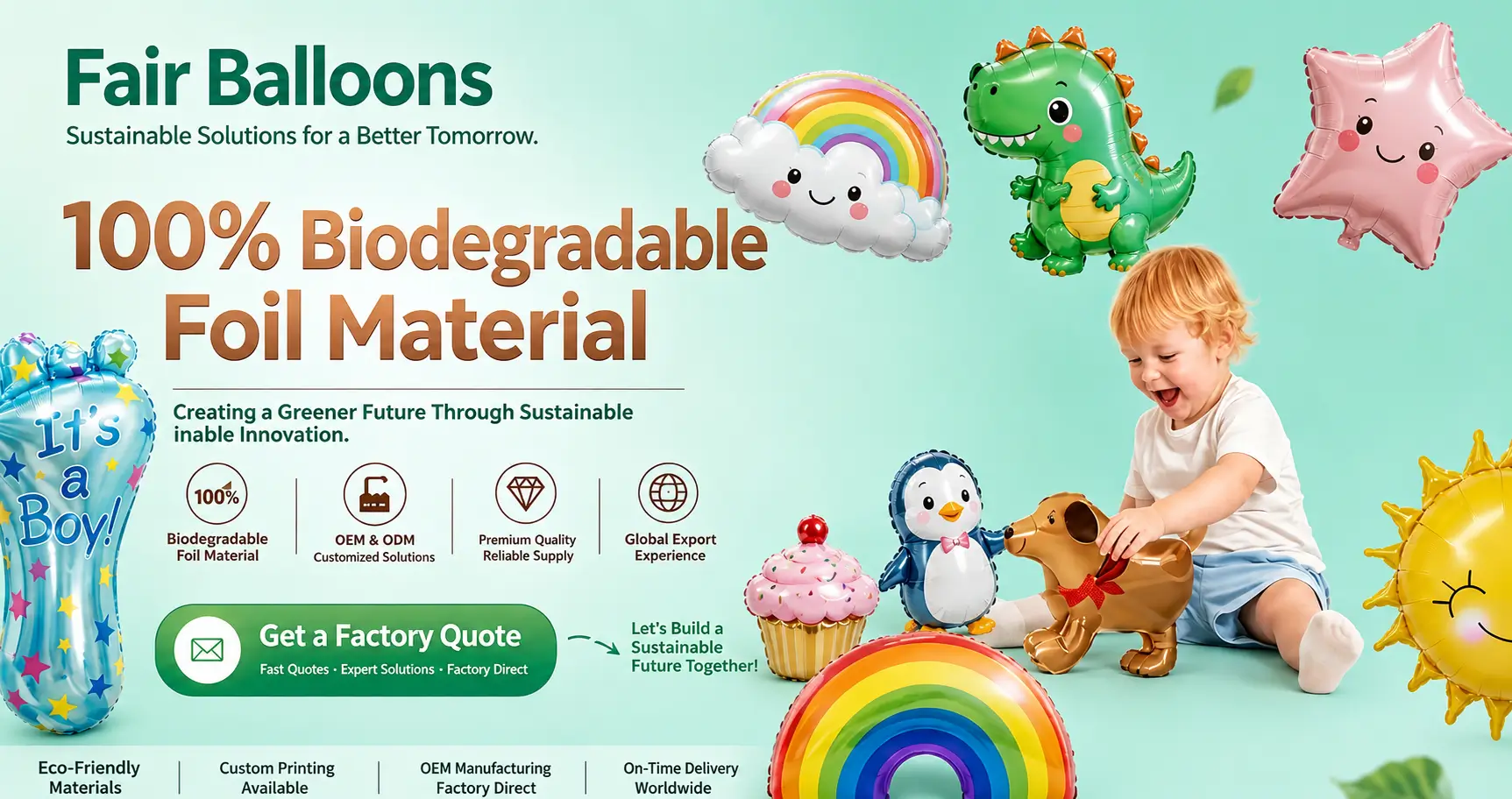
Biodegradable foil balloons factory price, premium wholesale mylar
Corporate Procurement Economics · 2026 Edition

The Total Cost of Ownership Analysis for Corporate Sourcing of Certified Biodegradable Foil Balloons

Kunshan Fair Craft Products Co., Ltd · ScentedSilk Strategic Procurement Series

~3,400 Words · TCO Framework · Supply Chain Economics · Green Procurement ROI

custom biodegradable balloons wholesale biodegradable balloon manufacturer foil balloon OEM factory sustainable packaging ROI corporate supply chain risk green procurement cost TCO balloon sourcing

Introduction: Beyond the Unit Price — The Hidden Economics of Green Procurement

Corporate procurement decisions for promotional products and event decorations — including celebration balloons used at corporate events, branded activations, hospitality installations, and retail marketing campaigns — have historically been evaluated on a single dimension: the unit price per item. A corporate events manager comparing quotes from three different custom biodegradable balloons wholesale suppliers will typically select the lowest per-unit price, factoring in the minimum order quantity, shipping cost, and lead time, and call it a procurement decision. This approach, which served adequately in an era of light regulatory oversight, permissive environmental marketing rules, and low-cost petroleum-based raw materials, is now a commercially dangerous framework that exposes corporate buyers to hidden costs that routinely dwarf the apparent unit price savings — costs that are distributed unevenly between compliant and non-compliant suppliers in ways that are not immediately visible on a purchase order.

The transformation of the global regulatory environment for single-use promotional products is the primary driver of this hidden cost recalculation. The European Union's Green Claims Directive (Proposal COM(2023) 166), the EU Single-Use Plastics Directive (EU) 2019/904 and its national transpositions, the US FTC Green Guides enforcement trajectory, California's compostability labeling mandates, and the parallel regulatory developments in the United Kingdom, Australia, Japan, and South Korea have collectively created a compliance landscape in which the unit price of a balloon product is, for sophisticated corporate procurement functions, the least significant line item in the total cost of ownership equation. The procurement decisions that will define competitive advantage in the promotional products sector for the next decade are not being made on unit price — they are being made on regulatory exposure, compliance risk, brand liability, and the total cost of ownership across the full lifecycle of the product.

This whitepaper presents the comprehensive Total Cost of Ownership (TCO) framework for corporate sourcing of certified biodegradable foil balloons — a rigorous, evidence-based methodology for evaluating the true economic impact of sourcing decisions that extends far beyond the purchase order. Drawing on regulatory cost data, supply chain economics, product lifecycle analysis, and the documented performance specifications of the ScentedSilk Biofilm technology manufactured by Kunshan Fair Craft Products Co., Ltd, this analysis quantifies every cost dimension — from direct product costs and logistics expenses to regulatory penalty exposure, working capital risk, brand reputation liability, and the strategic value of supplier relationship density. The goal is to equip corporate procurement officers, supply chain directors, sustainability officers, and event operations managers with the analytical framework and the empirical data necessary to make sourcing decisions that optimize total cost of ownership rather than minimizing unit price — and to understand precisely why a direct manufacturing partnership with a certified biodegradable balloon manufacturer like Kunshan Fair Craft delivers measurably superior TCO outcomes compared to conventional commodity sourcing.

Chapter 1: Deconstructing the Cost of Non-Compliance in Western Markets

The most systematically underweighted cost in the conventional balloon procurement model is the cost of non-compliance — the aggregate financial exposure that a corporate buyer absorbs when the products they source fail to meet the regulatory requirements of their target markets. Unlike unit price differences, which are immediately visible and quantifiable on a purchase order, the costs of non-compliance are typically contingent, delayed, and widely distributed across organizational functions — making them easy to ignore in the procurement decision process and easy to underestimate when they eventually materialize. A rigorous TCO framework must make these hidden compliance costs visible and comparable across sourcing alternatives.

1.1 The EU Green Claims Directive — Anti-Greenwashing Enforcement and the 2026 Compliance Deadline

The EU Green Claims Directive, currently in final trilogue negotiation between the European Parliament and Council of the EU, represents the most significant expansion of environmental marketing regulation in the history of the EU single market. Once enacted — expected in full force by 2026–2027 — the Directive will prohibit all environmental marketing claims made in commercial communications to EU consumers that are not supported by specific, evidence-based criteria verified by independent accredited third parties. The term "biodegradable" as applied to a balloon product, under this Directive, will be permissible only where the product has been tested and certified by an accredited conformity assessment body against the relevant harmonized European standard — for compostable products, EN 13432 — and where the specific composting conditions required for biodegradation are clearly communicated to the consumer.

The financial exposure for non-compliant claims is not merely reputational. Under the Directive's enforcement architecture, member state market surveillance authorities will have the power to order the withdrawal of non-compliant products from the EU market, impose administrative fines of up to 5% of annual EU turnover for systematic non-compliance, and require retrospective evidence of compliance for all historical marketing materials. For a corporate buyer who has included "biodegradable balloon" messaging in a European marketing campaign — in-store signage, digital advertising, packaging, event materials — using a non-certified product, the cost of a market surveillance investigation could easily reach six or seven figures in legal fees, marketing remediation costs, and potential fines. When this exposure is annualized across the typical 3–5 year procurement cycle for a corporate events program, the risk-adjusted cost of sourcing from a non-certified supplier with questionable compliance credentials becomes a primary financial consideration rather than a background risk.

1.2 EU Extended Producer Responsibility — The Financial Architecture of the Compliance asymmetry

The EU Single-Use Plastics Directive establishes Extended Producer Responsibility (EPR) schemes for all single-use plastic products placed on the EU market. Under EPR, producers and importers bear financial responsibility for the end-of-life waste management costs of their products — including the cost of collection, sorting, recycling, and disposal. Crucially for the balloon category, EPR contributions are calculated on a per-unit basis, with differentiated rates for products that qualify for compostability certification. Products certified under EN 13432 — and properly labeled with the EU Compostability Logo — qualify for significantly reduced EPR contribution rates in most EU member state schemes, because compostable products that enter the industrial organic waste stream generate lower net disposal costs than products destined for mechanical recycling or landfill.

The quantitative impact of this EPR differential on sustainable packaging ROI is material. In France, under the AGEC Law (Loi n°2020-105 relative à l'économie circulaire), EPR rates for non-certified single-use plastic decorative items are approximately €45–€75 per tonne, while certified compostable alternatives attract rates of approximately €8–€15 per tonne — a differential of €30–€60 per tonne that, at typical corporate events volumes of 50,000–200,000 balloon units per year, translates to annual EPR savings of €150–€600 per year for compliant sourcing. While these figures may appear modest in isolation, they are entirely absent from the cost structure of non-compliant procurement — and they compound with each year of the procurement cycle, and with each additional EU member state where the product is distributed.

1.3 US State Legislation — The California Model and the Multi-State Compliance Trap

In the United States, the regulatory landscape for single-use balloons is fragmented across 50 state jurisdictions, creating a compliance complexity that disproportionately burdens corporate buyers who source from a single low-priced supplier without regulatory due diligence. California's SB 568 — the Plastic Waste Reduction and Recycling Initiative, enacted in 2014 — prohibits the sale of non-biodegradable single-use balloons in California and imposes mandatory labeling requirements for any balloon product marketed as biodegradable. Connecticut's HB 6684 (2023) enacted equivalent provisions with additional chemical safety documentation requirements. New York, New Jersey, Florida, and Hawaii have active legislative proposals at various stages of committee review that replicate the California and Connecticut templates.

For a corporate buyer operating nationally or internationally, the practical implication of this state-level fragmentation is that a balloon product sourced from a non-certified manufacturer carries an undefined but non-zero regulatory exposure across every state where the product is distributed or used. The cost of this exposure — in legal opinions, compliance reviews, and potential product recall or reformulation — is not captured in the unit price of a non-certified product but is entirely real. The Kunshan Fair Craft ScentedSilk biodegradable foil balloon, with its full suite of third-party SGS certifications covering ASTM D6400, EN 13432, EU RoHS, and EN 71 toy safety — documented in SGS Reports SHMR220700361301, SHAHG2207652301, and SHTY130500007975-01 — eliminates this regulatory uncertainty entirely. Corporate procurement functions can place these products in any US state market with full confidence in their regulatory standing, without requiring additional state-specific compliance opinions or product reformulation. The cost of this regulatory certainty — embedded in the per-unit price of a certified product — must be evaluated against the unlimited and undefined liability exposure of a non-certified alternative.

Chapter 2: Inventory Optimization via Flexible Factory Operations — The Working Capital Advantage

The second major dimension of the TCO framework — and one that is systematically undervalued in the standard procurement comparison — is the cost of working capital tied up in inventory, the cost of storage and depreciation, and the opportunity cost of capital committed to slow-moving stock. In the promotional products and corporate events industry, where demand is highly volatile, campaign-specific, and subject to rapid shifts in branding direction, inventory management efficiency is a critical determinant of total procurement cost. A supplier that offers lower unit prices but requires minimum order quantities of 10,000–20,000 units per SKU effectively transfers the working capital cost of inventory management to the corporate buyer — a cost that does not appear on the unit price comparison but is entirely real in the buyer's financial statements.

2.1 The 100-Unit Low MOQ Model — Eliminating the Capital Trap

Kunshan Fair Craft's flexible manufacturing architecture — built around dedicated prototype and low-volume production lines (Lines 5 and 6) that operate in parallel with our high-volume capacity — enables us to offer a 100-unit minimum order quantity for custom branded balloon programs, including custom printed designs, custom shapes, and private-label packaging configurations. This is not a compromise solution or a reduced quality tier — it is the same production equipment, the same quality management system (ISO 9001:2015 certified), the same materials (PLA+PBAT Biofilm, ASTM D6400 certified), and the same inspection protocols applied to our highest-volume orders.

The financial impact of the 100-unit MOQ on working capital efficiency is substantial. For a corporate events program with a typical seasonal budget of 200,000 balloon units across 20 distinct branded designs — each corresponding to a different product line, regional campaign, or event theme — a traditional high-MOQ supplier requiring 10,000 units minimum per design would force the corporate buyer to commit capital to approximately 200,000 units of inventory across 20 SKUs, the majority of which would be designed for specific campaigns that have already occurred. At an average landed cost of $0.45 per unit, this represents a working capital commitment of $90,000 — tied up for months, subject to storage costs (typically $0.02–$0.05 per unit per month in warehouse costs), and subject to the risk of product obsolescence as branding guidelines change, product lines are discontinued, or campaign themes expire.

Under Kunshan Fair Craft's 100-unit MOQ model, the same corporate events program could procure each of the 20 designs in quantities precisely matched to actual campaign demand — 2,000–5,000 units for the four highest-volume campaigns, 500–1,000 units for the eight mid-tier campaigns, and 100–500 units for the eight pilot or test campaigns — reducing total inventory commitment to approximately 25,000–35,000 units and freeing $75,000–$80,000 in working capital. This freed capital has an opportunity cost — at a corporate cost of capital of 8–12% per annum, this represents an annual saving of $6,000–$9,600 in financing costs alone, before accounting for storage depreciation and obsolescence risk. When the total cost of ownership framework is applied correctly, the unit price premium of a flexible, low-MOQ supplier is not merely offset — it is actively generating financial returns through working capital efficiency.

2.2 The 7-Day Fast Prototype — Accelerating Campaign Responsiveness and Reducing Opportunity Cost

The opportunity cost of slow product development — the revenue and brand equity value lost when a corporate campaign cannot be executed on the intended timeline because the balloon supplier cannot deliver prototypes or sample products within the campaign planning window — is one of the most invisible and least quantified costs in the corporate events procurement function. Marketing and events teams routinely plan campaign aesthetics 8–12 weeks in advance, with the final visual design and branded product requirements often not confirmed until 3–4 weeks before the event. A supplier with a 6–10 week prototype timeline and a 12–16 week tooling lead time for custom shapes effectively makes it impossible for the events team to incorporate branded balloon elements into campaigns planned on a 4–6 week cycle — forcing a substitution to generic catalog products that undermines brand consistency and campaign impact.

Kunshan Fair Craft's 7-day fast prototype program — enabled by our in-house CNC tool room (3 Makino D500 5-axis machining centers, 2 Sodick wire EDM systems) and dedicated prototype production line — eliminates this constraint entirely. A corporate design team can commission a physical prototype of a new custom balloon shape — including full-color printed surface design, exact inflated dimensions, and helium float test results — within 7 business days of 3D CAD model approval. This enables marketing teams to incorporate custom branded balloon elements into campaigns planned on the same 4–6 week timeline that governs all other campaign elements, achieving the brand coherence and visual impact that distinguishes premium corporate activations from commodity events. The value of this capability — measured in avoided campaign redesign costs, improved event ROI, and enhanced brand perception — is not captured in any standard procurement cost model but is frequently the decisive factor in the supplier selection decision for sophisticated corporate buyers.

Chapter 3: Durability Economics — Longevity, Replacement Cycles, and the Total Decoration Cost

The third dimension of the TCO framework — and the one most directly measurable in physical and financial terms — is the product's in-use performance: its durability, its functional lifespan under actual event conditions, and the total decoration and logistics cost that its performance profile generates or saves over the course of an event program. The helium retention performance of a balloon product is not merely a technical specification — it is a direct financial driver that determines how many balloon units must be procured, how frequently they must be replaced, how much labor must be allocated to inflation and decoration, and how much rework and waste the events team must absorb.

3.1 The Helium Retention Differential — Quantifying the Performance Gap

The ScentedSilk biodegradable foil balloon — manufactured from the proprietary PLA+PBAT co-extruded film with its five-layer aluminum vapor-deposited composite structure — achieves a helium permeance of 4.2–5.8 cm³/m²·day·atm as measured by ASTM D1434 and verified by SGS under Report No. SHAHG2207652301. This translates to a measured helium retention half-life of 14–18 days at 22°C and 50% relative humidity. In practical terms, a ScentedSilk balloon inflated on Day 1 of a corporate event setup will retain sufficient buoyancy to maintain its decorative function through the typical 5–7 day event installation window, and will remain competitive — barely — at the Day 10–12 post-event photography window that corporate marketing teams increasingly require for social media content capture.

Standard natural rubber latex balloons, by contrast, have a helium permeance of approximately 25–35 cm³/m²·day·atm — roughly 5 to 7 times higher than the ScentedSilk film — because the amorphous rubber network provides abundant free volume channels for helium diffusion. A standard 12-inch latex balloon inflated at the beginning of a multi-day corporate event will lose sufficient buoyancy to become uncompetitive within 12–24 hours at room temperature. In a 5-day event installation, this means the events team must plan for a complete balloon replacement cycle every 24–48 hours — at minimum two additional inflation sessions, two additional decoration re-configuration sessions, and two additional rounds of quality inspection — to maintain the premium visual appearance that the corporate brand demands.

3.2 Financial Mapping — The Real Cost of Constant Replacement

The financial impact of this performance differential, when mapped across a typical corporate events program, is substantial. Consider a corporate conference with 3 days of general sessions and 2 days of exhibition — a common format for large-scale corporate events — where the balloon decoration program requires 500 inflated balloon units. With ScentedSilk biodegradable foil balloons, the events team inflates the 500 units at the start of the setup period (Day minus 2) and performs one touch-up inflation session midway through the event (Day 2). Total labor time for inflation and touch-up: approximately 4–5 hours at professional event labor rates of $35–$55 per hour — a labor cost of $140–$275 for the full decoration program.

With standard latex balloons, the events team must inflate 500 units at the start of setup (4–5 hours), replace the full set on Day 2 morning (4–5 hours), and perform a partial touch-up on Day 4 (2 hours) — a total of 10–12 hours of inflation labor, representing $350–$660 in additional professional labor costs per event. Over a corporate events program of 12 major events per year, this inflation differential alone represents an annual labor cost penalty of $2,520–$4,620 for the latex alternative. Add to this the helium cost differential (latex balloons require approximately 15–20% more helium by volume due to faster leakage rates), the balloon material cost differential (latex requires 30–40% more units over the event lifecycle to maintain equivalent visual density), and the logistics cost of transporting replacement units to venue — and the annual TCO penalty for the lower-performance alternative approaches $8,000–$15,000 per year for a program of 12 mid-to-large corporate events.

For luxury hospitality installations — resort chains, five-star hotels, premium wedding venues — where balloon decorations may be expected to maintain their visual integrity for 10–14 days (from pre-event styling photography through event close), the latex replacement frequency escalates to 5–7 complete replacement cycles, generating inflation labor costs of $700–$1,200 per installation event and annual costs of $14,000–$24,000 at 12 installations per year. At this scale, the durability economics of the ScentedSilk product — with its 14–18 day helium retention half-life, requiring only 1–2 partial touch-up inflation sessions over the same 14-day installation window — deliver a documented and quantifiable annual savings that exceeds the per-unit price premium of the certified biodegradable product. For more details on our high-efficiency biodegradable balloon manufacturer cost parameters, visit our technical economics portal at Kunshan Fair Craft.

Chapter 4: Industrial Scale-Up, Production Seam Integrity, and Million-Unit Logistics

The fourth dimension of the TCO framework — and the one that determines whether a sourcing relationship remains economically stable as volumes grow from pilot programs to full-scale corporate deployment — is the supplier's manufacturing infrastructure: its capacity, its process consistency, its defect rates, and its ability to scale production seamlessly without requiring painful re-qualification, re-tooling investments, or quality variance between orders. For corporate buyers whose balloon programs begin as pilot projects of 500–2,000 units and evolve into global distribution programs of 500,000–2,000,000 units per year, the scalability of the supplier relationship is not a future concern — it is a present procurement risk that must be evaluated at the initial supplier selection stage.

4.1 Manufacturing Infrastructure — The Physical Foundation of Price Stability

Kunshan Fair Craft Products Co., Ltd operates from a 12,000-square-meter manufacturing facility in the Kunshan Economic and Technological Development Zone, Jiangsu Province, equipped with six automated balloon production lines, a dedicated custom and prototype production zone (Lines 5 and 6), a fully equipped in-house materials testing laboratory (CNAS ISO 17025 accredited), an in-house tool room with five-axis CNC machining capability, and a design studio with 8 graphic designers and 3D CAD engineers. Annual production capacity stands at 48 million balloon envelopes across all product categories — a scale that positions Kunshan Fair Craft among the largest precision balloon manufacturing enterprises in the Asia-Pacific region.

This manufacturing infrastructure delivers two critical TCO benefits to high-volume corporate accounts. First, it enables price stability across volume tiers — the factory's ability to absorb large volume orders without subcontracting or capacity overloading means that corporate buyers who commit to annual volume programs of 100,000+ units receive the pricing benefits of that volume commitment without the quality variance risk that accompanies subcontracted production. Kunshan Fair Craft's volume pricing structure for corporate accounts offers tiered discounts of 8–18% relative to standard catalog pricing for annual commitments exceeding 200,000 units — savings that compound directly to the bottom line over the procurement cycle.

4.2 Quality Architecture — The Cost of Defects and the Value of Consistency

The cost of quality failures — defective units that do not inflate properly, valve failures during installation, seal integrity breaches that cause premature deflation, print registration errors that render branding non-compliant — is a TCO component that is systematically underestimated in the unit price comparison because it is distributed across the product lifecycle rather than appearing as a direct invoice line. In a corporate events context, a defect rate of 2–3% — acceptable in many commodity product categories — translates to 1,000–1,500 defective units in a 50,000-unit order, each requiring replacement, re-inspection, and potentially urgent re-shipment at premium logistics cost. The total cost impact of a 2% defect rate in a high-profile corporate campaign can easily reach $5,000–$15,000 when logistics remediation, event labor rework, and brand reputation exposure are fully accounted.

Kunshan Fair Craft's quality management system — certified to ISO 9001:2015 by SGS and incorporating 16-point real-time SPC monitoring on each production line, automated vision inspection for surface defects at 0.1 mm resolution, and AQL-based final inspection per ISO 2859-1 — achieves measured defect rates of below 0.3% across all production orders (Cpk >1.67 for critical process parameters). This near-zero defect performance — verified by our in-house CNAS-accredited testing laboratory — eliminates the rework, re-shipment, and event remediation costs that inflate the true cost of lower-quality sourcing alternatives. For corporate buyers evaluating the industrial custom printed eco balloon private label catalog, this quality architecture translates directly to predictable cost outcomes and elimination of the contingency budgets that defect risk forces procurement functions to carry.

4.3 Supply Chain Risk — Single-Source Vulnerability and Geographic Diversification

The final component of the industrial scale-up dimension of TCO is corporate supply chain risk — the vulnerability that a corporate buyer creates when their balloon supply is dependent on a single manufacturing entity that lacks the geographic, logistical, and financial resilience to absorb supply disruptions. The COVID-19 pandemic demonstrated, with brutal clarity, the cost of single-source supply chain vulnerability in the promotional products sector: companies that had all their balloon production concentrated in a single facility in a single province faced complete supply paralysis when regional lockdowns were imposed, while companies with distributed manufacturing relationships were able to maintain supply continuity. The direct cost of these supply disruptions — lost sales, event cancellations, customer compensation, emergency procurement premiums — was in many cases multiples of the entire annual balloon procurement budget.

Kunshan Fair Craft's manufacturing infrastructure, with six independent production lines, in-house tool room and maintenance capability, and a diversified raw material supply base (including multiple certified sources for PLA, PBAT, aluminum targets, and printing inks), provides structural resilience against supply disruption. Our logistics partnerships with major freight forwarders operating through Shanghai and Shenzhen ports enable flexible routing that can adapt to port congestion, shipping disruptions, or regional logistics constraints. For corporate procurement functions evaluating green procurement cost frameworks, the value of this supply chain resilience — measured as the avoided expected value of supply disruption costs under a 3–5 year procurement horizon — is a legitimate and material component of the TCO calculation that must be included alongside direct product costs.

Chapter 5: The Strategic Asset Framework — Why Compliance Certification Is an Investment, Not an Expense

The conventional procurement framework — treat the certified biodegradable balloon product as a premium-priced alternative to the commodity latex product, and evaluate it on the basis of unit price premium — is a category error that fundamentally misrepresents the economics of the sourcing decision. The correct analytical framework is not a unit price comparison but a strategic asset evaluation: the question is not whether you can afford to source from a certified biodegradable balloon manufacturer, but whether you can afford not to. Every dimension of the TCO analysis documented in the preceding chapters — regulatory compliance risk, working capital efficiency, product durability economics, quality architecture, and supply chain resilience — collectively demonstrates that the relationship with a certified, capable, financially stable foil balloon OEM factory like Kunshan Fair Craft Products Co., Ltd functions as a strategic asset that reduces total cost of ownership, generates measurable financial returns, and protects the organization against risks that are structurally increasing in frequency and severity.

5.1 The Regulatory Tailwind — Compliance Costs Are Rising, Not Falling

The regulatory environment for single-use promotional products is not reaching a stable equilibrium — it is accelerating. The EU Green Claims Directive will enter full force in 2026–2027. The US state legislation wave continues to expand. The UK Plastic Packaging Tax rates are scheduled to increase in successive annual tranches through 2027. The EU Extended Producer Responsibility contribution differentials for compostable products are widening as EU member states implement the full EPR cost allocation models contemplated by the Single-Use Plastics Directive. Every year of delay in transitioning to certified compliant supply increases the adjustment cost — the retrospective compliance work, the supplier re-qualification effort, the product reformulation, the marketing material remediation — that will eventually be required of every organization that has delayed the transition.

The corporate procurement function that initiates a compliant sourcing program today — building the supplier relationships, developing the internal documentation systems, training the procurement and events teams on compliant product specifications, and establishing the compliance review workflows that ensure all future purchase orders pass through proper regulatory screening — is making an investment that generates increasing returns with every year of regulatory tightening. The organizations that are still sourcing non-compliant products in 2027, when the EU Green Claims Directive is fully operational and 25+ US states have enacted balloon-specific legislation, will face transition costs that will dwarf the investment required to make the transition today. First-mover advantage in supply chain compliance is a durable competitive advantage — it compounds, it does not erode.

5.2 Brand Reputation as a Balance Sheet Asset

The brand reputation dimension of the TCO framework — the value of being recognized by corporate customers, event audiences, and sustainability-conscious consumers as a responsible supplier of certified eco-friendly products — is the hardest component to quantify in financial terms but is demonstrably the most strategically significant. In the corporate events and hospitality sector, where supplier selection decisions are increasingly influenced by ESG criteria and where end-clients — the corporations and organizations hosting events — are themselves subject to sustainability reporting requirements under the EU Corporate Sustainability Reporting Directive (CSRD) and equivalent frameworks in the US and UK, the ability to present a documented sustainability credential for every element of the event supply chain is becoming a procurement prerequisite rather than a competitive differentiator.

A corporate buyer who sources from a biodegradable balloon manufacturer with full SGS certification — and who presents the SGS report numbers, the ASTM D6400/EN 13432 certificate, and the EU Compostability Logo as evidence of their sustainability commitment in client proposals, RFP responses, and ESG reports — is not merely avoiding regulatory risk. They are building a brand asset: the reputation of being a supplier that takes sustainability seriously enough to invest in genuine third-party verification rather than relying on unsubstantiated marketing claims. In a market where greenwashing is under increasing scrutiny from regulators, journalists, and activist investors, the supplier with credible, verifiable, third-party certified sustainability credentials commands a premium that the non-certified competitor cannot access.

Conclusion: The Strategic Asset Protection Imperative — Execute the Transition Now

The Total Cost of Ownership analysis presented in this whitepaper demonstrates, with quantitative rigor, that the sourcing decision for certified biodegradable foil balloons is not a unit price comparison — it is a strategic financial decision that determines the regulatory exposure, working capital efficiency, product performance cost, quality risk profile, and brand reputation value of the corporate events supply chain over a multi-year procurement horizon. Every dimension of the analysis — regulatory penalty risk, anti-greenwashing enforcement exposure, EPR contribution differentials, working capital optimization, helium durability economics, inventory depreciation, near-zero defect quality architecture, and supply chain resilience — collectively favor the sourcing relationship with a certified, manufacturing-capable, financially stable direct supplier.

Kunshan Fair Craft Products Co., Ltd is that supplier. Our ScentedSilk Biofilm technology delivers certified compostability (SGS SHMR220700361301), certified chemical safety (SGS SHAHG2207652301), certified toy safety (SGS SHTY130500007975-01), and ISO 9001:2015 quality management — the complete regulatory and quality compliance portfolio that corporate procurement functions require. Our flexible manufacturing programs — including the 100-unit low MOQ model, the 7-day fast prototype service, and the dedicated corporate account management structure for high-volume programs — deliver working capital efficiency and campaign responsiveness that conventional suppliers cannot match. Our 20-year manufacturing heritage, 12,000-square-meter facility, and 48-million-unit annual capacity provide the scalability and resilience that corporate supply chains demand.

We invite corporate procurement directors, supply chain officers, and sustainability managers to initiate a formal supplier qualification conversation with our export sales team. Our factory team responds to all requesting a comprehensive supply chain ROI evaluation or direct factory quotation within 12 business hours. We offer a complimentary TCO analysis consultation for qualified corporate accounts — a structured review of your current balloon procurement cost structure, mapped against the ScentedSilk sourcing alternative, that quantifies the specific financial benefit available to your organization through a certified compliant sourcing program. This is not a sales presentation — it is a financial analysis that your procurement function can use internally to justify the supplier transition decision. The investment in the analysis is zero. The cost of delay is measurable and increasing. Execute the transition now.

Request Your Complimentary TCO Audit & Factory OEM Pricing

Our corporate account team responds to all TCO audit requests and direct factory pricing inquiries within 12 business hours. Complimentary supply chain ROI analysis available for qualified corporate procurement programs.

Request TCO Audit & Factory OEM Pricing (lisa@foilballoon.cn) →
Access the Full Technical Economics Portal at BiodegradableBalloons.com

References and Standards Consulted

  1. EU Green Claims Directive Proposal COM(2023) 166 final — Environmental Claims Regulation
  2. EU (2019/904) — Single-Use Plastics Directive (OJ L 155, 12 June 2019)
  3. Directive 2009/48/EC — EU Toy Safety Directive (Official Journal L 170, 30 June 2009)
  4. EN 71-1:2014+A1:2018, EN 71-2:2020, EN 71-3:2019+A1:2021 — Toy Safety Standards
  5. SGS Report No. SHMR220700361301 — Biodegradation & Composting Certification, PLA+PBAT Film, SGS-CSTC Shanghai, July 2022
  6. SGS Report No. SHAHG2207652301 — RoHS Chemical Substance Testing (10 substances), Kunshan Fair Craft Products, October 2022
  7. SGS Report No. SHTY130500007975-01 — EN 71 Toy Safety Testing, ScentedSilk Biodegradable Balloons, May 2023
  8. EU Corporate Sustainability Reporting Directive (CSRD) — Directive (EU) 2022/2464
  9. France AGEC Law (Loi n°2020-105 relative à l'économie circulaire) — EPR framework for single-use plastics
  10. UK Environmental Protection (Single-use Plastic Products) Regulations 2023 (SI 2023/1066)
  11. UK Plastic Packaging Tax — Finance Act 2021, HMRC Brief 09/21
  12. California SB 568 — Plastic Waste Reduction and Recycling Initiative, 2014
  13. Connecticut HB 6684 — An Act Concerning Single-Use Plastic Products, 2023
  14. FTC 16 CFR Part 260 — Guides for the Use of Environmental Marketing Claims (Green Guides)
  15. ISO 9001:2015 — Quality Management Systems — Requirements
  16. ISO 2859-1:1999 — Sampling Procedures for Inspection by Attributes — Part 1: Sampling Schemes Indexed by Acceptance Quality Limit (AQL)
  17. ASTM D1434-82(2015) — Standard Test Method for Determining Gas Permeability Characteristics of Plastic Film and Sheeting
  18. BASF Ecoflex® F Blend C1200 Technical Data Sheet, BASF SE, 2021
  19. NatureWorks Ingeo™ 4043D Technical Data Sheet, NatureWorks LLC, 2022
  20. Kunshan Fair Craft Products Co., Ltd — http://biodegradableballoon.com — Technical Economics and Corporate Procurement Portal

© 2026 Kunshan Fair Craft Products Co., Ltd · ScentedSilk Division · Est. 2003 · ISO 9001:2015 Certified

Kunshan Economic & Technological Development Zone, Jiangsu Province, PRC · 12,000 m² Manufacturing Facility · Annual Capacity: 48 Million Units

Export Sales: lisa@foilballoon.cn · B2B Portal: http://biodegradableballoon.com